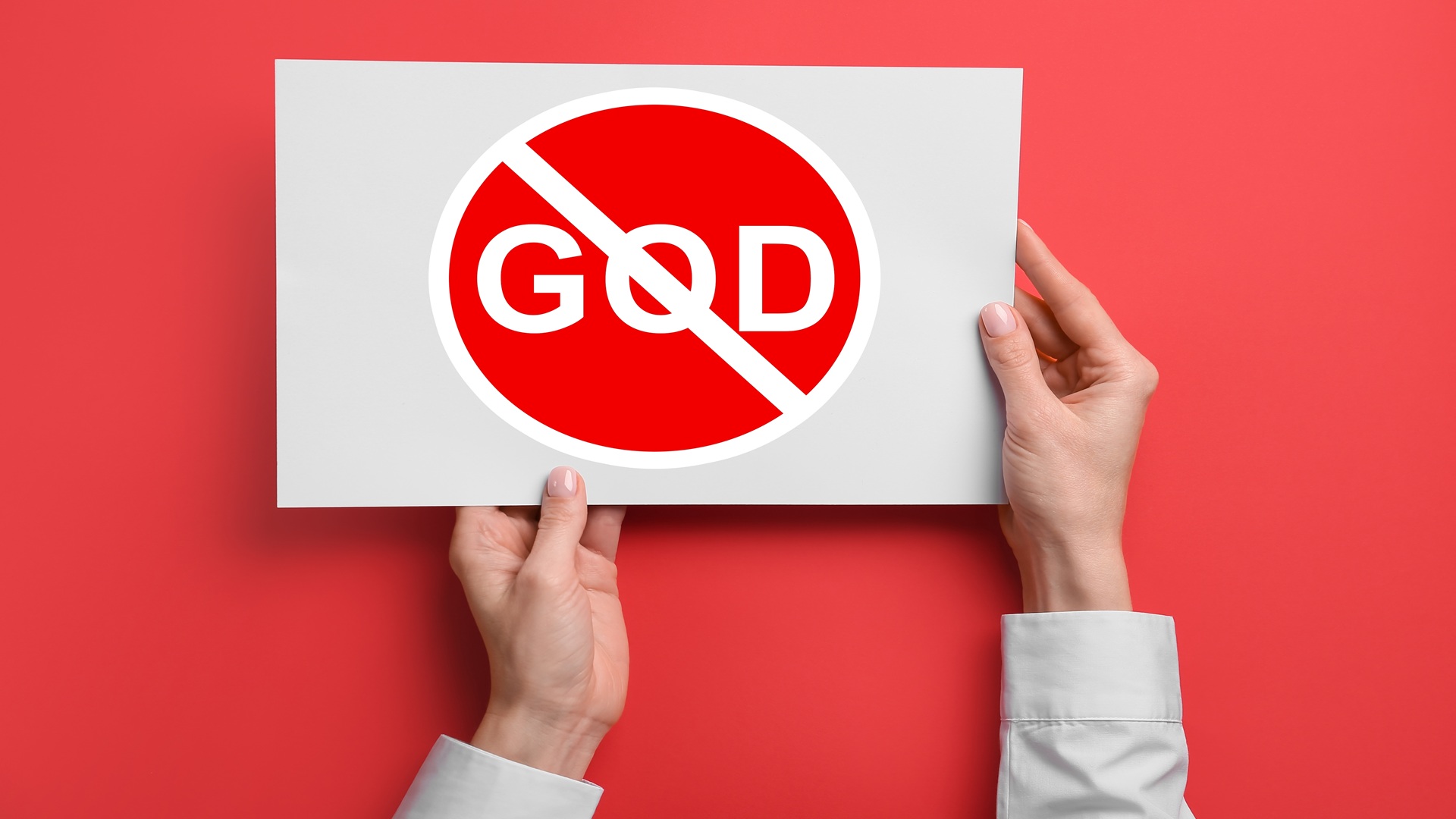
It's Time to Stop the Government's Gag Order on the Church
The National Religious Broadcasters are fighting back over the unconstitutional Johnson Amendment's chilling impact on pastors.
In America today, a pastor can freely preach about heaven and hell—but applying Scripture to an election can trigger an IRS investigation. The Johnson Amendment, which created this barrier, is not a neutral tax rule. It's an unconstitutional government restriction on the free exercise of religion that continues to silence pastors who dare to apply the Bible to public life.
First added to the Internal Revenue Code in 1954, the Johnson Amendment's purpose was to silence two secular nonprofit groups that supported then-Sen. Lyndon Johnson's (D) political challenger. As Alliance Defending Freedom (ADF) explains, Johnson wanted to "chill the speech of his political opponents." This chilling effect continues today, silencing religious organizations from publicly participating in the political process.
The Johnson Amendment prohibits tax-exempt organizations from "participat[ing] in, or interven[ing] in (including the publishing or distributing of statements), any political campaign on behalf of (or in opposition to) any candidate for public office."
The First Amendment declares: "Congress shall make no law respecting an establishment of religion, or prohibiting the free exercise thereof; or abridging the freedom of speech, or of the press; or the right of the people peaceably to assemble, and to petition the Government for a redress of grievances." Yet the Johnson Amendment is a law that prohibits the free exercise of religion—in defiance of the Constitution.
A 2026 report by the Trump administration's Task Force to Eradicate Anti-Christian Bias revealed "a consistent and systematic pattern of discrimination against Christians during the Biden Administration" and detailed how the IRS targeted Christian churches.
In summer 2020, the First Baptist Church of Dallas, Texas held its annual patriotic service attended by Vice President Mike Pence and other prominent Republicans attended. That drew ire and an IRS complaint from the radical anti-Christian activist Mikey Weinstein and his Freedom from Religion Foundation. It wasn't until 11 months later, in May 2021—and after Joe Biden was elected—that the IRS launched an investigation into First Baptist Church's tax-exempt status.
The inquiry lasted a year, and the IRS eventually declared that First Baptist didn't violate the tax code. Yet it cost the church hundreds of thousands of dollars in legal fees to defend itself.
In 2023, the IRS fined Cornerstone Chapel in Leesburg, Virginia because the agency claimed Pastor Gary Hamrick endorsed Donald Trump in a sermon. Hamrick did not explicitly endorse a candidate; he explained the two parties' platforms and whether they lined up with Scripture.
In 2024, the IRS informed New Way Church in Florida it was being investigated for allegedly violating the Johnson Amendment in a 2022 church service. In that service, a candidate for school board addressed the congregation, talking about her faith and why she ran for office. The pastor also prayed for her. Then two years later, the church was told it was being investigated over the event and the IRS demanded answers to specific questions. The church refused to respond and the IRS dropped the matter, but it created fear in the pastor and congregation for what could happen in the future.
In 2024, the National Religious Broadcasters (NRB) and multiple churches filed a legal complaint in a U.S. District Court in Texas challenging the Johnson Amendment's restrictions on nonprofit organizations, including churches.
In 2025, the Trump administration agreed to settle the NRB case which included an agreement that the Johnson Amendment does not apply to a house of worship's speech to its congregation "concerning electoral politics viewed through the lens of religious faith."
Over 1,800 anti-Christian groups such as American Atheists, American Humanists, Freedom from Religion Foundation, Greenpeace USA, National Menopause Foundation, and National LGBTQ Task Force signed onto a letter opposing the settlement.
Of course, when Kamala Harris campaigned at an Atlanta church in 2024, there was no outcry from the Freedom from Religion Foundation or any other leftist group.
In March 2026, a judge rejected the IRS settlement with the NRB, citing a lack of jurisdiction because it was a tax related issue, further claiming it wasn't a first-amendment problem.
NRB general counsel Michael Farris disagreed. He pointed out that the "IRS agreed that in such settings [worship services], the Johnson Amendment does not apply, and to contend otherwise would violate the First Amendment's Establishment of Religion Clause."
In April 2026, the NRB filed an appeal to the Fifth Circuit Court which is pending.
The Johnson Amendment Violates Religious Liberty
A pastor or priest should be able to instruct his flock on any topic from the pulpit without fear of government reprisal. Christians look to the Bible and church leaders for guidance on countless life issues—including politics.
America is in political turmoil. Without moral, biblically based teaching that turns people toward God, conditions will not improve.
Babies are being murdered, the sacrament of marriage is being defiled, and the very definitions of man and woman are being twisted. The church should stand at the center of these conversations. Yet many church leaders dismiss them as "political" matters that belong to the government, not the church. That excuse directly contradicts biblical teaching.
The Bible provides answers to these hard "political" questions. God tells us in Romans 15:4, "For whatever was written in former days was written for our instruction, that through endurance and through the encouragement of the Scriptures we might have hope."
Paul teaches in 2 Timothy 3 that there will be Godlessness in the last days. He warns that "in the last days there will come times of difficulty. For people will be lovers of self, lovers of money, proud, arrogant, abusive, disobedient to their parents, ungrateful, unholy, heartless, unappeasable, slanderous, without self-control, brutal, not loving good, treacherous, reckless, swollen with conceit, lovers of pleasure rather than lovers of God, having the appearance of godliness, but denying its power."
Immediately after this warning, Paul gives answers. In verses 16-17 he declares, "All Scripture is breathed out by God and profitable for teaching, for reproof, for correction, and for training in righteousness, that the man of God may be complete, equipped for every good work."
These passages are ideal for church leaders who must instruct their congregations on political issues and the candidates who seek office. Yet the Johnson Amendment restricts pastors from speaking these truths freely if they apply them to politics or political candidates, violating their religious liberty.
The Johnson Amendment was never about protecting the integrity of the tax code. It was, and remains, a tool to silence the church. As long as pastors fear government retaliation for applying Scripture to the moral and political questions of our day, the pulpit will remain partially muted—and a nation in turmoil will continue to drift without the clear voice of God's Word. Religious liberty demands that this restriction end.
MORE FROM RESTORATION NEWS:
ELECTIONS: The Permanent Campaign is Paying Off in Pennsylvania—Why It Matters
INTERVIEW: Open Borders and Election Integrity Are the Same Fight
EXCLUSIVE: I Sat Down With Kash Patel on the FBI's Future (INTERVIEW)
FAKE FAITH: Comrades for the Cause: DSA Fills the Loneliness Void that Churches Vacated
SOCIALISM: Autobiography Tells the Tale of a Christian Capitalist Who Escaped Mao's China