Katie Hobbs Faces a Federal Reckoning Over Late Audits
Arizona's auditor finds state agencies missing deadlines and a misleading school grading system that overstates performance.
Arizona is running out of time, and Gov. Katie Hobbs (D) is running out of excuses. The state has missed federal audit reporting deadlines every year since Hobbs was elected, forcing state universities to pay the price.
The federal government has withheld over $220 million from the University of Arizona and Arizona State because the state has repeatedly failed to -meet federal reporting requirements needed to keep federal dollars.
The Arizona Auditor General report to the Joint Legislative Audit Committee found problems on multiple fronts. The state's year-after-year missed federal financial audit deadlines have led to a significant "progression in delays" with subsequent filings. The same report concludes that the Arizona Department of Education (ADE) has built a school grading system that overstates how well schools perform. In both cases, auditors say the problems start with state agencies that delayed or withheld information they were legally required to provide.
Arizona has failed to submit its fiscal year 2025 Single Audit Reports to the Federal Audit Clearinghouse by the required deadline of March 31, 2026. Therefore, it is non-compliant with the terms to receive federal financial awards. The report cites and includes a letter, dated July 14, 2026, from Gustav Chiarello, the assistant secretary for financial resources with the Department of Health and Human Services (HHS), to Hobbs, expressing his concern regarding a pattern of consistent noncompliance. HHS oversees the audits, and Arizona was nine months late with its reporting requirements in 2022 and 2023 and over one year late in 2024. The letter insists the state provide a corrective action plan by July 31, 2026.
In the letter, Chiarello tells Hobbs that Arizona’s failures to meet federal requirements "leave Arizona’s federally funded programs with significant gaps in oversight, heightening the risks to program integrity and to the individuals and families who depend on these critical health and human services programs."
HHS outlined the consequences if Arizona failed to comply with the requirements, including "suspending or terminating federal awards, in whole or in part."
On July 31, 2026, Elizabeth Alvarado-Thorson, the director of the Arizona Department of Administration (ADOA), responded to Chiarello with a plan of action for compliance. Her letter, also in the audit report, offers a target date for submission on December 30, 2026, but includes this disclaimer: "However, no guarantees have been given at this stage, and ADOA maintains no statutory oversight over the Arizona Auditor General." Then, the letter states that not only will ADOA be significantly late with the 2025 report, but the 2026 report also will not be on time.
On September 3, 2026, the Arizona Auditor General Lindsey Perry sent Chiarello an update on the audit status. Perry corrects the ADOA’s response, claiming the December 2026 date for submitting the audit report is not realistic because the auditor’s office did not receive the necessary documents in a timely manner from other state agencies to conduct the audits. Perry, in her letter that's also cited in the audit report, indicates the ADOA provided inaccurate information regarding the process of the auditor’s office. Her letter notes the completed audit would likely not be before March 2027.
Arizona agencies fail to timely report information to the auditor, sometimes more than six months behind schedule. They also fail to provide the auditor with access to key systems. For example, the audit report notes that the state education department provided access three months late to a key financial system required in the audit: "ADE significantly delayed audit testing by taking nearly 3 months to grant read-only ClassWallet access and by providing inconsistent Empowerment Scholarship Account (ESA) audit methodologies that slowed completion of test work."
The same department also continually updated and changed its own audit methodologies.
State law requires state agencies to provide all necessary financial information to ADOA by specified dates. That’s not happening.
Arizona Department of Education Audit
State law requires the auditor general to review the programs and activities the ADE administers every ten years. Perry's office recently completed the review of the state’s letter grade school accountability system.
Perry's summary states, "Schools are graded on an A–F letter grading scale, with statute requiring an A letter grade to reflect excellent performance and an F letter grade to represent failing performance." The education department and state board developed a system that does not accurately communicate school performance. The ADE rated 77 percent of schools excellent or highly performing even though they didn't meet the established criteria. Essentially, it created its own misleading grading scale and made key decisions about its system behind closed doors and out of compliance with open meeting laws.
The audit reveals a lack of compliance with state law: "Since 2018, statute has also required a letter grade to be applied to each performance indicator, but the Department and State Board have not implemented this requirement." Upon further digging, auditors found that less than ten percent of students at some A-rated high schools demonstrated proficiency in math and English assessments. The audit findings conclude, "the A and B letter grades issued to some schools appear to contradict the State Board’s public letter grade definitions denoting them as excellent or highly performing."
The federal Every Student Succeeds Act (ESSA) requires states to report school performance, but Arizona's reporting measures give taxpayers a misleading picture. National testing data show that Arizona students perform about on par with the national average. Yet, the ADE’s grading system suggests Arizona schools outperform those in every other state reviewed in the report.
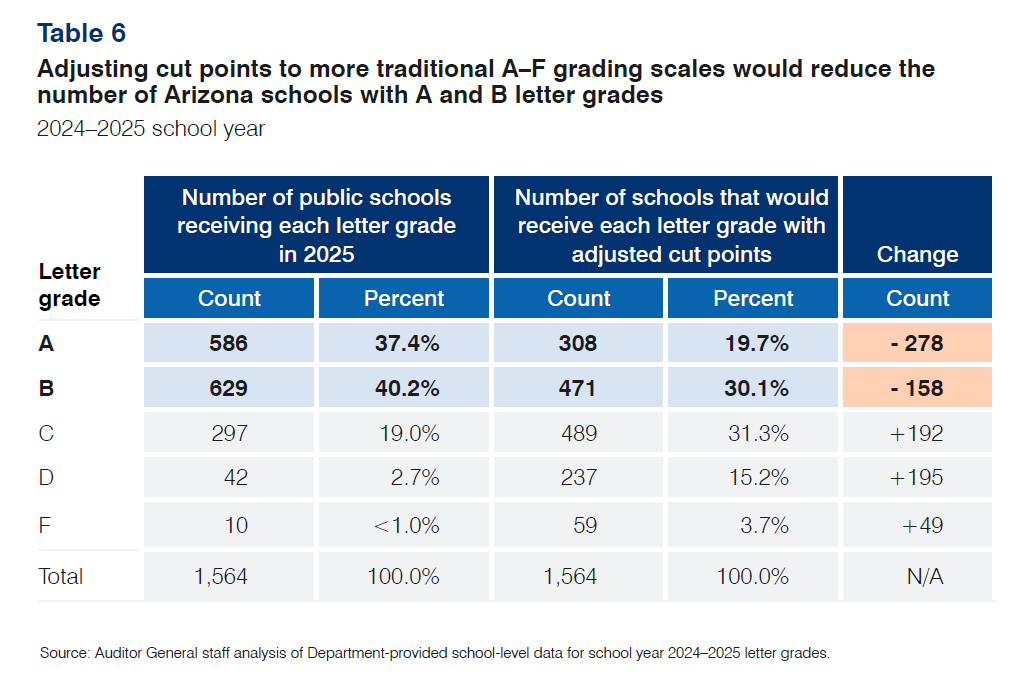
The audit's graphic compares ADE's school grades with the grades that schools would have received under a more realistic model. Under ADE's model, only 3 percent of schools received a D or F. Under the realistic model, nearly 20 percent did.
The fix is not complicated. State agencies must deliver required financial records to the auditor on time, and the ADE must adopt a grading system that tells parents and taxpayers the truth. Until Hobbs makes that a priority, Arizona's federal funding and its credibility remain at risk.
MORE COVERAGE FROM RESTORATION NEWS
ROAF Report: Comstock Act Is 'Law of the Land'—Enforce It
Defense: Civilian Tenure Is Out at America’s Military Service Academies—Why It Matters
Immigration: ICE Detains Illegal Alien Charged with Dealing Fentanyl in Virginia—Why It Matters
Corruption: Michigan Fraud Investigation Unit Waved Through Billions in Questionable Medicaid Claims
We need your help to save America—chip in today.
Restoration News, a project of Restoration of America, is your trusted investigative news source for the America First movement. As a rapidly growing conservative news site, we focus on delivering accurate and insightful exposés on political news, immigration news, leftist lies, and other pressing issues affecting everyday Americans. Our uncompromising commitment to a hard-hitting, fact-based, America First, and faithful perspective ensures that you receive news that aligns with your values.
Every dollar gets us closer to winning the war on woke.