EXCLUSIVE: Supreme Court Strikes Race-Based Gerrymandering in ‘Massive Victory for Voting Rights’
Louisiana v. Callais reshapes redistricting law and deals a blow to racial representation
The Supreme Court delivered a long-awaited constitutional reckoning on April 29, ruling 6-3 that Louisiana's race-based congressional map is unconstitutional. This has fundamentally restructured the legal framework that has for decades allowed activists and the courts to sort voters by race.
Louisiana v. Callais, written by Justice Samuel Alito and joined by the other five conservative Justices, marks the most significant reinterpretation of the Voting Rights Act (VRA) in two generations.
The Attorney Who Argued the Case at the Supreme Court
“I think it’s a massive victory for voting rights,” attorney Edward Greim told Restoration News. Greim argued the case before the Court last year. He said the Justices delivered everything he hoped for. “The key to every controversy we have in redistricting right now is that we had to stop using race to draw districts. That had to come to an end, because that’s unconstitutional.”
After Louisiana drew its congressional map following the 2020 census, a federal court held that the map likely violated Section 2 of the VRA by failing to include a second majority-black district. Louisiana complied, hoping to avoid costly litigation, and drew a new map, which included the racially gerrymandered Congressional District 6.
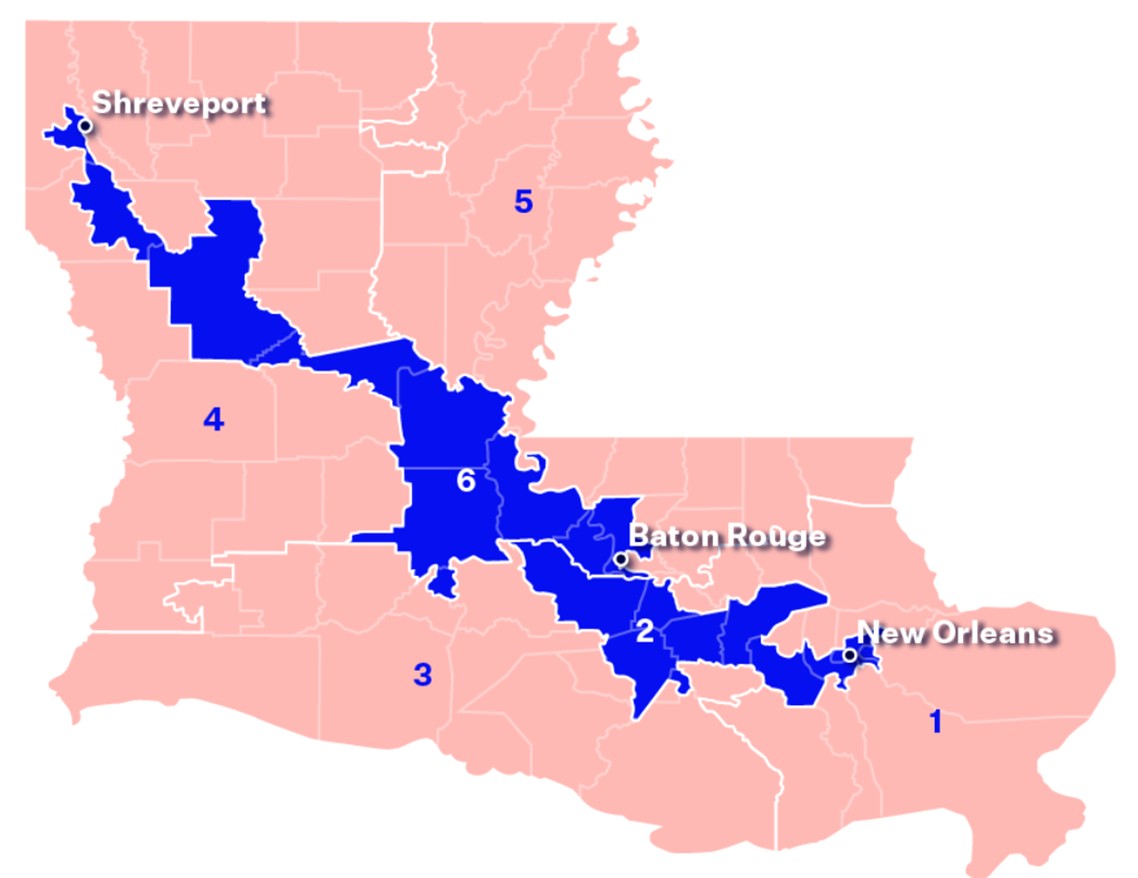
A second court then struck that map down as a racial gerrymander when non-black residents of the new district challenged it in court for violating their rights. The Supreme Court heard arguments last March and October.
Much of the outcome hinged on whether the second black-majority district, which snakes from Baton Rouge to Shreveport, was legal, according to the Thornburg v. Gingles (1986) case, which was based on Congress’ amending the VRA in 1982. That amendment made it easier for plaintiffs to win on the effects of racial discrimination instead of stated intentions.
Gingles laid out three criteria that permit remedial racial gerrymandering. These consist of determining whether the minority population inhabits an area large and compact enough to form a minority-majority district, whether the minority votes as a bloc, and whether the majority votes as a bloc sufficiently to defeat any minority candidate who runs for office.
The Majority Decision
On Gingles’ first point, Alito wrote that the black plaintiffs never presented a map showing how the state could protect its key Members, while creating a second black-majority district. This, he noted, would not be that difficult if it were possible with “the increased use and capabilities of computers in drawing districts and creating illustrative maps.”
In Rucho v. Common Cause (2019), the Court held that the courts could not prevent political gerrymandering. In Callais, the plaintiffs’ illustrative maps failed to account for the state's legitimate political goals, including protecting key incumbents like House Speaker Mike Johnson (LA-04).
On points two and three, Alito wrote that in a state where there is significant overlap between partisanship and racial bloc voting, it becomes difficult if not impossible to prove the voting preferences are not based on partisanship alone. Trying to parse out voters’ partisan and racial preferences opens the floodgates to frivolous lawsuits abusing the VRA by claiming racial bias, when the state is legally gerrymandering politically.
In her dissent, Justice Elena Kagan, joined by the other two liberal Justices, engaged in typical leftist fearmongering about alleged lost minority representation. “Under the Court’s new view of Section 2,” Kagan wrote, “a State can, without legal consequence, systematically dilute minority citizens’ voting power.”
However, neither the 15th Amendment nor the VRA assign proportional representation based on race.
“This case basically said you can use the VRA for the things it was meant for like a remedy for intentional racial discrimination,” Greim said. “If we return to those principles, the VRA will do its original job and won’t be used as a backdoor way to achieve proportional representation.”
Kagan argued that the conservative majority effectively overturned the Gingles decision, returning Section 2 to what it was before Congress amended it in 1982.
Greim disagrees.
“To say that there is a wholesale overturn of Gingles is wrong,” he said. “The court went into the Gingles factors and said, in today’s world, you’re going to have to use those differently.”
He added that by the same measure, this decision does not represent a de facto overturn of Section 2 either, as Kagan and much of the liberal media claim.
Greim argued that this does not mean one must show evidence of stated intention on the part of elected officials to discriminate against minorities in redistricting before one can successfully challenge that redistricting in court. He noted that litigants can still look at whether elected officials engaged in racial discrimination before they carved up districts “or [litigants] can look at the lines carving in and carving out people based on race.”
Where We Go From Here
The practical consequences of Callais will be significant and immediate. States that drew majority-minority districts under court orders may now reassess and correct those maps. Besides Louisiana, Alabama and Tennessee have already begun that process. Others will likely follow, however, the full impact on a deracialized congressional map will be felt most clearly in 2028.
For too long, liberals stretched the VRA beyond its text to authorize something the Constitution forbids—race-based government action deployed not to remedy actual discrimination, but to engineer partisan outcomes. The Court has now affirmed that this is illegal and against the spirit of both the Constitution and the VRA. American law recognizes American citizens as individuals, not as members of racial blocs to be governed like tribes.
MORE COVERAGE FROM THE FRONT LINES
Clean the Voter Rolls: Secure Elections? Feds, Watchdog Found Over 6 Million Illicit Votes on US Rolls
Systemic Vulnerabilities: Jimmy Carter Knew Voting By Mail Was a Mistake—and Endorsed It Anyway
How It All Began: America’s Worst Voting Irregularities Started With Oregon’s All-Mail Elections
We need your help to save America—chip in today.
Restoration News, a project of Restoration of America, is your trusted investigative news source for the America First movement. As a rapidly growing conservative news site, we focus on delivering accurate and insightful exposés on political news, immigration news, leftist lies, and other pressing issues affecting everyday Americans. Our uncompromising commitment to a hard-hitting, fact-based, America First, and faithful perspective ensures that you receive news that aligns with your values.
Every dollar gets us closer to winning the war on woke