
Why Are Young Women So Liberal?
What’s driving the massive gender split between America’s youngest voters?
A Restoration News Investigation
The political gender gap among young Americans is widening at an alarming rate. If the Republican Party wants to avoid losing close, winnable elections, it must figure out why its message is repulsing young women and fix it.
In 2020, young voters supported Democrats at a similar wide margin as they did in 2008. But the real jolt came in 2024. Facing a historically inept candidate, amid a historically inept Democrat administration, President Donald Trump made understandable, large gains with Gen Z men.
But Gen Z women barely budged.
Men ages 18–29 made a 15-point swing to Trump. Young women, meanwhile, only moved eight points toward him. This turned young voters’ previous eight-point gender gap into a 15-point chasm.
By contrast, the overall gender gap in 2024 shrunk to 10 points from 2020’s 11 points.
Many blamed the young gender gap explosion on Trump’s appearances on male-centric podcasts in the online "manosphere.” But a newly released poll from the League of American Workers (LAW), coupled with last week’s elections, show 2024 was no fluke.
In the LAW poll, Trump holds a 38-percent approval rate with men, ages 18–25, versus a 24 percent approval rate with young women.
Democrats’ cataclysmic victories last week show this problem is getting worse for Republicans at the ballot box. Pollster Will Jordan aptly noted Democrats are "approaching Assad margins” with young women, referring to deposed Syrian dictator Bashar al-Assad’s past election wins.
Ironically the gender gap actually exploded among 18-29s if you believe the NJ/VA exits. But it was for the “good” reason: approaching Assad margins among young women.
— Will Jordan (@williamjordann) November 5, 2025
(And numbers from OP are out of date; Spanberger/Sherrill won young men by +14/+18 in latest data) https://t.co/Pmop9CV9PJ pic.twitter.com/pM1SYFpCI2
The Gender Gap is Not New—But This One's Different
Women voting more Democrat than men is not recent or novel.
"Gender gap” became a political term in the 1980 election, when women voted nine points higher than men for former President Jimmy Carter.
Fast forward to 1988, and former President George H.W. Bush thumped Michael Dukakis 58–42 with men yet eked out a mere two-point victory with women.
In 2000, white men broke heavily for George W. Bush—60 percent to Al Gore's 36 percent—but white women were a near-split—49 percent Bush, 48 percent Gore.
Democrats’ consistent 8-to-12-point advantage with women remained a stubborn but containable problem for Republicans…until Gen Z became old enough to vote.
Here is the gender gap breakdown in New Jersey’s gubernatorial election recently from Fox News.
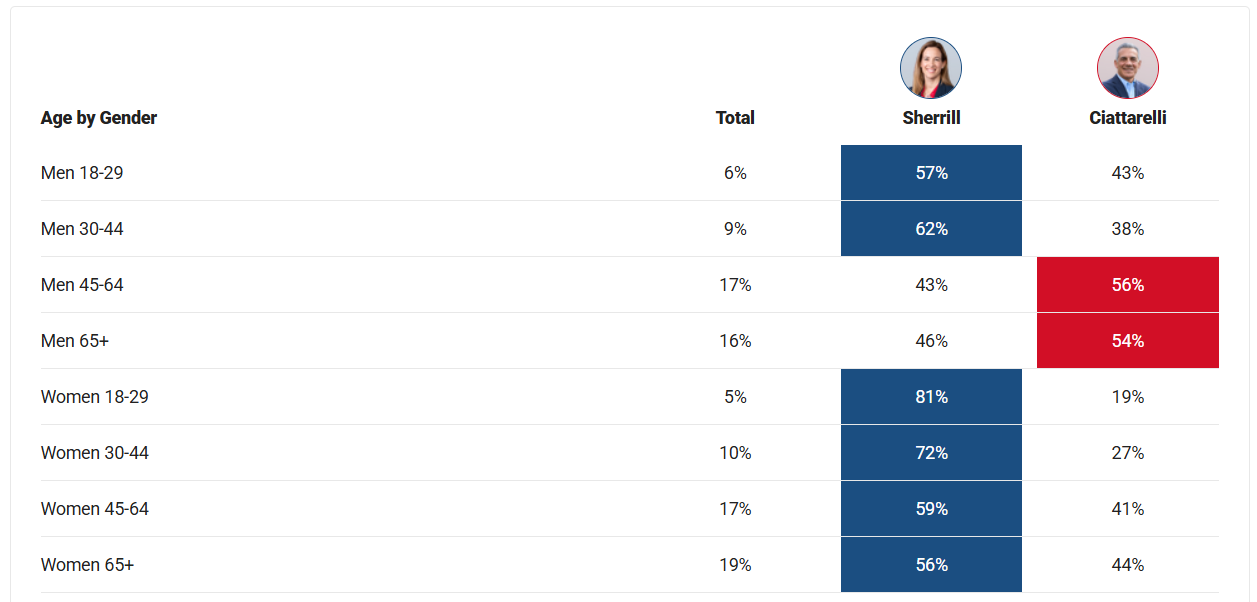 Image credit: Fox News
After four decades of maintaining a 10-point distance, young women are suddenly sprinting leftward at the ballot box. Some pundits blame the Gen Z gender chasm on the education gap; others on feminist catalysts like the MeToo Movement, the Dobbs decision, deprioritizing marriage and children, and even Taylor Swift. Regardless, Republicans cannot sit idly by and hope they grow out of it if they want to go back to just losing women—instead of getting wiped out by them.
The Voting Gap is Greater Than the Ideology Gap
Young women do identify as more liberal than young men—but the ideological gap isn’t as wide as the voting gap.
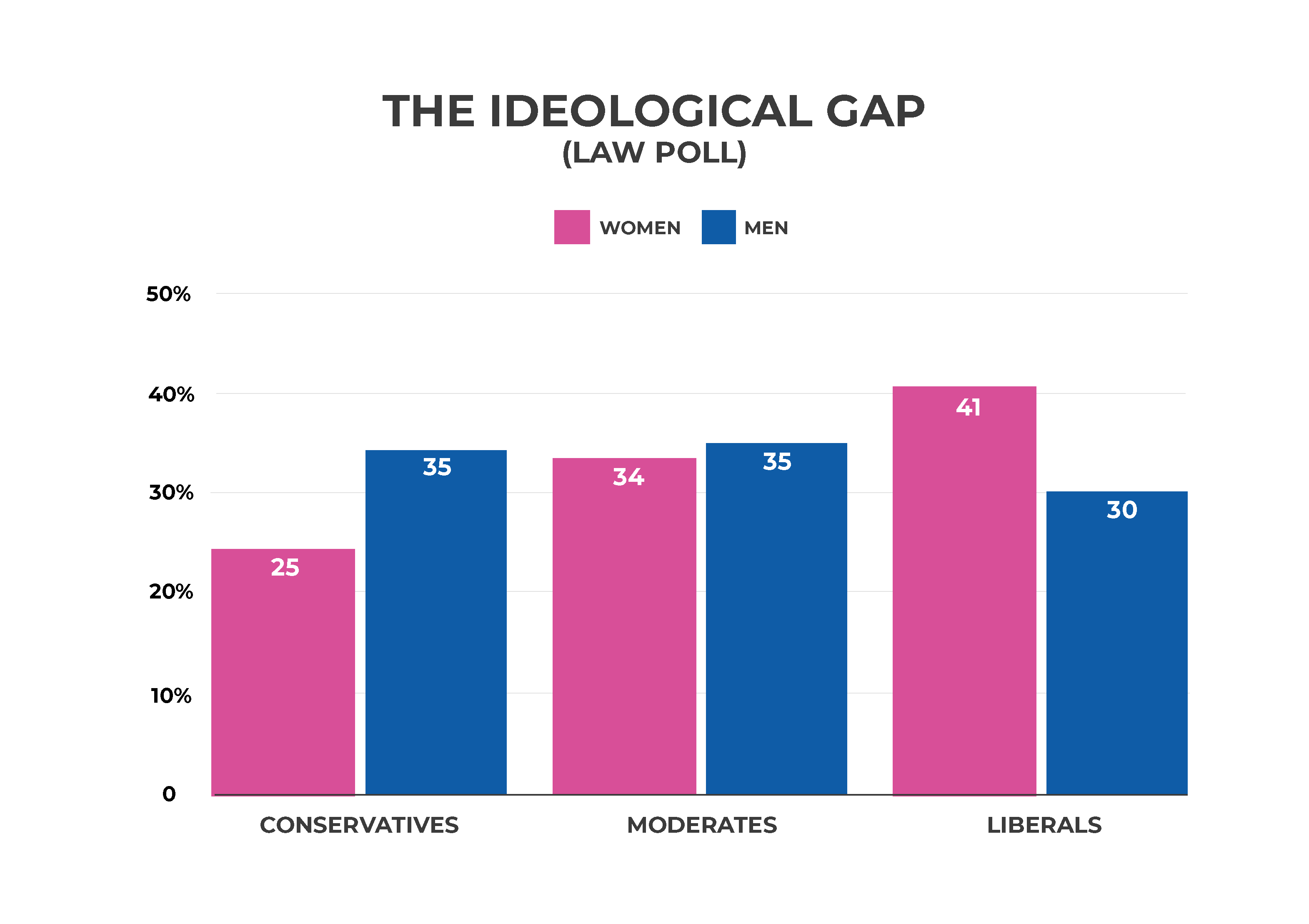
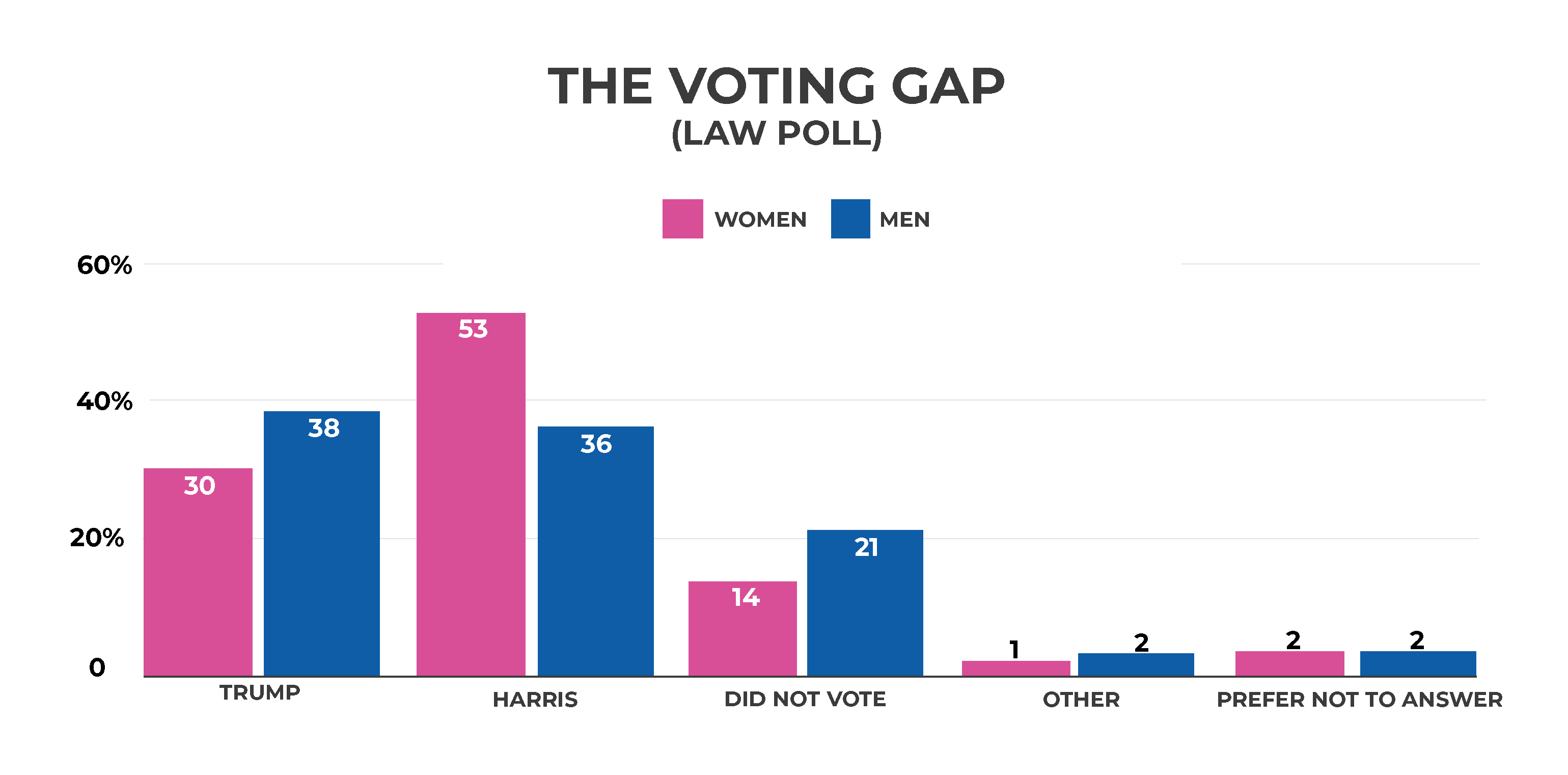
If young women voted according to their self-reported ideology at the same rate as young men, the 2024 gender gap would have looked more like it did in every election from 1980 through 2020. Instead of voting 53–30 for Harris, female LAW poll respondents would have split roughly 41–34.
Young conservative women are not expanding the gap. In fact, when the LAW poll asked Trump voters why they voted for him, eight percent of young women said they were motivated by conservative values, compared with only three percent of young men.
The LAW poll shows young conservatives and young liberal men are not unusual in their crossovers—about 15 percent voted against their own ideological camp, consistent with the median from the 2000 election.
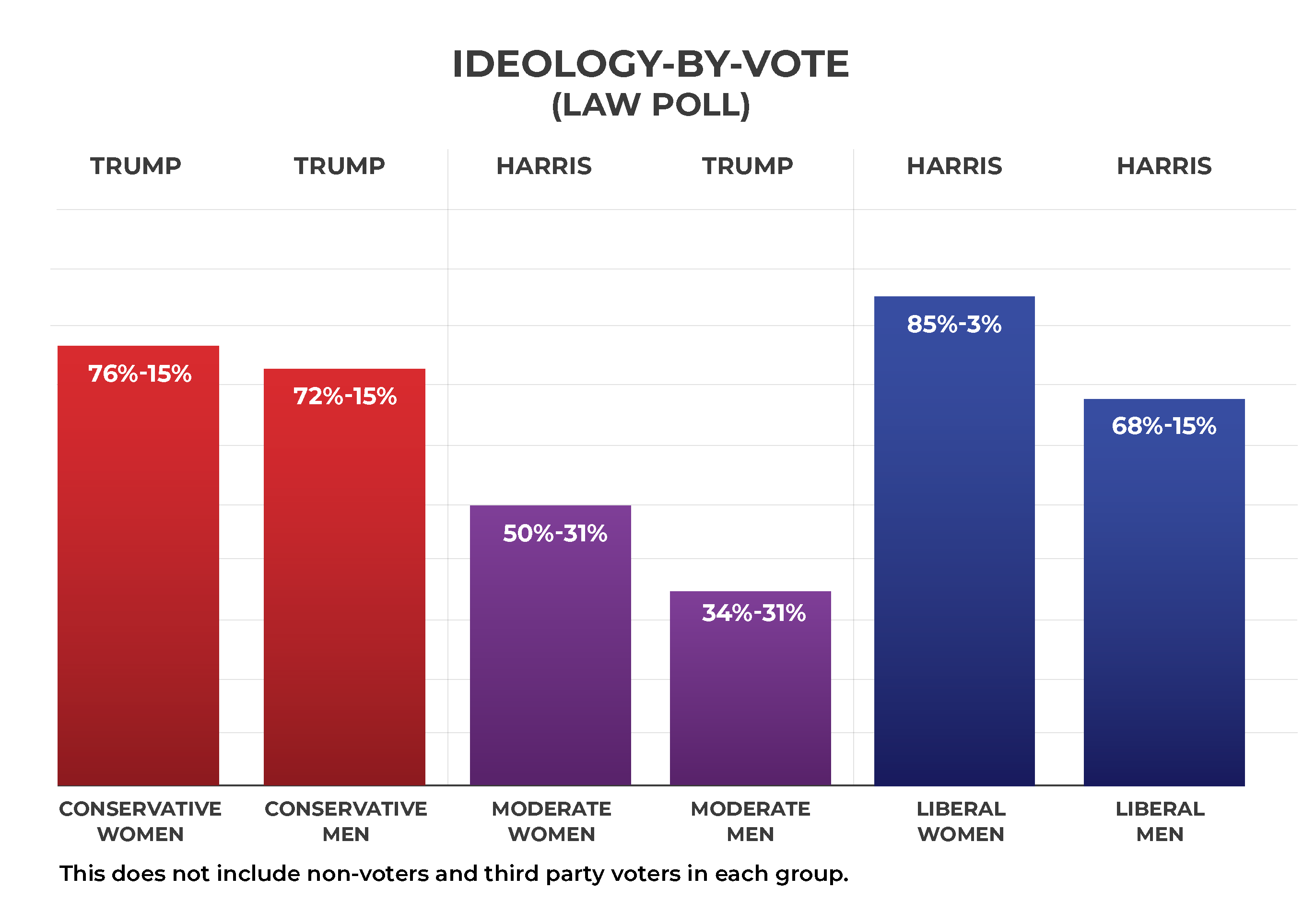
The divergence comes from liberal women becoming immovable and Republicans failing to keep the gap manageable with young moderates.
Either niche Republican positions are alienating Gen Z women more than their mothers’ generation, or something is aggravating the root causes of the gap.
Is it the Education Gap?
It’s no secret the Democratic Party has public schools and universities on its side. Girls pay more attention and retain more of what they’re taught than boys. They also graduate college at a higher rate and are overrepresented in the humanities.
Research by the New York Times shows these achievement gaps do contribute to young women leaning further left than young men. But the education gap is rooted in biology, and America’s education system has been liberal for decades. It might contribute to the voting gap’s existence; it does not explain what happened last year or last week.
Additionally, if increased college attendance were the aggravating factor to this root cause, young women would identify much further left on key issues. As we will see, they do not.
Is it Partisanship?
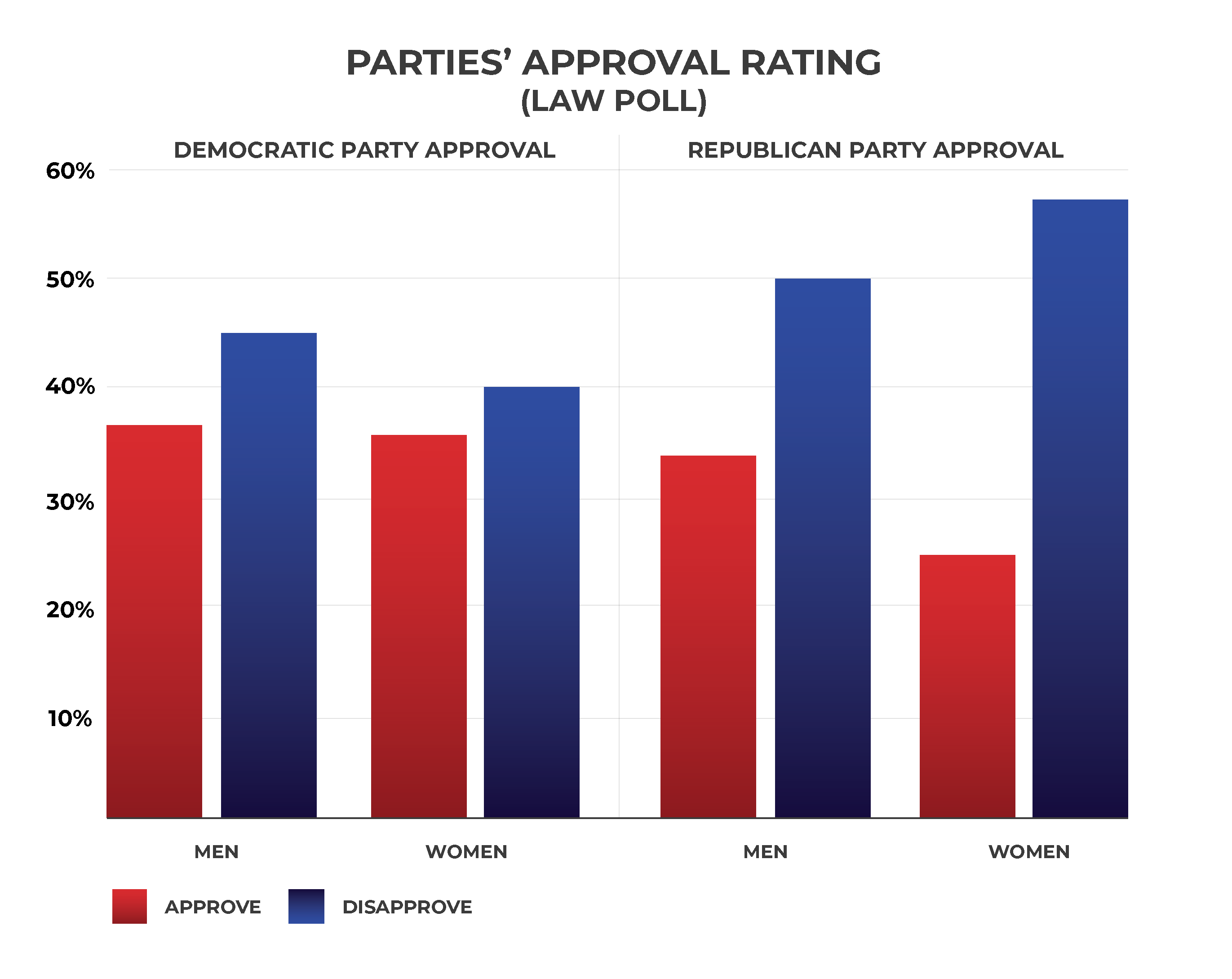
If young women are not as liberal as they vote, perhaps loyalty to the Democratic Party or the perceived toxicity of the Republican Party could explain it.
But men were twice as likely as women—eight percent to four percent—in the LAW poll, to name Democratic Party support as their top reason for voting for Harris.
The gender divide in partisan approval rates is not that large either.
What About Abortion or Feminism?
The gender gap began after two decades of second-wave feminism and the Republican Party’s opposition to Roe v. Wade. It seems intuitive the gap would expand after Republicans succeeded in getting Roe repealed in 2022.
But, in the 2024 election, just 32 percent of women reported abortion as their top priority—behind every single economic issue. And that includes pro-life women who view it as a top priority because they want it criminalized in most cases.
Gen Z is more liberal on abortion than previous generations. But, according to the Public Religion Research Institute, among young Republicans, women are only seven points more pro-choice than men, and, among young Democrats, only six points more pro-choice than men.
On general feminism, only 15 percent of young women told LAW that support for women’s rights motivated them to vote for Harris, and only four percent cited historical representation as a motivating factor.
Trump Derangement Syndrome, Perhaps?
Some believe Trump’s past statements and media-distorted image have damaged the Republican Party’s brand with young women.
But according to the LAW poll, young women were less likely—36 percent—than young men—41 percent—to vote for Harris because of anti-Trump sentiment.
Young women who voted for Trump were not exactly holding their nose either.
Among young Trump voters, an equal 25 percent of young men and women named candidate suitability, general satisfaction with past performance, leadership and strength, personal traits and charisma, or positive personal qualities as the top reason for their vote.
Or Fear of Climate Change?
Women certainly are far more concerned about climate change than men.
A survey of 10,500 voters by the Environmental Voter Project found a 25-point "green gender gap” among "climate voters,” those who named environmental issues as a top political priority. Voters 18–24 have a 34-point gender gap.
But leftists have already beaten that horse to death, and the LAW poll shows it. Only two percent of young women named environmental concerns as their top reason for voting for Harris.
How About Support for Socialism?
Support for socialism isn’t exacerbating the gender gap either, despite young women’s infatuation with newly elected New York Mayor Zohran Mamdani. In fact, young men are much likelier to support socialism.
According to the LAW poll, 37 percent of women and 49 percent of men view socialism positively. Only 13 percent of women view it very positively, compared with 20 percent of men.
Understanding the Voting Gap Means Grasping the Pessimism Gap
Enter the elephant in the polling booth—female pessimism.
In the LAW poll, 67 percent of young women were unsatisfied with the country’s direction. Only nine percent said were very satisfied, and 44 percent said they were not satisfied at all.
This contrasts sharply with young men—54 percent unsatisfied, 17 percent very satisfied, and 31 percent not satisfied at all. Interestingly, this tracks almost exactly with the usual gender voting gap.
Regardless of age or generation, there has always been a gender gap in perception of well-being, both on a personal and national level.
For instance, a few weeks before the chaotic withdrawal from Afghanistan tanked former President Joe Biden’s approval rating, women already rated him nine points lower than men—a near complete reversal from the gender gap he had won just nine months prior.
Right before the 2024 election, men’s approval rate of the economy was underwater by 28 points, while women held a negative 48 percent approval of the economy. A Guardian poll this summer found 62 percent of women still believed the economy and inflation were getting worse under Trump—despite inflation dropping to its lowest level since early 2021—compared with 47 percent of men.
The Biden economy was clearly terrible… but what about when times were good?
In 2019, Trump's pre-COVID boom year, men gave the economy a 44-point positive rating. Women, however, gave it a tepid nine-point positive rating.
Monthly peer-reviewed data from three generations reveal American women are natural Debbie Downers.
The University of Michigan's Consumer Sentiment Index has tracked over 500 respondents monthly since 1978. There was only one month when women had a higher consumer confidence than men—March 2000.
That makes sense, considering women had higher anxiety about Y2K than men—similar to how they are more easily frightened by climate change scaremongering.
Escaping the end of the world as we know it makes for a consumer confidence booster if there ever was one.
A study in the Journal of Economic Behavior and Organization found women aren't just gloomier about the economy and politics—they’re more bearish on life. Its analysis of 33 gender-differentiated polls from 1999–2008 in multiple countries found non-American women are no different. Additionally, this pessimism gap persists even when controlled for income, employment, wealth, education, and marital status.
It found men are even less pessimistic on general economic conditions over which they have no control—refuting the notion that male optimism can be explained by men’s ability to exert more control over their personal lives and finances.
Unsurprisingly, the only area where women were more optimistic than men was on government efficacy.
Bad News for Republicans on Healthcare
The pessimism gap makes the healthcare issue a quagmire for Republicans, who favor a more hands-off approach than Democrats. Optimists, on average, have lower blood sugar, are less depressed, and recover easier from serious diseases.
Predictably, a 2022 KFF survey noted 48 percent of women carry medical debt versus 34 percent of men. There is also a large gap in prescription drug usage. Among women, 69 percent use prescription drugs versus 56 percent of men.
Young women unsurprisingly view "Big Pharma" more negatively than young men in the LAW poll—58 percent versus 52 percent
In a 2019 Edison Research poll, women were almost twice as likely as men to list healthcare as their top economic concern. By contrast, men were more concerned about unemployment and jobs by a factor of 3–2. This presents an obvious, systemic problem for a political party that defends the status quo: America’s unique employer-based health insurance system.
Worse News on Housing
Today’s housing market offers another example of female pessimism and economic conditions just not working in Republicans’ favor.
Single women are more likely to secure a home as soon as they can afford it, regardless of market conditions. Despite earning less on average, they outpace single men in home ownership except in North Dakota, South Dakota, and Alaska—unique states where young men can earn high salaries in the energy sector.
LAW poll respondents overwhelmingly said they believe homeownership is part of their American Dream—77 percent for young men and 73 percent for young women. Yet the average first age of homeownership just reached 40 for the first time in American history. In 1991, it was 28.
Women Really Don’t Like Laissez-Faire
As previously noted, the gender gap coincided with the Republican Party’s embrace of the pro-life movement—but it also coincided with its embrace of classical liberalism and supply side economics.
Classical liberalism was the dominant ideology in the U.S. a century before women had the right to vote. Only when former President Franklin D. Roosevelt largely divorced the Democratic Party from classical liberalism did it enjoy national success in the era of female suffrage.
To gain a better understanding of women’s disdain for laissez faire economic policies, one need look no further than the gender makeup of libertarians.
The Public Religion Research Institute’s 2013 American Values Survey found that less than one-third of libertarians were women, however, they made up 61 percent of communalists, an ideology that emphasizes communal living with shared resources.
In 2016, pollster Emily Ekins averaged the results of 10 surveys, showing among self-identified libertarians, 63 percent were male and 37 percent female. The gap widened to 68–32 percent among Millennials.
More recently, a 2023 YouGov poll found men were over twice as likely as women to say being libertarian described them well.
Back when former Texas Rep. Ron Paul and his surrogates kept libertarianism in mainstream discourse, Forbes contributor Bryce Covert gave her opinion on why the ladies find the ideology so unappealing: "If brought to its logical conclusions, libertarianism runs up hard against children and childrearing.”
That’s why, despite being less likely to embrace the term socialism, women consistently favor social welfare programs like guaranteed paid family leave and child tax credits at higher rates than men.
GDP Growth and Debt Reduction Just Aren’t That Attractive
Former President Ronald Reagan, who campaigned for fiscal hawk Barry Goldwater in 1964, famously said, "Goldwater didn’t lose. It just took 16 years to count the votes.”
Coincidentally, as soon as the Republican Party became the party of Goldwater it began to struggle with women.
Even on the economy, which both genders consistently rank as their number one issue, they often have entirely different concerns.
The Republican Party’s focus on economic growth simply doesn’t move the needle with women. For example, the LAW poll found men who earn over $75,000 are the only group that pulls away from today’s pessimistic pack of young voters. Higher earnings have zero effect on young women. In fact, women earning over $75,000 said they have a lower satisfaction rate than women earning under $30,000. In the Edison Research poll, men are nearly four times as likely to worry about the federal budget deficit.
None of this seriously hurts the Republican Party if it can balance social penny pinching with issues that women do care about like crime and inflation reduction. This tactic successfully froze the 1980s’ gender gap for four decades. Gen Z women, however, are quickly thawing it out.
Gen Z, as a whole, is abnormally pessimistic, which necessarily launches the outlying gender’s skepticism and negativity into the stratosphere. When facing a generation this bearish on the future, touting stock market gains and marginal deficit reduction doesn’t mean much to young women. Goldwater and Reagan had a good run, but it might be time for Republicans to find out why Dwight Eisenhower and Richard Nixon were more popular with the ladies.
Can Republicans Close the Chasm Before it’s Too Late?
The minimal importance young women place on feminist issues in voting should make Republicans reconsider whether feminism is widening the gender gap with Gen Z, and not the Republican policies’ perceived incompatibility with the maternal instinct Covert referenced.
Half a century of polling data shows it doesn’t matter how well or poorly the economy is performing, women will always be more pessimistic than men. Winning enough women in any generation to build a majority requires embracing the conservative belief that men and women are different, they have different concerns, and they respond differently to different appeals.
In a hyper-polarized era, young America's widening gender divide will present a serious electoral problem for Republicans going forward. If they can’t find a solution soon, the gender gap may grow too large for even a podcast blitz through the "manosphere” to overcome. Focusing on Trump’s myriad pro-worker and pro-family measures like lowering taxes on workers, increasing the child tax credit, and creating a newborn savings account would go a long way in reminding young women that the party does care about more than debt reduction and GDP growth. Expanding these policies would recreate a party that appeals to most men and women, collapsing the gap entirely.
(READ MORE: Young Americans’ Pessimism Is Going to Wreck America)
Help us finish the fight—chip in today
Restoration News, a project of Restoration of America, is your trusted investigative news source for the America First movement. As a rapidly growing conservative news site, we focus on delivering accurate and insightful exposés on political news, immigration news, leftist lies, and other pressing issues affecting everyday Americans. Our uncompromising commitment to a hard-hitting, fact-based, America First, and faithful perspective ensures that you receive news that aligns with your values.
Every dollar gets us closer to winning the war on woke.