Supreme Court Rules Candidate Can Challenge Endless Ballot Counting
This ruling opens the door to restoring electoral clarity and public confidence by undermining late mail-in ballot harvesting
The Supreme Court's decision on Jan. 14 to grant Rep. Mike Bost (R-IL-12) standing to challenge Illinois's extended ballot-counting period represents a crucial step toward restoring the meaning of "Election Day" in America. Although the Court has yet to rule on the merits, this marks a significant victory, as it sets the precedent of candidates being able to challenge state election laws before ballot counting begins.
The district court dismissed Bost et al. v. Illinois State Board of Elections et al., and the Seventh Circuit Court ruled Bost lacked standing—despite his being a sitting Illinois Congressman who is up for reelection this year. The Supreme Court’s ruling presents an opportunity to eliminate this late vote counting that sows distrust in the American democratic process.
Although the lower courts threw the case out, it was not close at the Supreme Court, winning 7–2, with liberal Justice Elena Kagan joining the conservative majority. The case is now remanded back to the Seventh Circuit Court.
Federal Law Sets a Clear Deadline
Federal law is explicit when vote counting should stop. Both 2 U.S.C. §7 and 3 U.S.C. §1 designate a single day, "the Tuesday next after the 1st Monday in November,” as the day for federal elections. When states extend the counting period, they are essentially rewriting federal law without Congressional authorization.
Illinois allows ballots to be counted until two weeks after Election Day. Strictly construing these federal statutes should render it and other states’ liberal ballot-counting laws unconstitutional.
“This ruling opens the door for increased transparency,” Joe Benson, Executive Director of Voter Reference Foundation, told Restoration News. “Scrutinizing the laws that regulate elections should be encouraged, not prohibited.”
The Supreme Court is already set to rule later this year on the Election Day aspect in a separate case that challenges Mississippi’s late ballot counting.
In addition to the constitutional aspect, Bost argued that post-Election Day ballot counting would harm him personally.
He notes it would pose an undue cost on his campaign, as he would have to budget for staffers to monitor the late ballot counting. He added that in a tight race, this could cost him his seat because late ballot counting makes it easier for illegitimate ballots to get mixed in.
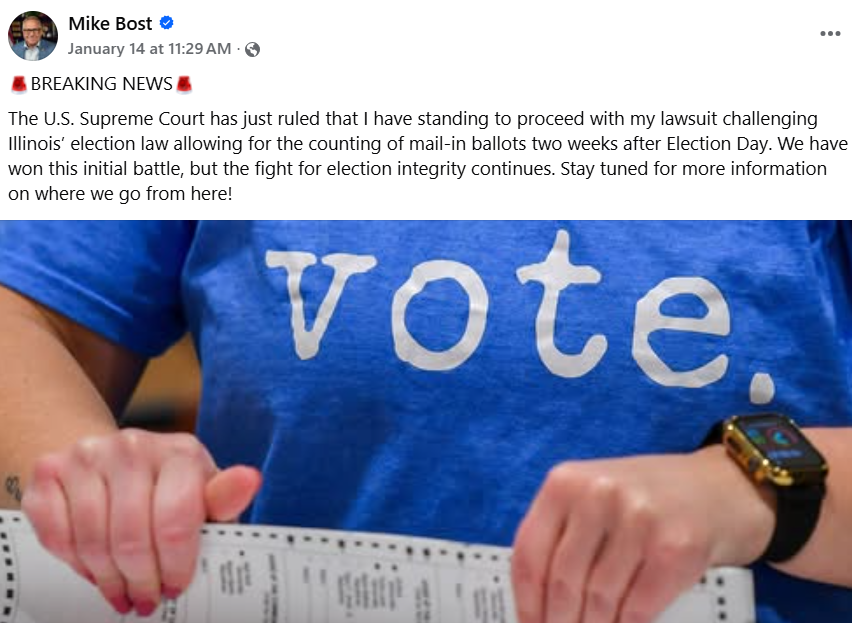
[Insert Bosts’s FB Post]
These are valid concerns. It has become a common expectation for Republicans to see close races, particularly in blue states like Illinois and California, slip from victory to defeat thanks to late-arriving ballots breaking for Democrats at unusually high rates.
Public Confidence and Finality
Proponents of extended counting periods argue that ballots postmarked by Election Day should count because voters acted in time. This reasoning, while superficially appealing, creates problems for the American democratic process.
First, even if this were sound policy, states cannot simply ignore the wording of federal laws because they don’t like them. Until Congress extends late ballot counting for federal elections, states should be obligated to discard all ballots that arrive after Election Day.
Second, from a merit perspective, late ballot counting shifts the operative deadline from a clear, observable event, inevitably muddying the results in the minds of the losing candidates’ supporters. Post Offices don’t always timestamp mail consistently, and some postmarks are illegible, multiplying the potential for disputes and dragging out the process. This propagates distrust and depresses future turnout. This can lead to political instability if people believe their elections are ripe for cheating and voting is a waste of time.
In a statement to Restoration News, Lisa Dixon, Executive Director of Center for Election Confidence, a “friend of the court” for Bost, said:
For too long candidates have suffered from confusing or impossible hurdles to challenge bad election rules, but this Supreme Court decision gives them equal access to federal courts on par with any other plaintiff. Candidates can challenge improper laws or unlawful procedures governing their election before the votes are cast and illegitimate ballots are mixed in. They don't need to wait and see what the margin is in their election and then prove, somehow, that the rule they are challenging made the difference. CEC is pleased that the Court adopted the position laid out in our amicus briefs and rejected the unfair and unworkable standard laid out by the Seventh Circuit.
Electoral legitimacy requires not just accurate vote counting but timely resolution. When Americans go to bed on Election Night without knowing which candidate won, as news cycles present endlessly shifting tallies, and candidates cannot concede or claim victory with confidence, the electoral process itself suffers. Mail-in ballot counting after Election Day is unconstitutional, ripens the system for corruption, and poses an undue burden on candidates who must budget campaign resources for post-election count observation and possible litigation. Granting standing to candidates to challenge this is a great first step to eliminating what is likely the biggest cause of doubt in election integrity among the public.
(READ MORE: Ballots After Election Day? Supreme Court Could Strike Down the Chaos)