Does the GOP Have a Road Back to a Senate Majority?
It exists, but we'll need to focus on flipping these seats in 2028 and 2030.
It's one thing to lose the House. It's quite another problem to lose the Senate—and two weeks after Election Day, Republicans are still uncertain how many seats they'll have once the midterm dust settles. Either way, we're looking at a long-term problem, given the Senate's six-year terms.
Or are we?
The path back to a Republican Senate majority is, in fact, already taking shape. The good news is that it runs through red-leaning purple states that President Donald Trump won in 2024. The bad news: conservatives likely won't achieve a majority until the 2030 midterms.
As painful as that sounds, it also means conservatives have two years to settle internal disagreements on the three issues dividing our movement—tariffs, artificial intelligence (AI) data centers, and foreign policy—and to unify around the pro-America economic and moral agenda that propelled Trump into office two years ago.
Where Things Stand
First, some context. Before the 2024 election, Senate control was split 51–49. Democrats held control of tie-breaking votes through Vice President Kamala Harris, who simultaneously served as Senate President.
Republicans swept the 2024 election, winning four Senate seats—Pennsylvania, West Virginia, Ohio, Montana—but losing Arizona. The net result: a 53–47 Senate majority.
Then came the blue tsunami in 2026. Democrats flipped eight Senate seats in Texas, Kansas, Ohio, North Carolina, South Carolina, Maine, Mississippi, and Iowa. Democrat Mary Peltola is also leading Alaska's Senate seat. Democrats are looking at a 56–44 majority, assuming the party wins in Alaska. That means Democrats will hold the largest Senate majority either party has enjoyed since 2011.
A nine-seat swing is big but far from unprecedented—in fact, Republicans shifted nine seats in the 2014 midterms under Barack Obama and took a 54-seat majority. Republicans swung eight seats in the 1994 midterms against Bill Clinton, for a 53-seat majority.
The 2028 Map: Seats to Flip
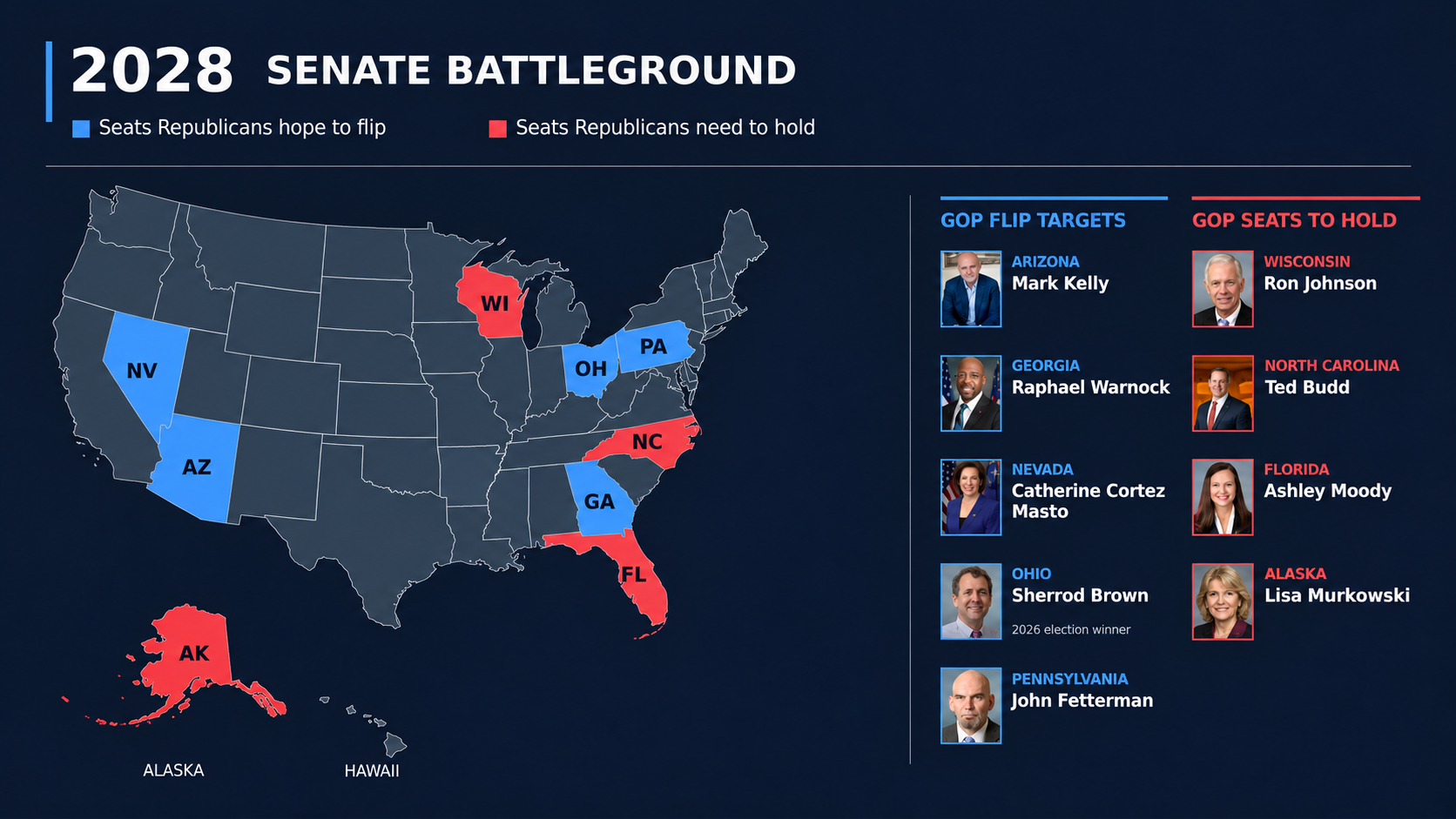
The 2028 Senate map will be a test of whether Republicans can claw back ground in states that voted for Trump but flipped to Democrats in 2026. At best, the GOP can flip five Senate seats in 2028—as well as take back the House and retain the presidency—leaving Democrats with a 51–49-seat majority heading into 2029.
However, a 51-seat majority is a tough thing to keep. Assuming Republicans keep control of the White House in 2028, a single Democrat defection gives a tie-breaking vote to the Republican Vice President on legislation and nominations. Given how overstretched the new Democrat Senate will be in ruby-red states, such as Kansas and Iowa, expect those opportunities to arise.
Here are the key races to focus on in 2028:
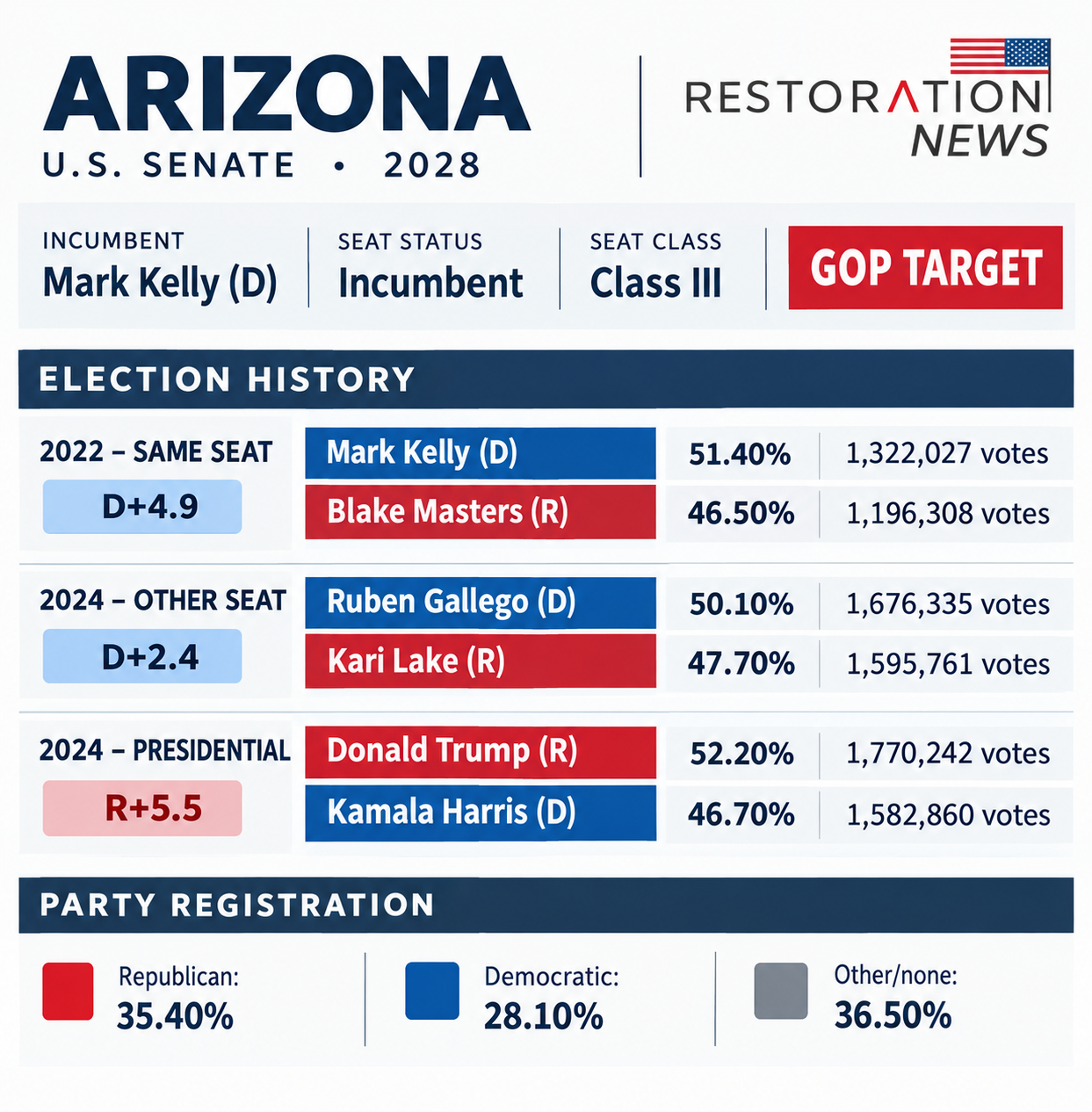
Arizona: Sen. Mark Kelly (D)
Arizona has become the North Carolina of the West: a state that usually votes red in presidential elections but increasingly backs Democrats in all other statewide races. Gov. Katie Hobbs, a Democrat, narrowly beat her Republican opponent by six-tenths of a percentage point in the 2022 governor's race, then trounced her opponent by 13 points in 2026.
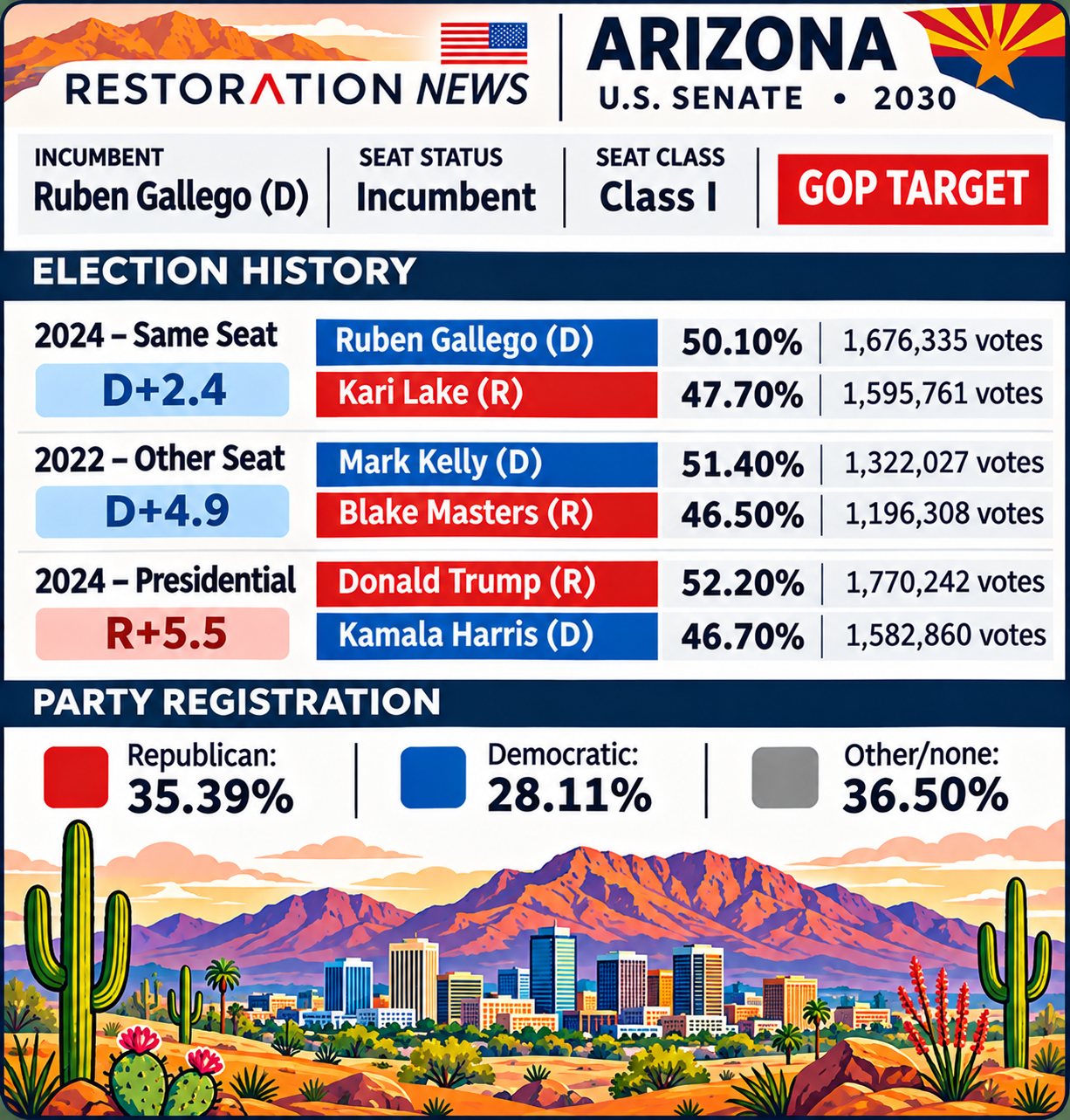
Two Senate Democrats: Kelly flipped the late Sen. John McCain's (R) seat by just over two points in 2020. Two years later, Sen. Ruben Gallego held the state's second Senate seat for Democrats by 2.4 points—even as Trump carried Arizona by 5.5 points in 2024.
Nevertheless, Republicans hold a 7.3-point advantage in voter registration. That will be the GOP's ticket to flipping Kelly's seat in 2028—if they can find the suitable message and candidate. (Here's a hint: start with the illegal "smurfing" allegations surrounding Kelly's campaign.)
Georgia: Sen. Raphael Warnock (D)
Warnock's 2022 runoff victory was narrow, but the 2026 result in Georgia's other Senate race was anything but close. Democrat Sen. Jon Ossoff won by a staggering 18 points in a state Trump carried by 2.2 points in 2024, suggesting that Georgians are less attached to party than they are to kitchen table issues.
In 2028, Republicans will need to make the race about Warnock himself—a pro-abortion, pro-transgender radical bankrolled by an out-of-state Goldman Sachs millionaire—rather than lean on loyalty to the GOP to win the day.
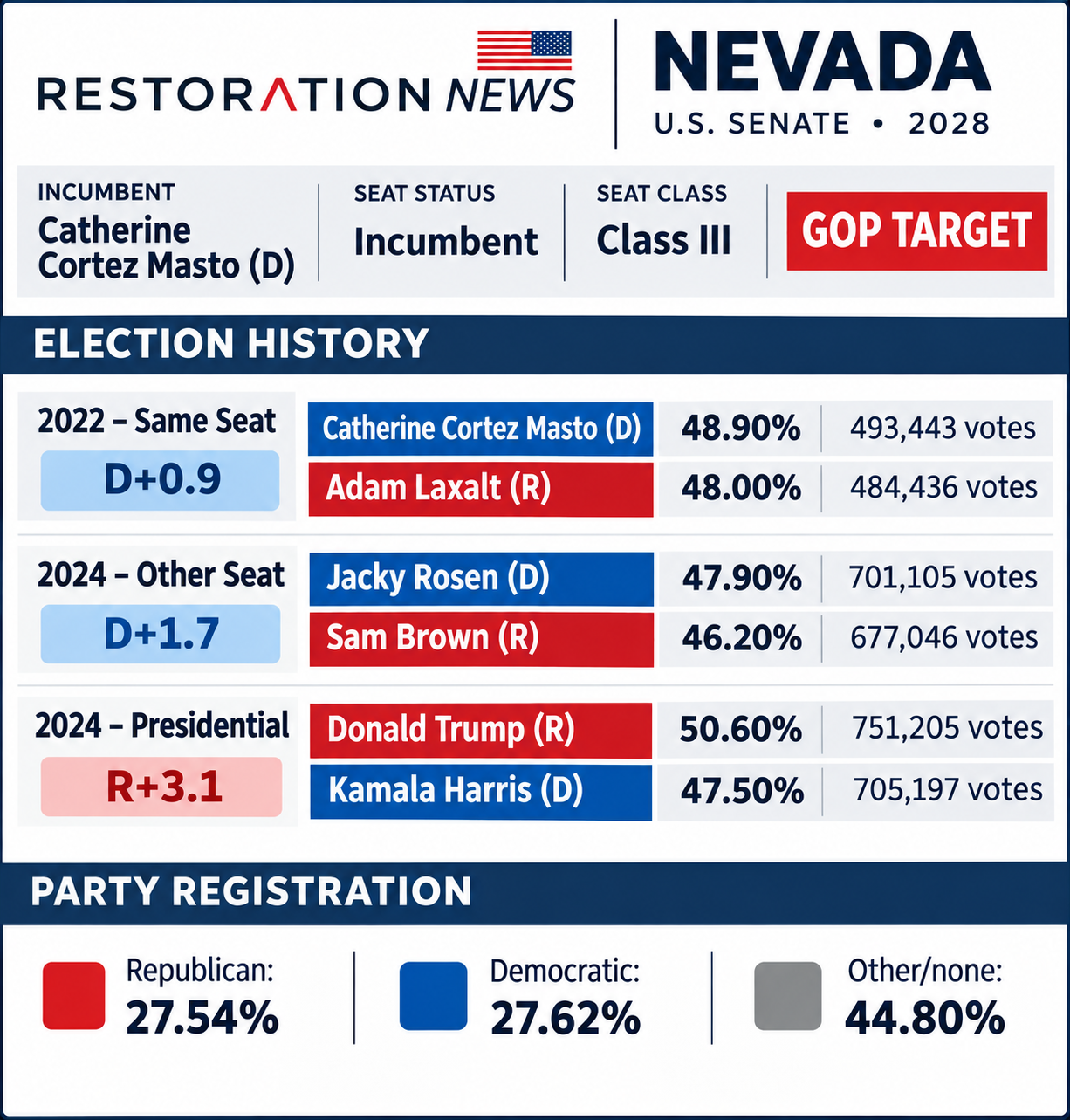
Nevada: Sen. Catherine Cortez Masto (D)
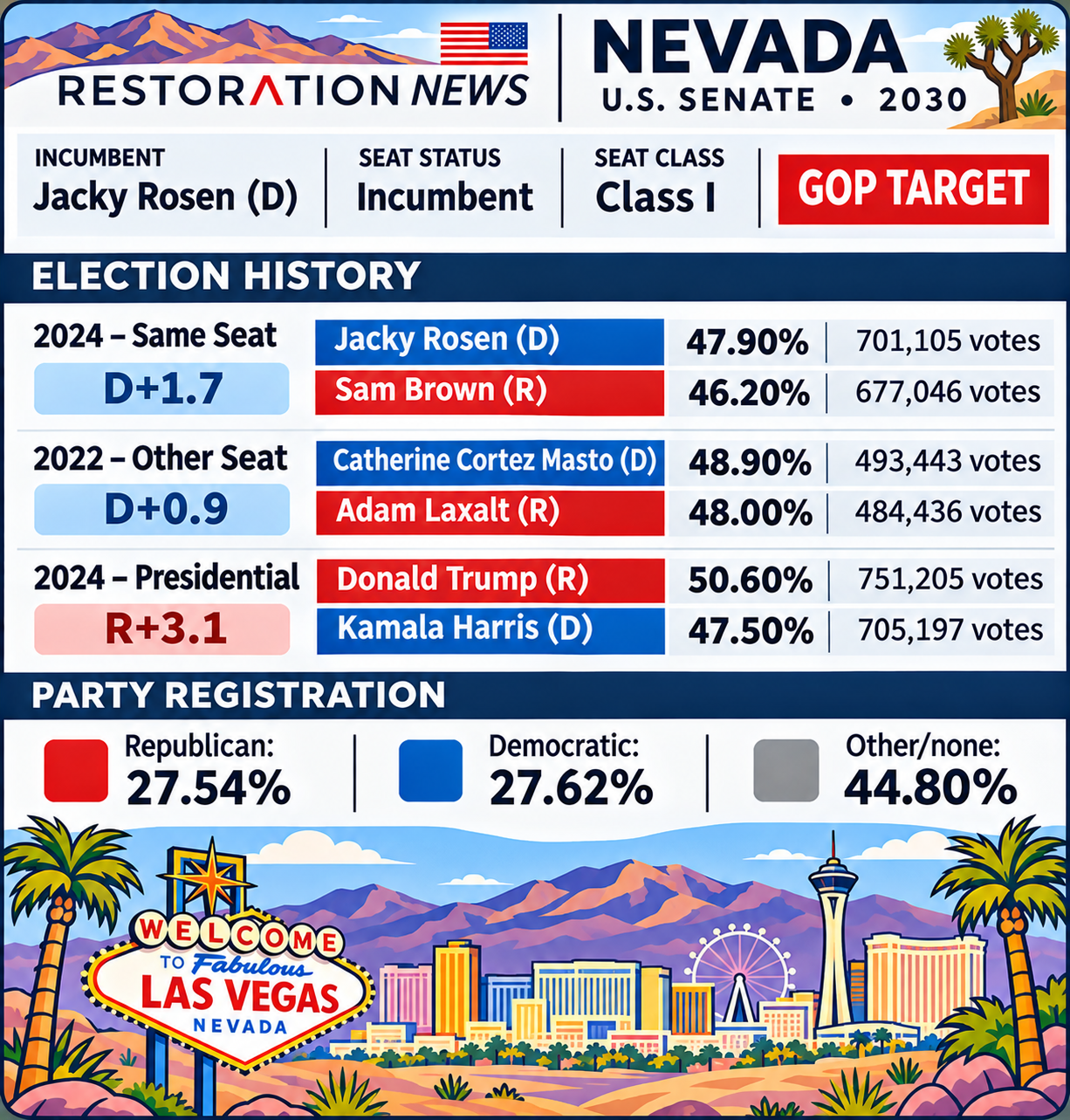
Nevada is one of the closest states on this map because it is a historically blue state slowly drifting into the Republican column. Democrats won both recent Senate races by less than two percentage points, while Trump carried the state by 3.1 points in 2024. Party registration is almost evenly divided—Democrats and Republicans both account for roughly 27 percent of registered voters, but a plurality remain independent (and thus up for grabs). Winning Nevada means connecting with independents who have the power to turn the Silver State into a red bastion—or keep it dark blue.
(Here's a hint to the GOP: don't call it "Nev-ah-da" when asking Nevadans to vote.)
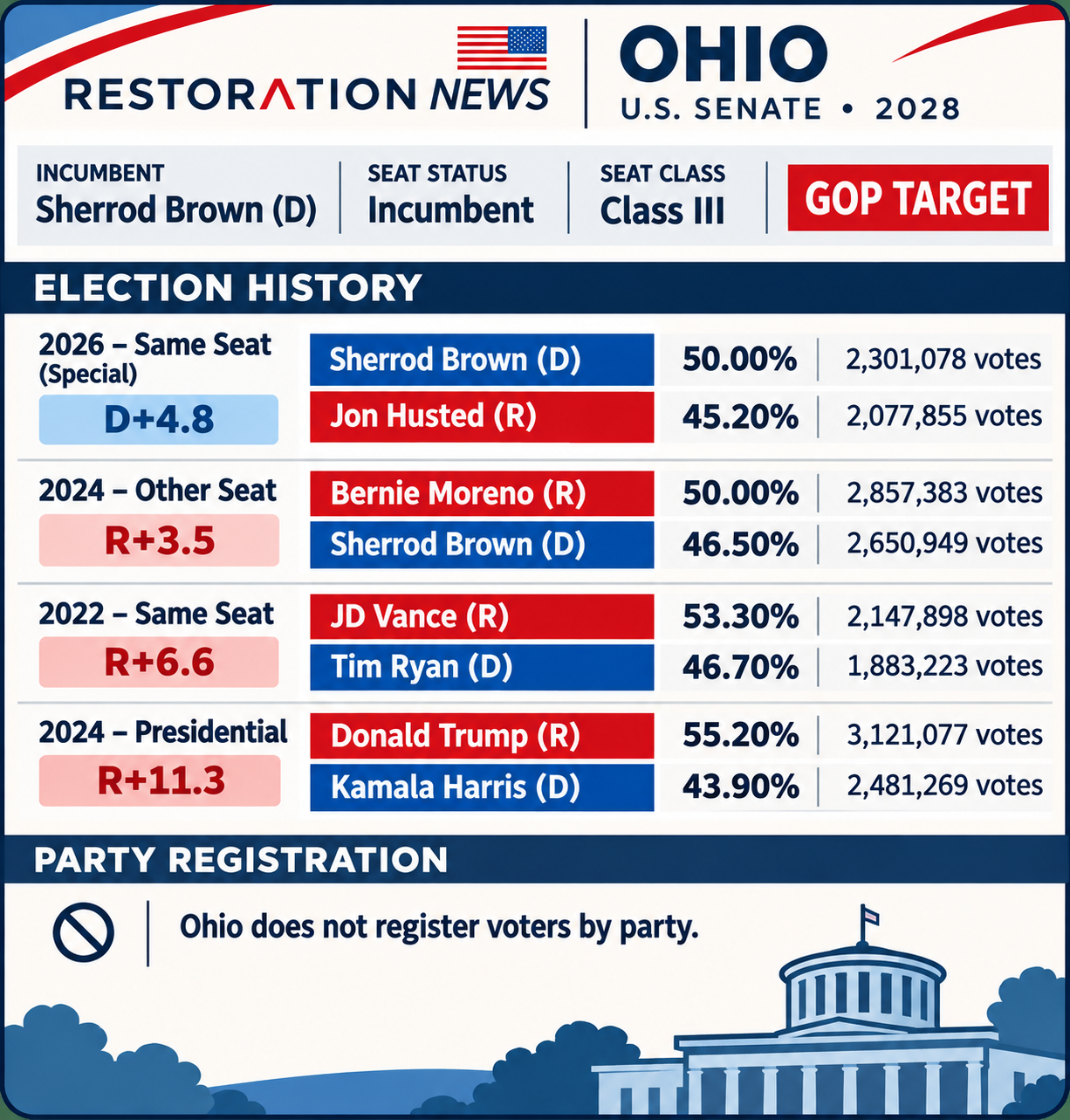
Ohio: Senator-elect Sherrod Brown (D)
Ohio shouldn't offer a challenge—but that never stopped Republicans from snatching defeat from victory's jaws.
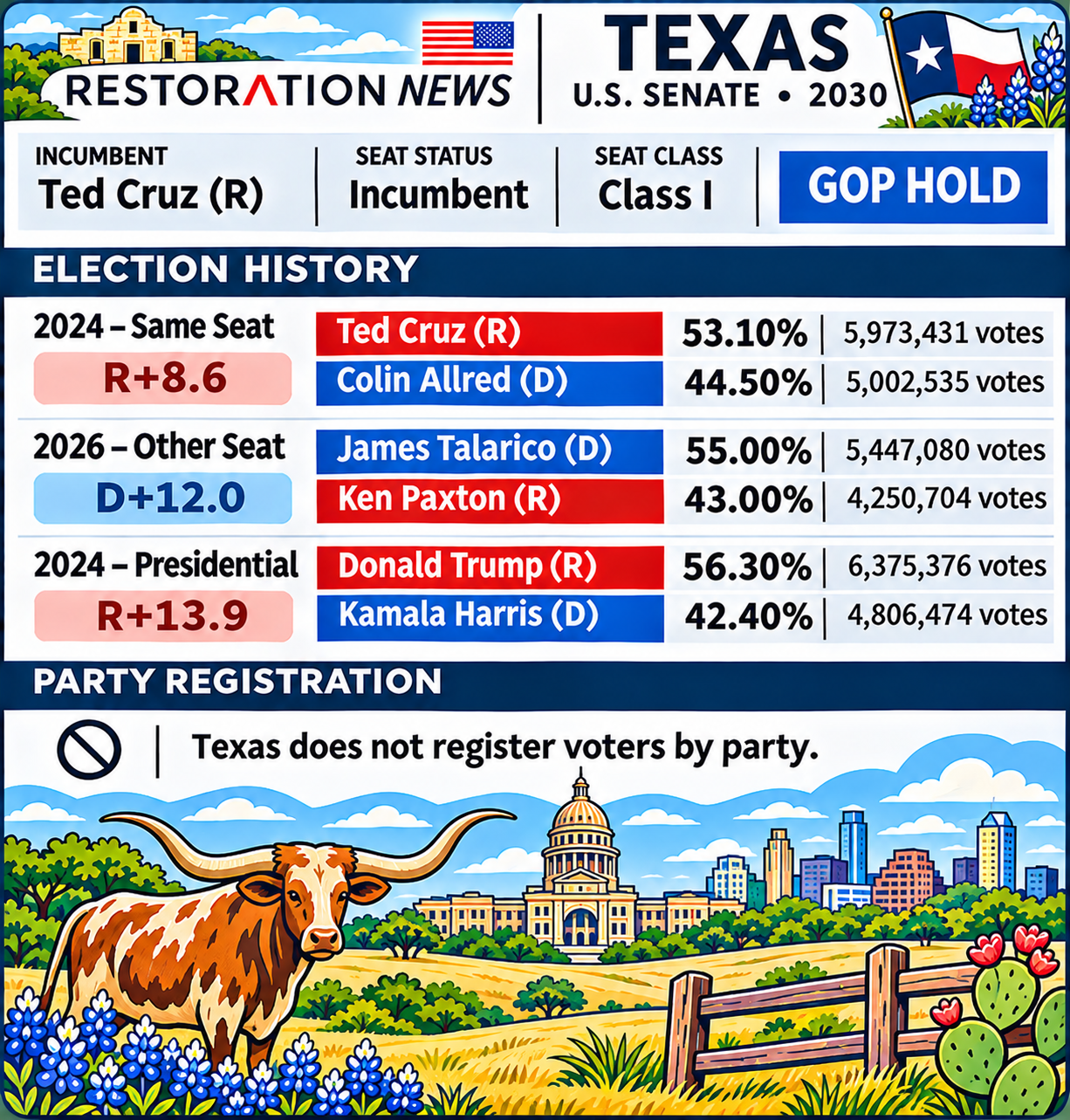
Brown, a Democrat, flipped Vice President JD Vance's old seat by close to five points in 2026, defeating Republican Sen. Jon Husted, who was appointed to the vacant seat in January 2025. Recall that Vance won his own 2022 Senate race by 6.6 points.
Brown himself previously held Ohio's other Senate seat, but was defeated by Republican Sen. Bernie Moreno in 2024—a Republican wave year in which Trump won Ohio by 11 points.
The clear takeaway: Ohio voters prefer Republicans, but they'll elect Democrats if the GOP fails to deliver on its promises of affordability.
Pennsylvania: Sen. John Fetterman (D)
Pennsylvania may be the most evenly divided battleground on the 2028 map. Fetterman, a Democrat, won by almost five percentage points in 2022, but Republican Sen. Dave McCormick edged out incumbent Sen. Bob Casey (D) in 2024 by just two-tenths of a point. Trump's victory was narrow.
The party registration figures are where the real battle is being fought. This deep-blue union stronghold has trended in Republicans' favor since 2016, when Democrats held a million-voter registration advantage. Today that advantage is less than 159,000 registered voters. That means Republicans must work harder to peel off independents and traditional Democrats to win the Keystone State—and fortunately, Trump and McCormick have proven it can be done.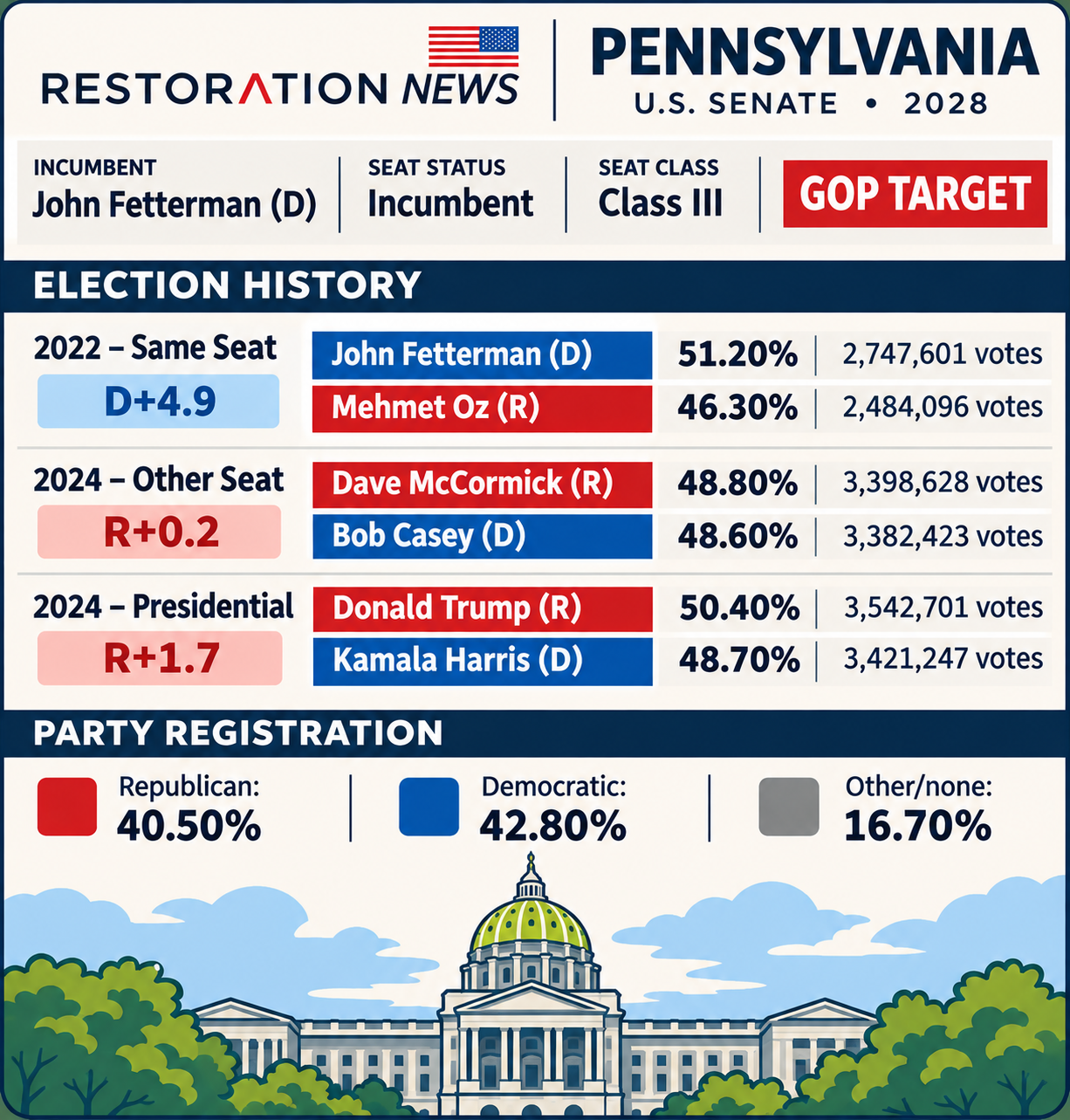
The 2028 Map: Seats to Keep
Republicans must also hold these four seats. Losing any one of them would be disastrous.
Wisconsin: Sen. Ron Johnson (R)
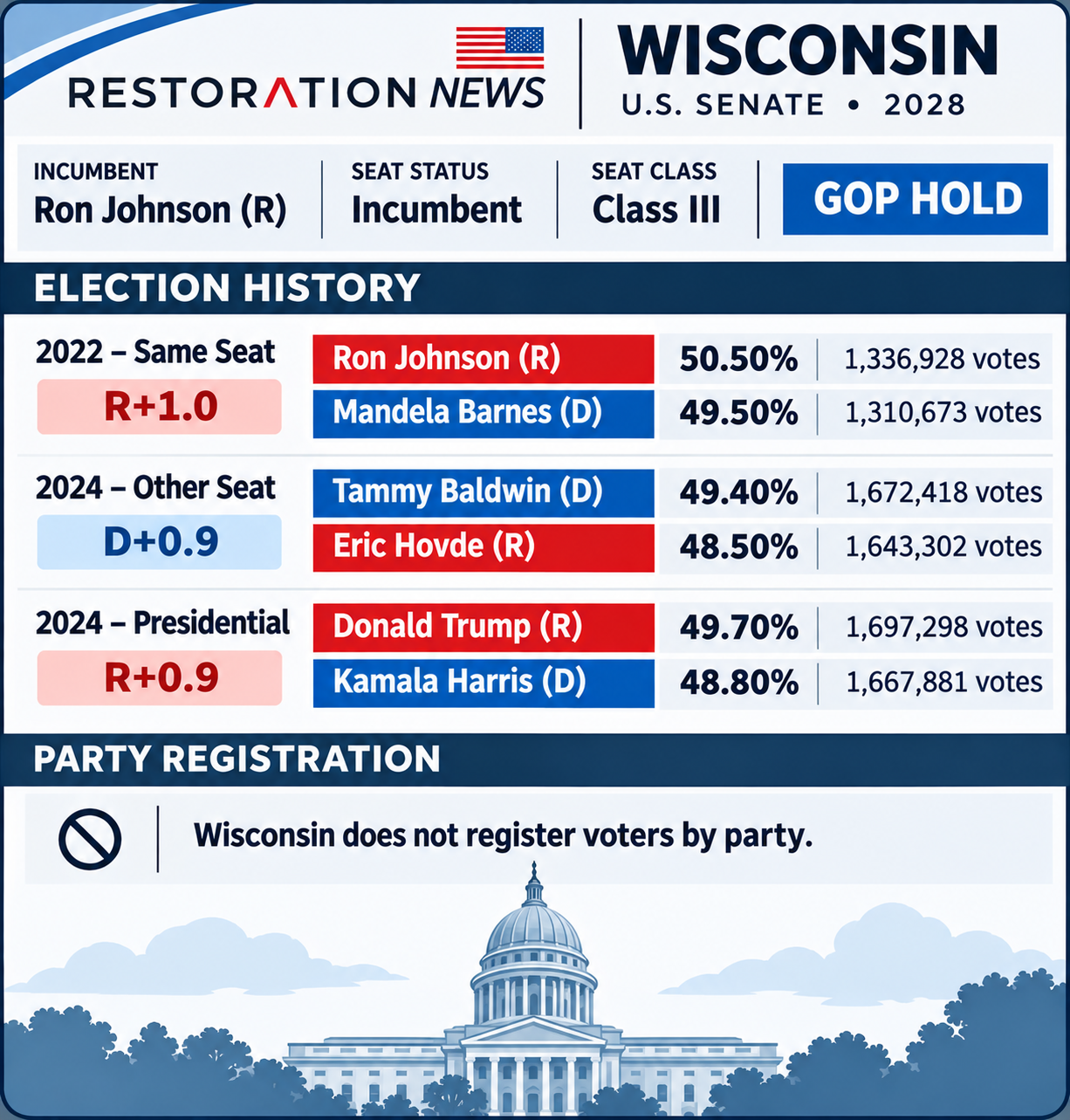
Of all the states on this map, Wisconsin may prove Republicans' stretch goal. Wisconsin was Trump's tightest battleground state in 2024—he won it by just 29,000 votes, or less than one percentage point. Johnson, as an incumbent Republican, won his second reelection bid in 2022 by a single point.
The GOP's consolation is that Wisconsin's other incumbent senator, Democrat Sen. Tammy Baldwin, held onto her seat in 2024 by nine-tenths of a point. But Democrats have performed strongly in statewide races and flipped both houses of the state legislature, granting the party their first trifecta in 16 years. That leaves Johnson as the last standing statewide Republican in the Badger State.
If Republicans are going to hold onto Johnson's seat, they'll need to muster all the resources and effective messaging to turn out early voters, win independents, and hope Democrats in Milwaukee and Madison stay home.
North Carolina: Sen. Ted Budd (R)
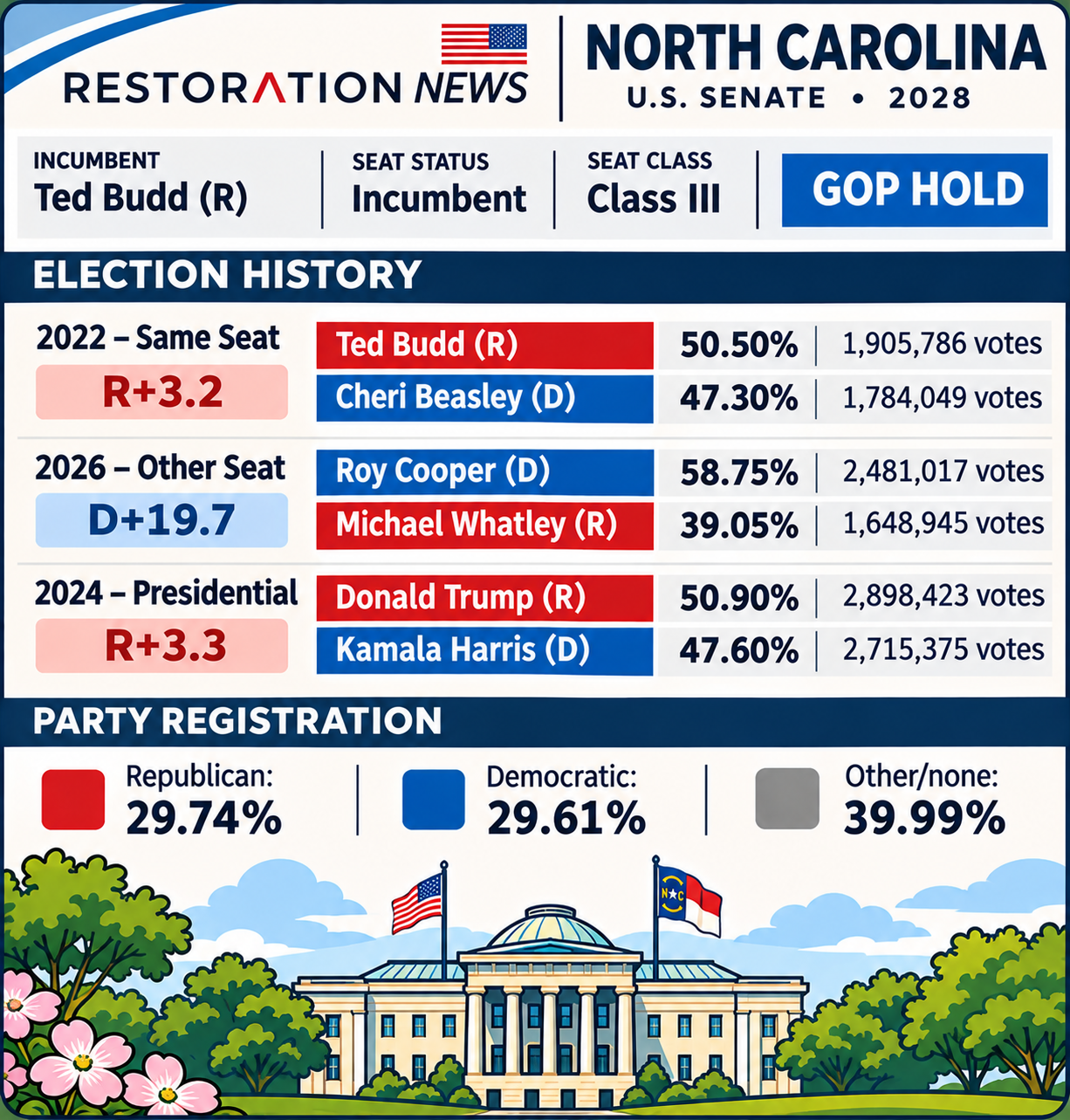
It's easy to forget that North Carolina was the sole battleground state that Trump carried in the deeply questionable 2020 election. Despite predictions that its strong tech sector and out-of-state immigration would flip North Carolina blue, the Tar Heel State has actually become more independent since Barack Obama left office. Today, Republicans are essentially tied with Democrats in party registration statistics. That's astounding considering Democrats boasted 43 percent of the registered electorate in 2013. The growth has largely come from self-identified independent voters who tend to vote Republican in presidential elections and in state legislative offices, but back Democrats in other statewide races.
Trump carried North Carolina by a comfortable 3.3 points in 2024. Two years later, former Gov. Roy Cooper (D) smashed his Republican opponent by nearly 20 points in the 2026 Senate race.
Budd (R), as an incumbent, will face strong Democrat resistance in 2028, but the GOP has a strong shot at retaining his seat if they don't take independent voters for granted.
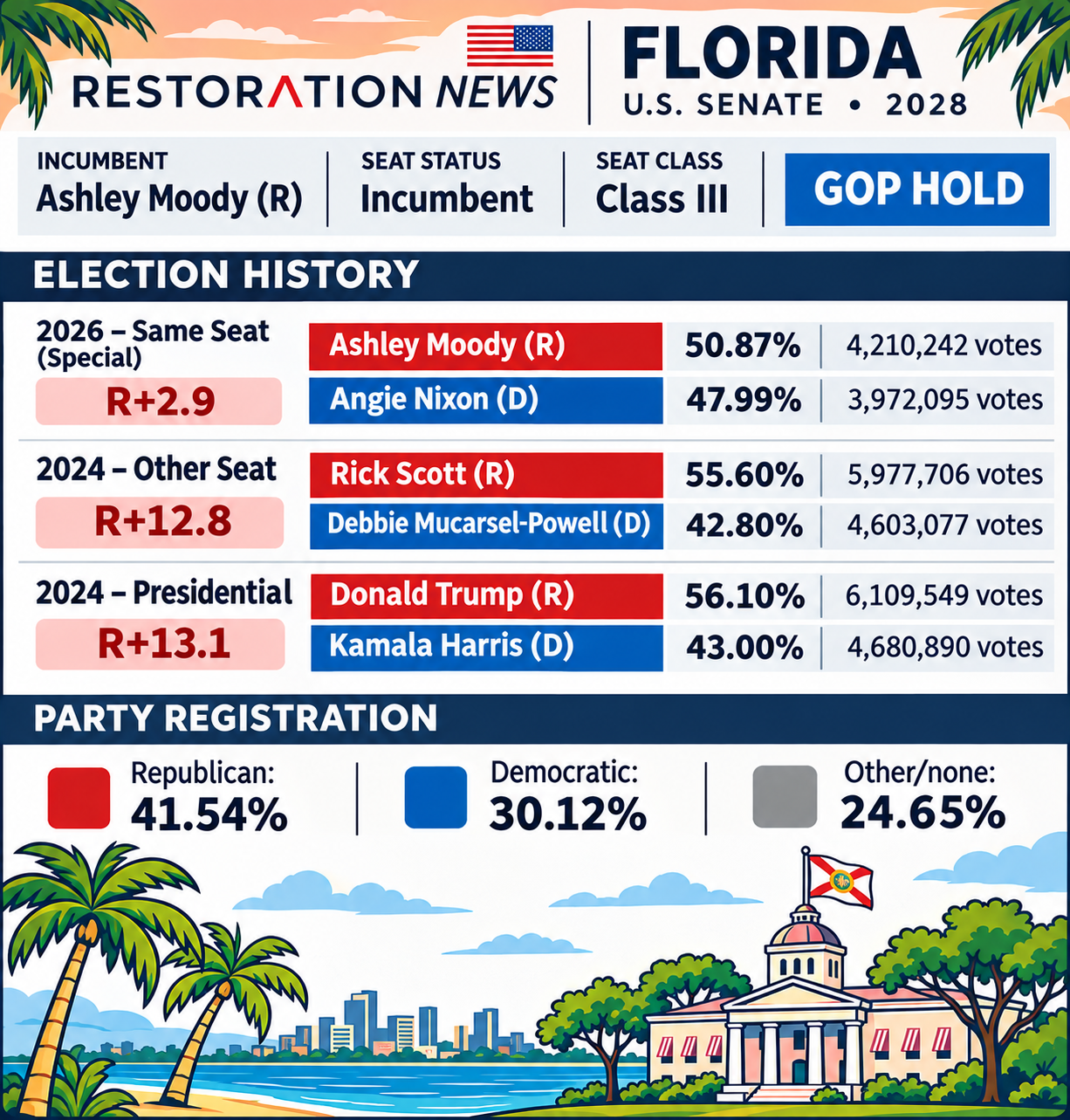
Florida: Senator-elect Ashley Moody (R)
Florida is officially the capital of the America First Republican Party, thanks to the efforts of its savvy outgoing governor, Ron DeSantis. When DeSantis was first elected governor by 79,000 votes in 2018—Trump's first wipeout midterm—registered Democrats outnumbered Republicans by more than 200,000 voters. Four years later, he smashed his Democrat challenger by 19.4 points—again, in a bad Republican year—and led the GOP to supermajorities in both houses of the legislature.
Registered Republicans today outnumber Democrats by more than 1.5 million voters.
That doesn't mean the GOP can coast easy in 2028. Moody (R) won her recent election by less than three points. But Governor-elect Byron Donalds faced an even tighter margin of victory in his race, winning by just over one point, or 106,000 votes.
That ought to be a grim lesson to the GOP: DeSantis built an impressive red wall, but the blue tsunami almost topped it.
Alaska: Sen. Lisa Murkowski (R)
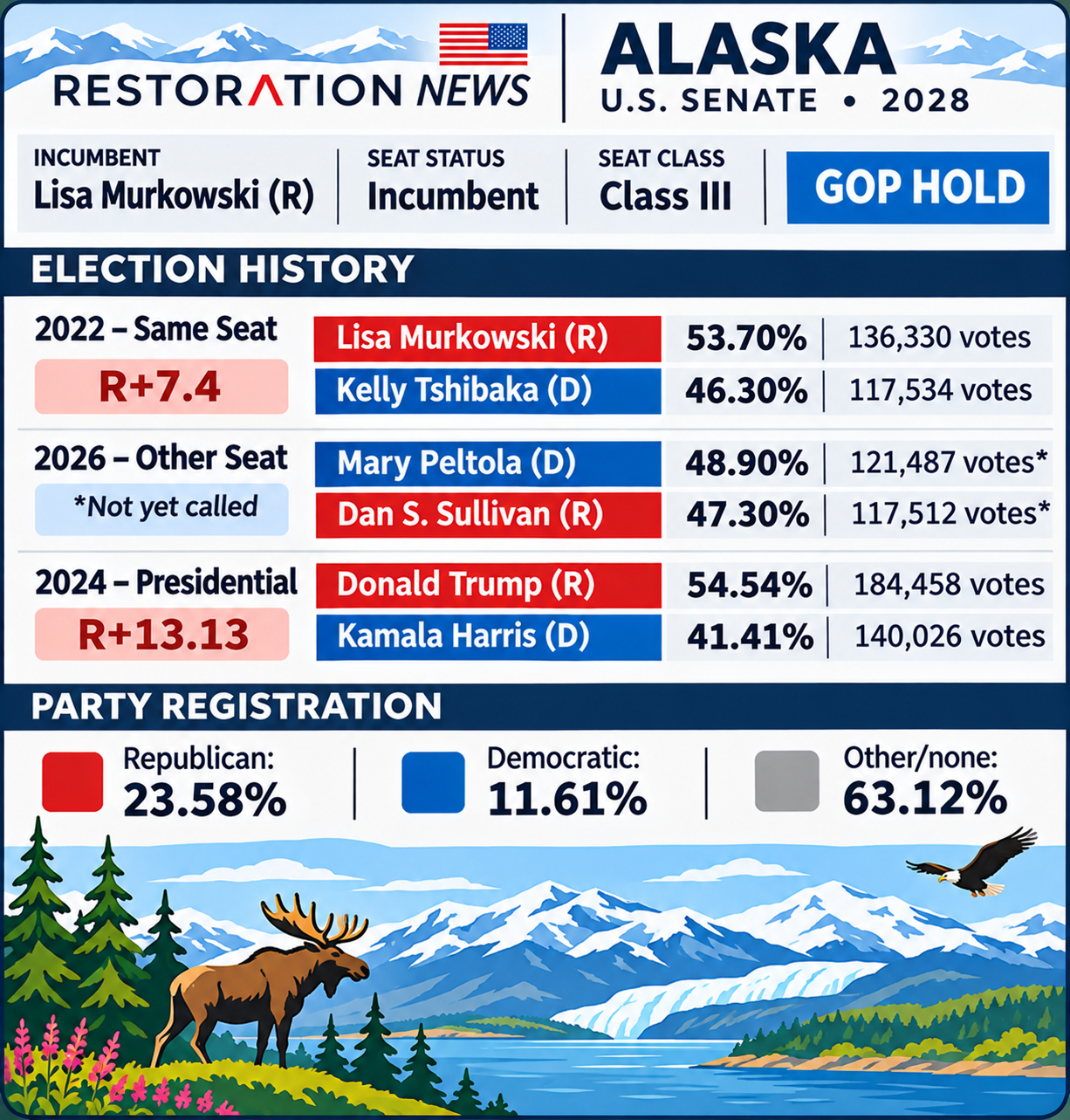
If Murkowski is the embarrassing girlfriend the GOP wishes it could forget (but can't), Alaska is the red state that can't remember it's supposed to be red. Blame ranked-choice voting and the out-of-state dark money that bought it.
Republicans outnumber registered Democrats two to one. The state's independents are far from woke. Yet Democrats keep finding ways to outplay and divide Republicans—as in the 2026 Senate race that elevated Democrat Rep. Mary Peltola to the U.S. Senate. Peltola defeated incumbent Republican Sen. Dan S. Sullivan by just 11,000 votes, while Republicans split 11,526 votes between GOP spoiler candidate Gerald L. Heikes, the "independent" spoiler Dan J. Sullivan, and worthless write-in candidates.
Will the Stupid Party learn its lessons to defend Murkowski's seat in 2028? God only knows, but there's a reason Communists adore ranked-choice voting.
The 2030 Map: Seats to Flip
Let's assume Republicans win all five competitive Senate seats and keep all four GOP-held seats listed above, reducing Democrats' majority to 51 seats. What opportunities does the 2030 midterm offer?
Democrats will be defending five highly competitive Senate seats, plus another two seats in Maine and Virginia that could become competitive if Republicans choose the right nominee and play their cards right. In contrast, Republicans will be defending five Senate seats in red or red-leaning states.
That gives the GOP a ceiling of 56 seats (but probably more like 52–53 seats).
Since some of these races take place in the same states as the 2028 races above, I've omitted redundant analysis in favor of the statistics.
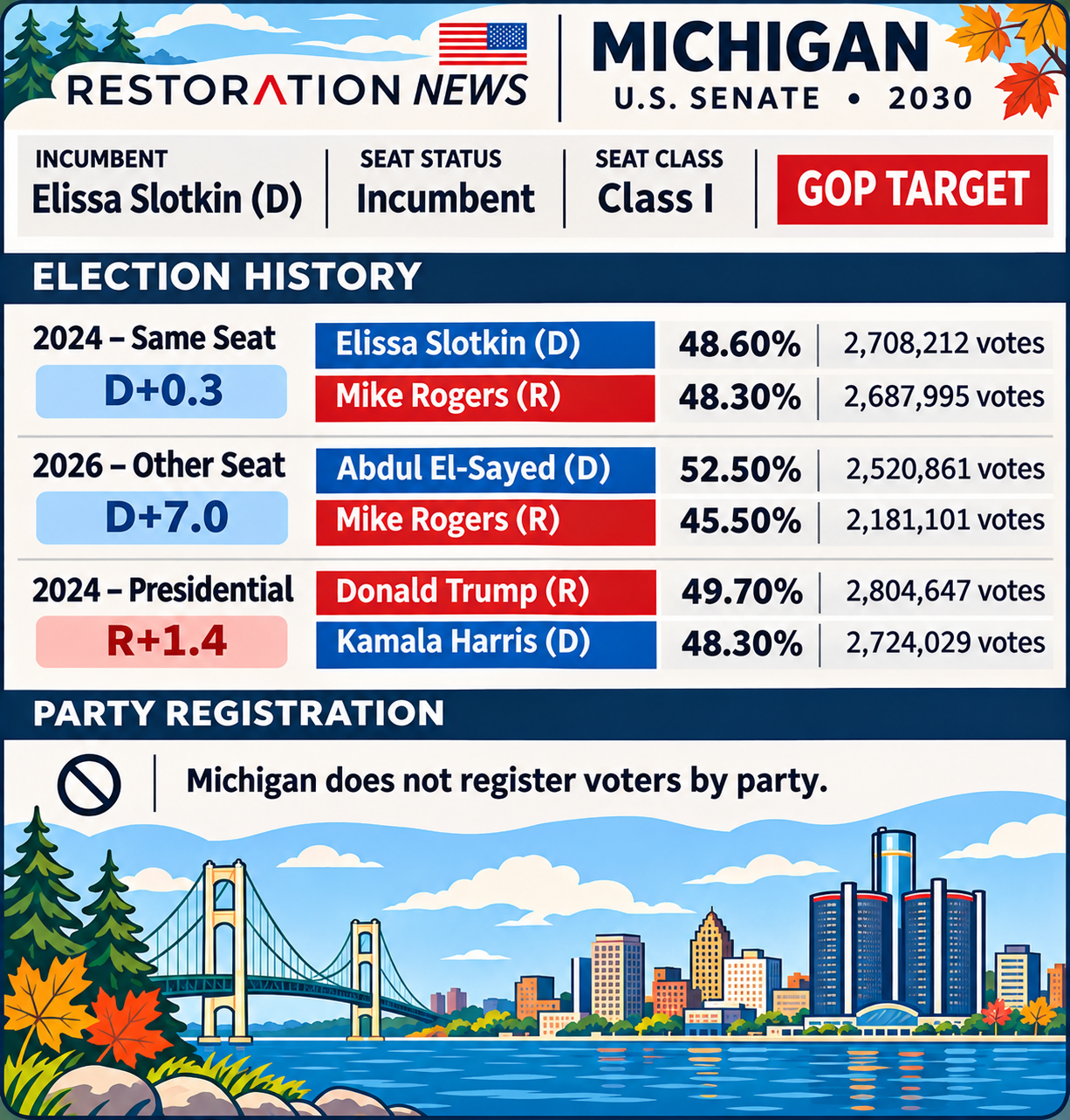
Michigan: Sen. Elissa Slotkin (D)
Michigan is the Rust Belt state that keeps slipping away. Slotkin won her 2024 race by just three-tenths of a point, while Trump held Michigan by a tight 1.4 points that same year. Then Democrats, in 2026, pushed through Abdul El-Sayed, their 24 supervillain, by an astonishing seven points. In short: this will be a tough battle for the GOP in 2030.
Wisconsin: Sen. Tammy Baldwin (D)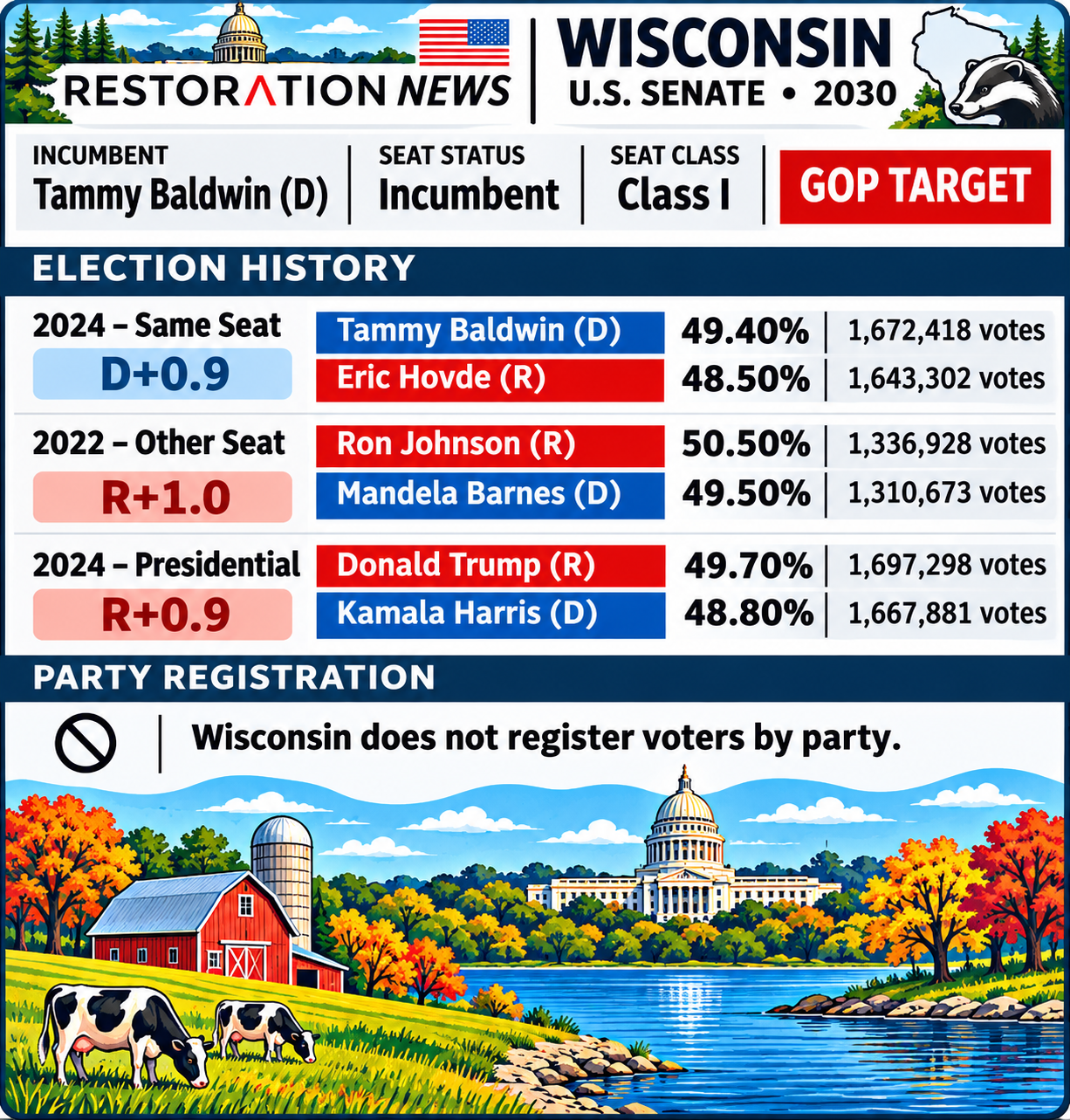
Nevada: Sen. Jacky Rosen (D)
Arizona: Sen. Ruben Gallego (D)
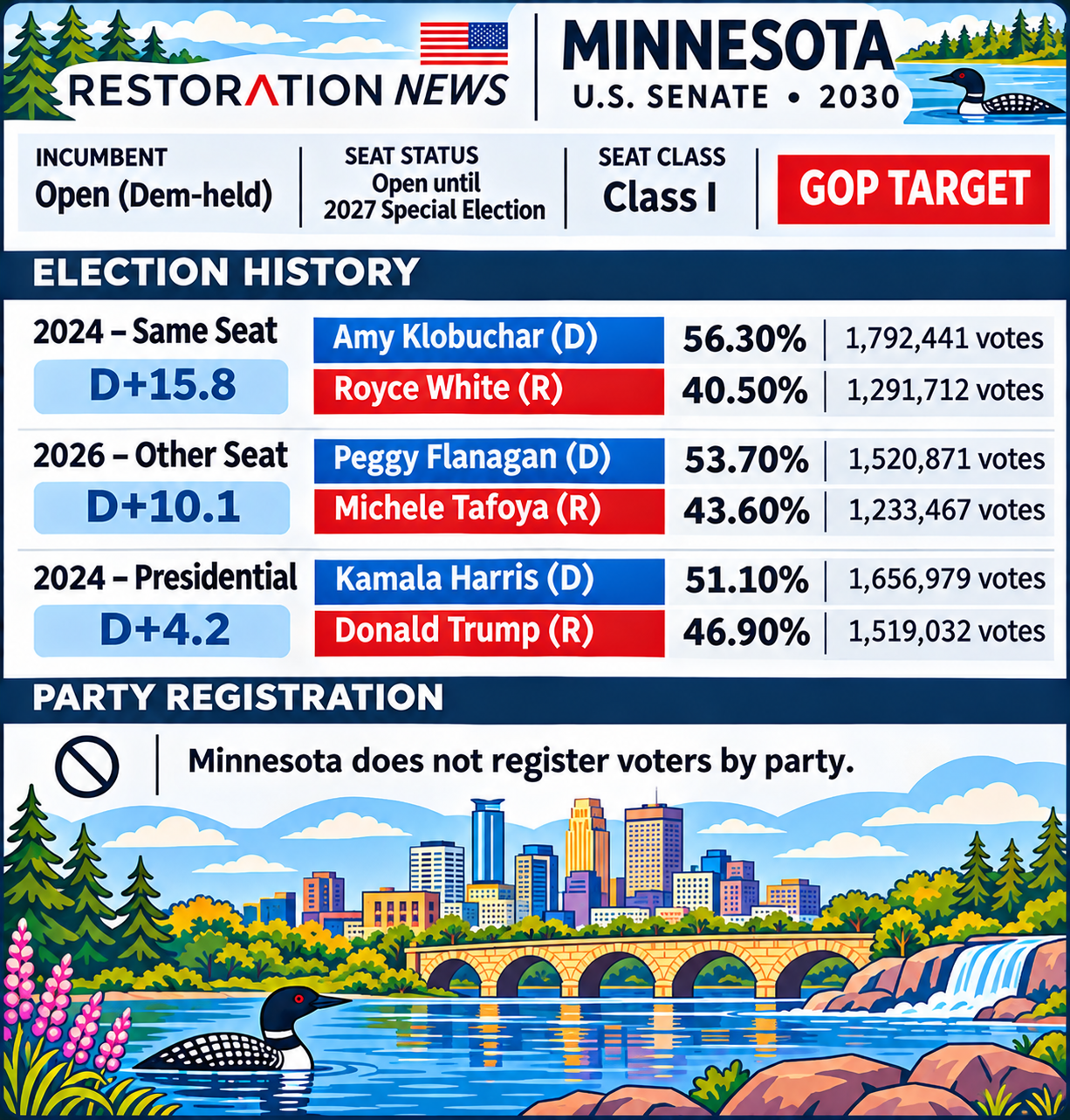
Minnesota: Open until 2027 (D)
Minnesota is the wild card on the 2030 map. Governor-elect Amy Klobuchar (D) won her reelection to the U.S. Senate by 16 points in 2024, a red wave year, and Lt. Gov. Peggy Flanagan won the state's other Senate race in 2026 by more than 10 points. Kamala Harris also carried Minnesota by 4.2 points.
But Klobuchar's departure for the governor's office means her Senate seat will be filled in a 2027 special election. Whoever wins that contest will have to defend the seat in 2030, giving Republicans their best shot at flipping the seat in 2030.
The 2030 Map: Seats to Hold
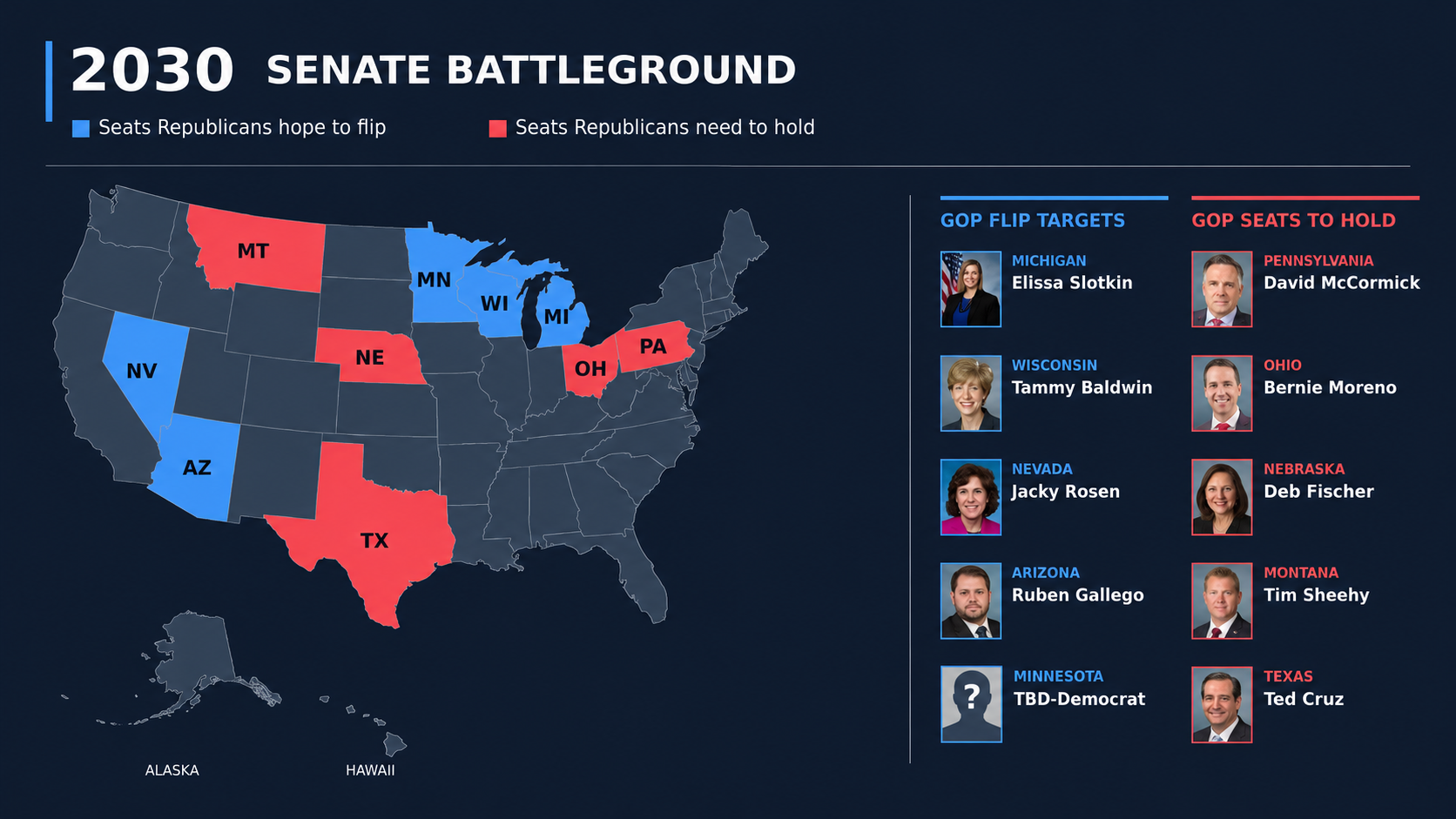
Republicans have six seats they must defend in 2030.
Pennsylvania: Sen. Dave McCormick (R)

Ohio: Sen. Bernie Moreno (R)
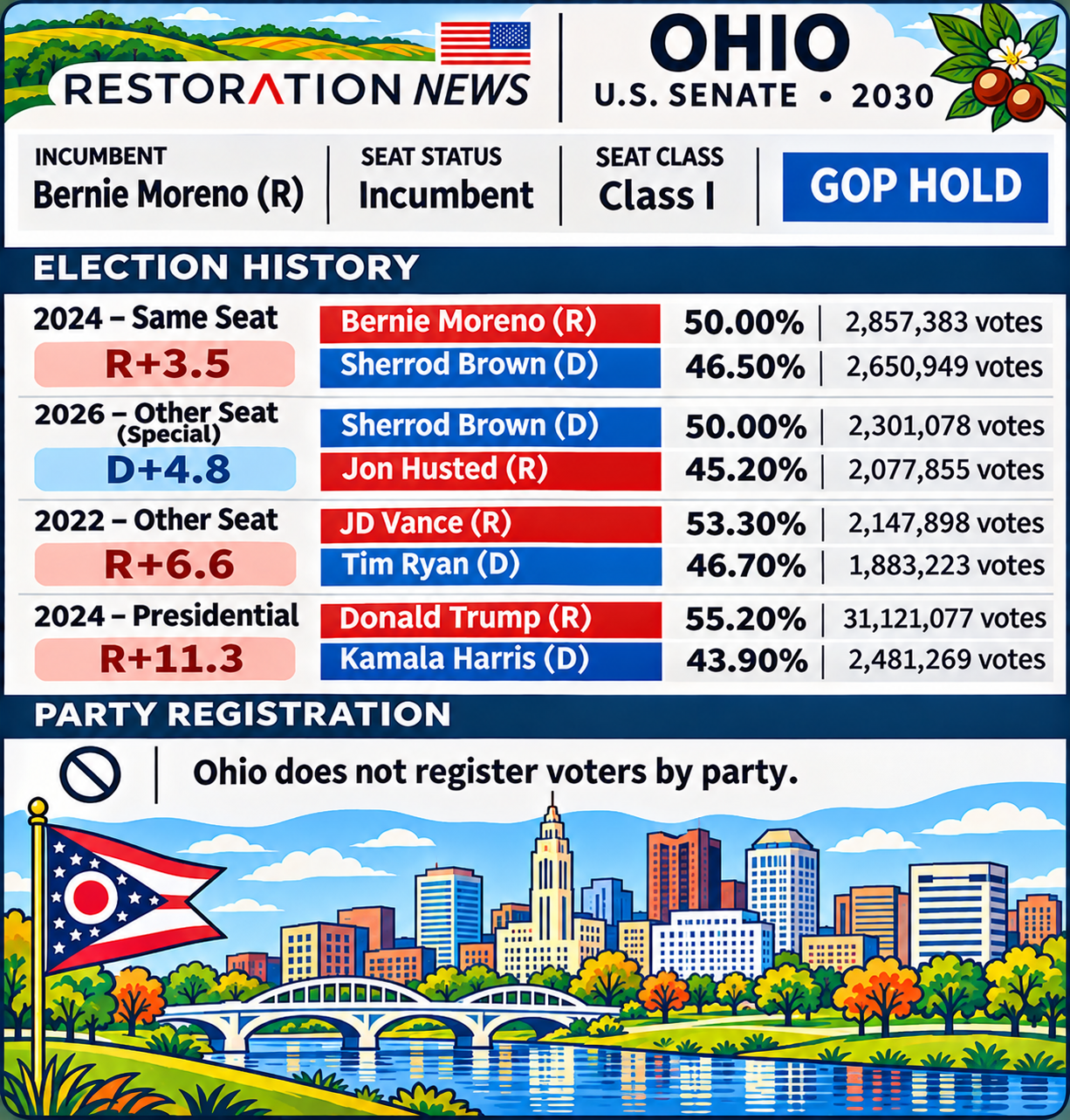
Nebraska: Sen. Deb Fischer (R)
Nebraska is a solidly red state. Trump carried it by 20 points in 2024, Republicans have a substantial registration advantage, and Democrats didn't even run as "Democrats" in the past two Senate races.
So why is Nebraska on this list? Because Democrats flipped safe GOP Senate seats in Iowa and Kansas in 2026. Let's not take any chances in 2030. We've included the 2024 results for both Republicans: Fischer and Sen. Pete Ricketts.
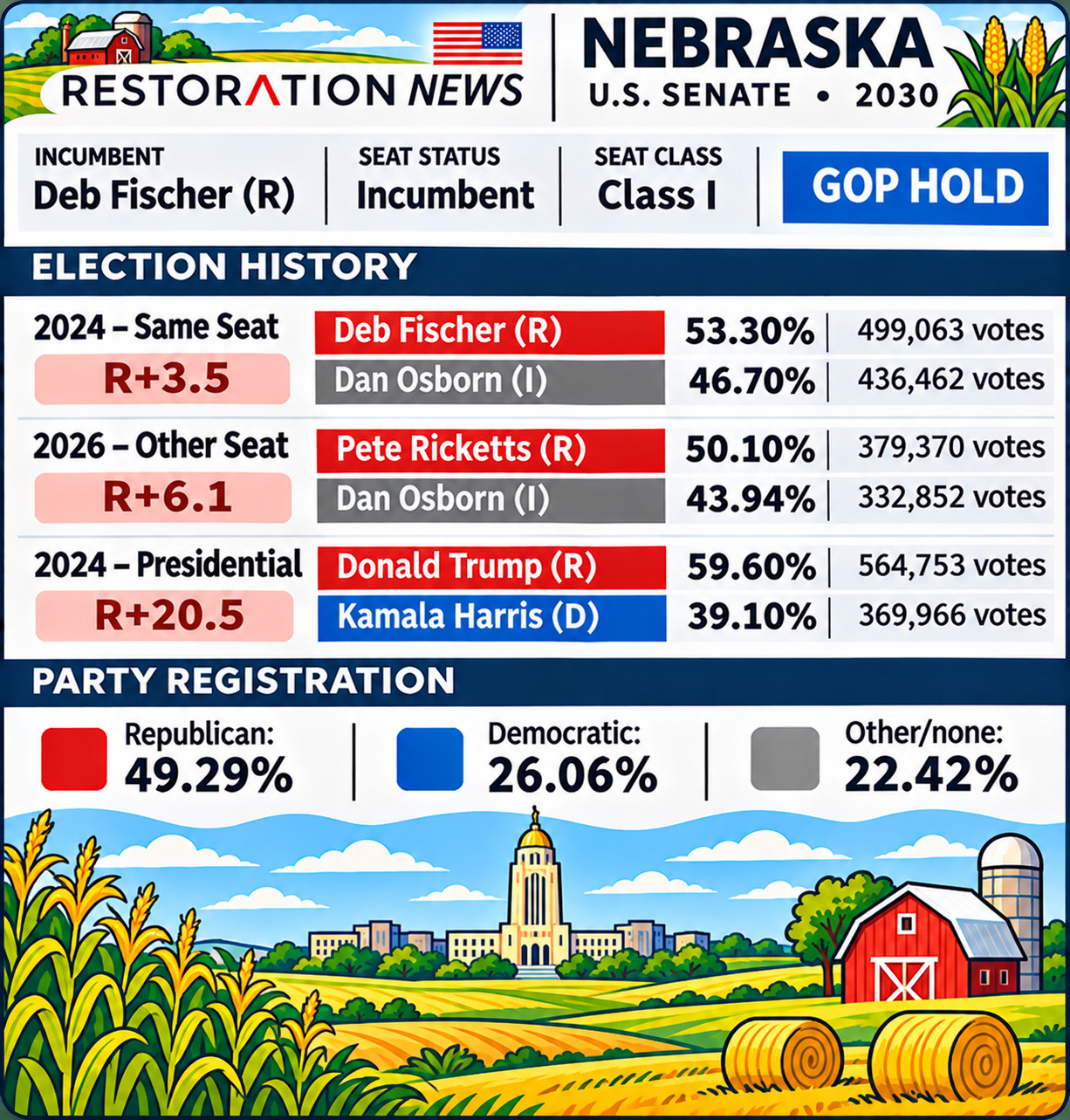
Montana: Sen. Tim Sheehy (R)
Sheehy, a Republican, successfully flipped Montana's longtime Democrat Senate seat in 2024. In 2026, Republican Sen. Steve Daines announced he would not seek reelection. Senator-elect Kurt Alme, a Republican, held Daines' seat with a plurality of the overall vote. Don't let that make you feel comfortable—between them, independent Seth Bodnar (a former Democrat) and Democrat Alani Bankhead netted 50 percent of the vote. Democrats only lost here because they split the vote—an advantage conservatives shouldn't count on in 2030.
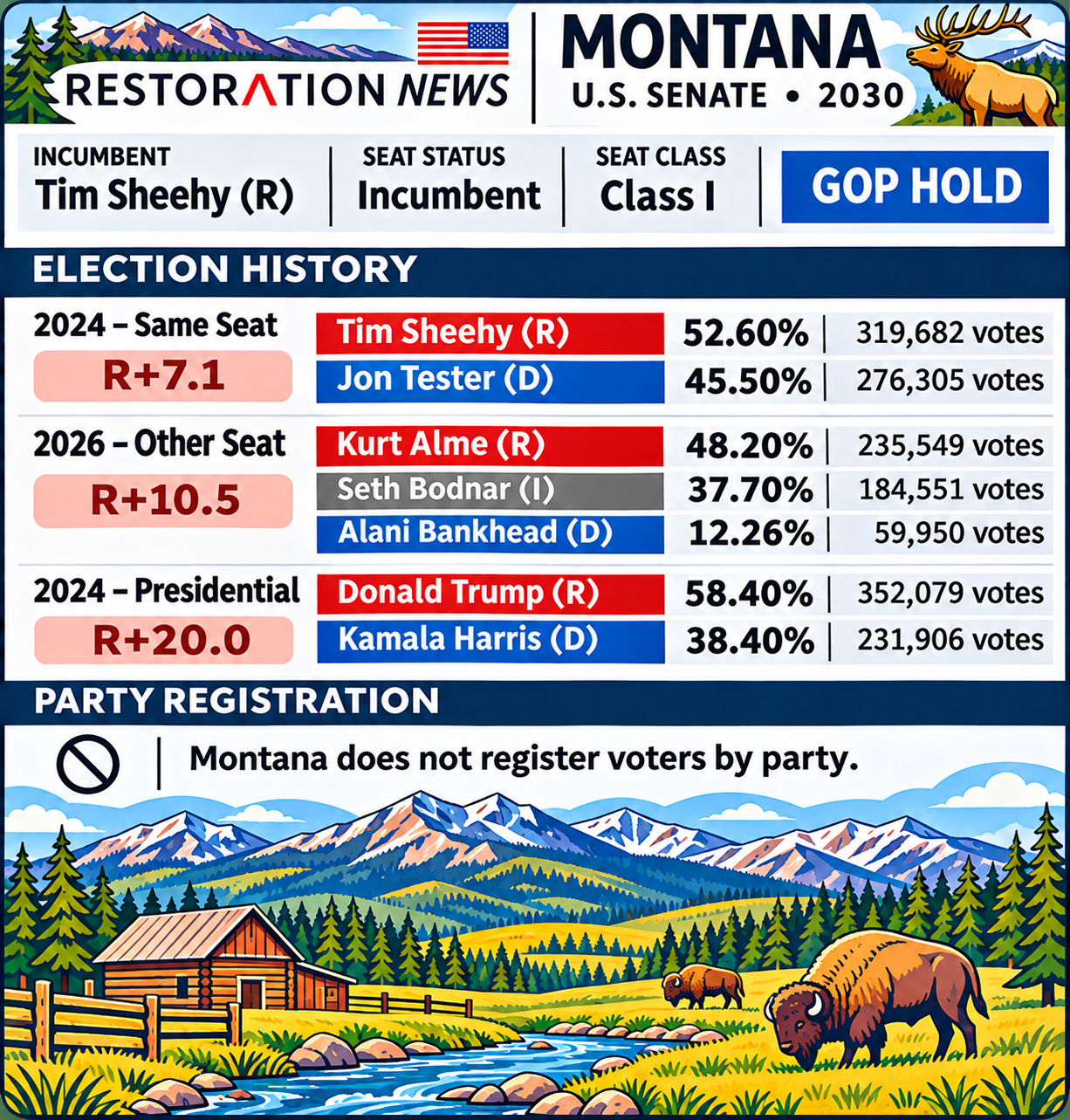
Texas: Sen. Ted Cruz (R)
Texas is the Left's white whale. Fresh off their surreal victory in 2026, Democrats believe they can oust Cruz and turn Texas into California. Cruz, a Republican who has held his seat since 2012, won his last reelection bid by close to nine points, but a lot can happen in the next four years and Republicans can't afford to take any chances.
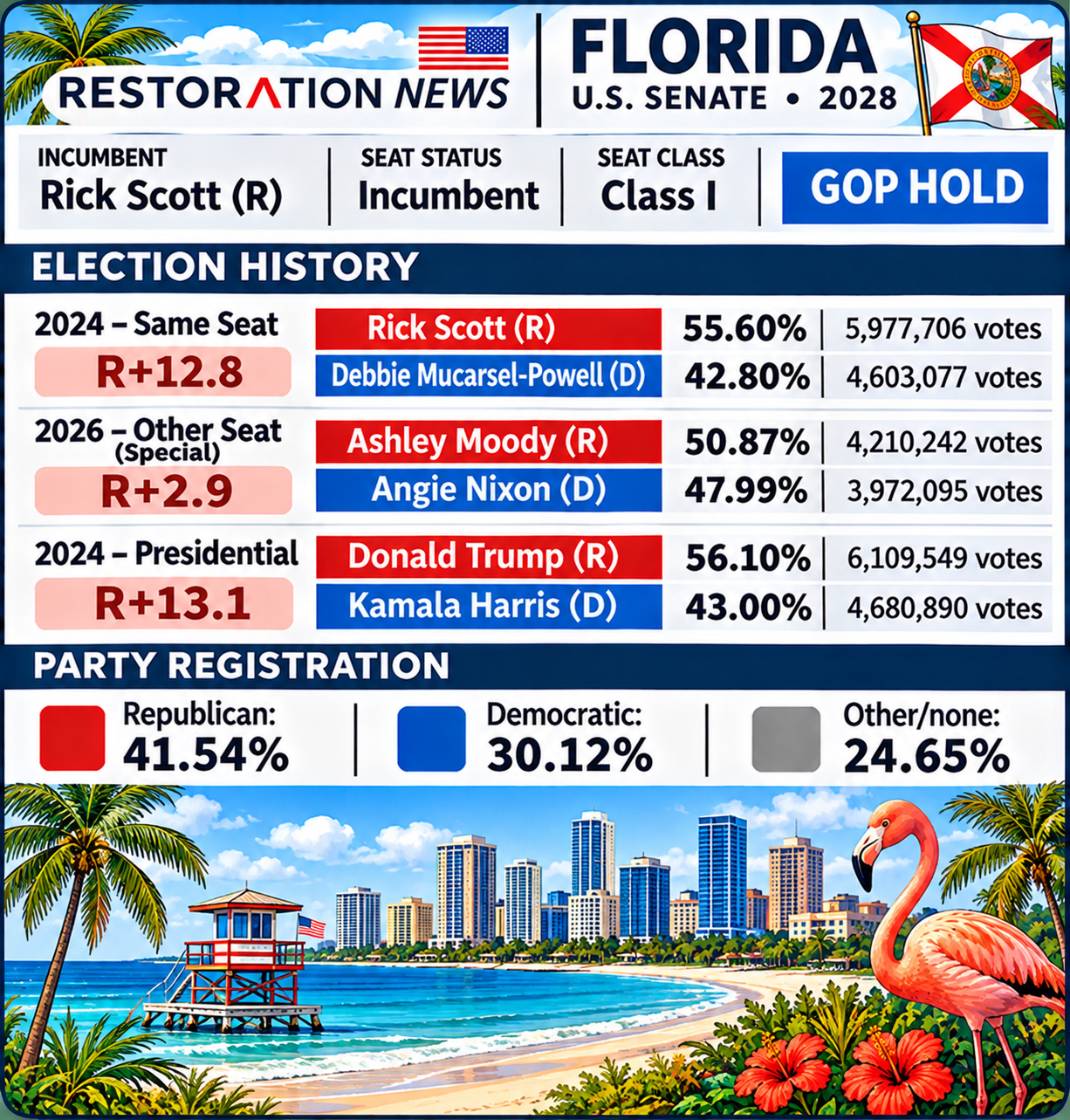
Florida: Sen. Rick Scott (R)
Restoring the Country Will Take Time
There's no denying the 2026 midterms were a major setback for the America First conservative movement, but they did not settle the Senate's future for the next decade. We need to use this time to weld the GOP's factions into a single, unified fighting force so we enter 2028 stronger than ever.
Believe it or not, the road to unity is shorter than you think. The entire conservative movement agrees on an economic agenda that protects families and regular people and reshores lost manufacturing jobs. We believe in closed borders and controlled immigration. We honor the Christian God and wish to limit abortion as much as possible, wherever possible. We're suspicious of Big Tech but want strong innovation and competitive markets. We oppose wars of choice.
That was the core of Trump's first election in 2016, and it remains the beating heart of the movement he launched. Ironically, it's what voters overwhelmingly voted for in 2026—an end to foreign wars so we can focus on restoring a high quality of life to everyone. Democrats aped America First language to win the midterms, but they're already moving on to impeachments, collective bargaining for government employees, and tax hikes—the things no one voted for.
Democrats are going to massively overplay their hand. But unless Republicans offer a genuine alternative—not warmed-over Bushism—they'll find a way to deceive America again in 2028.
MORE FROM HAYDEN LUDWIG:
Midterm Blues Got You Down? 2028 Is Bright If We Put America First.
Conservatives, Change the Narrative On 'Affordability' to Win. Here's How