Will the Supreme Court End Race-Based Gerrymandering?
In Louisiana v. Callais, the high court can restore a race-neutral Constitution and overturn four decades of judicial overreach.
Imagine, if you will, a world in which your congressional district is drawn according to the color of your neighbors' skin.
That’s the reality of today’s race-based redistricting practice—one that took off four decades ago thanks to a 1982 amendment to the Voting Rights Act (VRA). Cemented by the Supreme Court’s Thornburg v. Gingles (1986) interpretation of that amendment, this misguided approach treats the United States like a balkanized, racial federation rather than a real country with a single nationality.
In Louisiana v. Callais, the court has a chance to overturn Gingles and reverse this policy. This would force proof of discriminatory intent before courts could use race-based redistricting as a remedy to alleged past discrimination. It would not dismantle the 15th Amendment, or even the core components of the VRA. Instead, it would correct congressional and court overreach that’s led to unconstitutional, federally mandated racial stereotyping.
The Case Before the Supreme Court
Last year, Louisiana created a second black-majority district after lower courts found its original map likely violated the Voting Rights Act in Robinson v. Ardoin. The cases’ plaintiffs claimed the state’s proposed map was discriminatory because it provided just one black-majority district in a state with a population that is one-third black.
Faced with further redistricting litigation—which it had already spent $40 million on since 2012—and a possible court-imposed map jeopardizing key Republican incumbents, not least Speaker Mike Johnson (LA-04)—Louisiana crafted a new sixth district that snaked from Baton Rouge to Shreveport. This new district subordinated traditional redistricting principles like compactness and community to race.
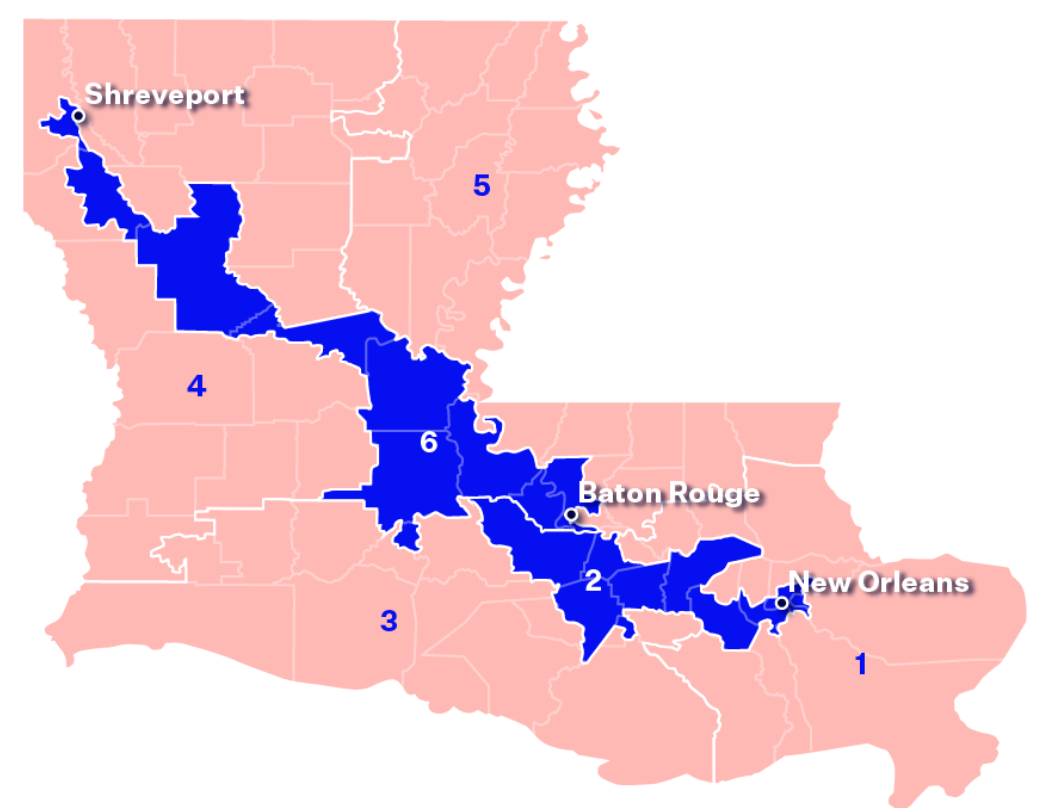 Louisiana's sixth congressional districts snakes through the state to capture enough black voters. Credit: Democracy Docket.
In Callais, non-black appellees are challenging the legality of the district on the 14th Amendment’s Equal Protection grounds.
In an exclusive interview with Restoration News, appellees’ attorney Edward Greim said, "I believe my clients are going to prevail,” noting how the state’s reliance on race violates the Court’s prohibition of race predominance in districting.
(RELATED: 36 Seats Could Be Up for Grabs in New Supreme Court Redistricting Case)
Why Do States Gerrymander by Race?
States rely on race in redistricting to avoid costly lawsuits—which, if they lose, will force them to rely on race in redistricting.
In City of Mobile v. Bolden (1980), plaintiffs challenged Mobile’s use of at-large city council seats on Section 2 grounds, arguing the practice denied black residents the right to elect their own (black) representatives because white residents could always outvote them. The Supreme Court sided with Mobile because plaintiffs could not show the city had intentionally discriminated.
This prompted Congress to go back to the drawing board.
In 1982, it amended Section 2 to allow plaintiffs to succeed based on discriminatory effects rather than intent.
To placate opponents, Congress tacked on the language: "Nothing in this section establishes a right to have members of a protected class elected in numbers equal to their proportion in the population.”
But this did little to prevent courts from implementing de facto proportional representation on a case-by-case basis. The Senate Judiciary Committee, in fact, made it easy for courts to do just that.
The committee's accompanying report suggested factors courts could consider when determining if the "totality of the circumstance of the local electoral process" had the result of denying a racial or language minority an equal opportunity to elect one of its own. Many of these factors were highly subjective like "the use of overt or subtle racial appeals in political campaigns."
In Gingles, the Court established a three-part test for discrimination claims. The minority group must:
- “demonstrate that it is sufficiently large and geographically compact to constitute a majority in a single-member district,”
- “show that it is politically cohesive,” and
- “demonstrate that the white majority votes sufficiently as a bloc to enable it . . . usually to defeat the minority's preferred candidate.”
To avoid court challenges, southern states rushed to racially gerrymander where possible. After Gingles, the number of majority-minority districts tripled.
But this launched a new wave of map challenges from white voters who argued that overly race-conscious map-drawing violated their rights under the Equal Protection Clause.
In Shaw v. Reno (1993), the court addressed a bizarrely shaped majority-black district in North Carolina. The case established that race-based districting, while permissible under the VRA, could be unconstitutional if it unjustifiably subordinated traditional principles like compactness or contiguity.
In Bush v. Vera (1996), Justice Sandra Day O'Connor wrote, "Significant deviations from traditional districting principles, such as the bizarre shape and noncompactness . . . cause constitutional harm insofar as they convey the message that political identity is, or should be, predominantly racial."
This caught states between a rock and a hard place. They needed to create majority-minority districts to avoid Section 2 lawsuits—while ensuring race did not dominate the process.
Despite the '90s cases applying brakes to racial considerations in redistricting, Gingles still gives leftist judges free rein to redraw electoral divisions that maximize majority-minority representation.
In 2021, for instance, Virginia Beach Judge Raymond Jackson violated the city's charter and appointed a "special master" to redistrict all 10 at-large city council and school board seats on similar grounds that black voters challenged Mobile's elections in 1980. The leftist "dark money" group Campaign Legal Center bankrolled the lawsuit that led to Virginia Beach's forced redistricting, and both the "special master" and his research assistant were proven partisan hacks for the Democratic Party.
In Callais, NAACP Legal Defense Fund president Janai Nelson, who represented the Robinson case plaintiffs, said the constitutional boundaries of maps that federal district courts can order "are between Gingles and Shaw."
Justice Neil Gorsuch compared the endless redistricting questions arising from this conundrum with constantly trying to outrun a bear.
(RELATED: EXCLUSIVE: Virginia Beach Voting Lawsuit Tainted by Dark Money, Undisclosed Partisan Ties)
Here's How the Supreme Court Can Fix This Mess
In his opening Callais statement, Greim told the Supreme Court, "The appellees should prevail here regardless of the grounds on which the Court chooses to rely," because if it was ever constitutionally acceptable to racially stereotype voters, "it was never intended to continue indefinitely."
Although the conservative justices seemed favorable to this argument, there are a few different ways they could decide in the appellees' favor.
They could rule that ordering Louisiana to carve a second black-majority district does not meet the Gingles test; they could overturn Gingles, which would return Section 2 to its pre-1982 intent-based interpretation; or they could simply throw out Section 2 entirely.
 Edward D. Greim. Credit: Federalist Society
Greim told Restoration News the Supreme Court will likely not return to a former version of Section 2 but will instead interpret vote dilution based directly on the 14th and 15th Amendments—as it would if the VRA didn't exist.
Despite leftists' pearl clutching, this would not be "catastrophic" as Nelson put it, nor would it "cease to . . . prevent vote dilution" as Justice Elena Kagan claimed.
Greim stressed the courts don't need Section 2 to remedy minority vote dilution. The Constitution itself provides enough ammunition to prevent blatant schemes to pack or crack minority-majority regions, using race as the predominant factor.
Liberal critics argue Greim is using the same rebuffed arguments from Allen v. Milligan (2023), when Chief Justice John Roberts and Justice Brett Kavanaugh joined the liberal justices to force Alabama to create a second black majority district.
Greim said Callais is different, however, partly because Alabama didn't make the temporal argument—that race-based remedies expire after a period when racial discrimination becomes less common.
In his concurring opinion in Milligan, Justice Brett Kavanaugh acknowledged the temporal aspect Justice Clarence Thomas raised in his dissent but declined to consider it because Alabama didn't bother to raise it.
In her Callais arguments, Nelson made the same claim leftists incessantly insist on: That the temporal aspect doesn't apply to Section 2 because—unlike the VRA's Section 5—it has no expiration date.
Greim rejects this line of reasoning. He believes applying the temporal argument to Section 2 is actually easier than applying it to Section 5 because the latter allowed Congress to extend it. This kept it on life support before the Supreme Court effectively put it out of its misery in Shelby County v. Holder (2013).
Kavanaugh told Nelson the court doesn't require a legislative expiration date on race-based remedies to past discrimination because "the court's cases in a variety of contexts have said that race-based remedies are permissible for a period of time . . . but that they should not be indefinite and should have an end point."
Nelson conceded that race-based redistricting as a remedy to Section 2 violations have some de facto time limit, adding, "When racialized politics and residential segregation wane, so will the ability to satisfy Gingles."
But what if racialized politics and residential segregation never wane? By Nelson's logic, courts should then mandate race-based redistricting indefinitely, which itself exacerbates racial divisions, making it unlikely either will wane.
A Race-Neutral Republic, Not a Multiracial Democracy
The NAACP and its leftist allies misunderstand the 15th Amendment—whether by confusion or wishful thinking. They argue that any change to Section 2 of the Voting Rights Act would weaken our "multi-racial democracy." But that premise itself is wrong. A "multi-racial democracy" implies a system where political power is divided proportionally by race—something more akin to the United Nations.
The 15th Amendment guarantees ballot access against racial discrimination. It does not guarantee racial block voting.
That distinction is central to this debate.
"In the Robinson case, the NAACP's experts claimed that partisanship flows from race," Greim told Restoration News. "They said we are fundamentally divided by race and always will be, and, therefore, we should entrench these divisions."
This is the exact opposite of O'Connor's opinion in Bush v. Vera.
The Gingles precedent unfortunately lends credence to the NAACP's position—that racial minorities must have segregated districts to have a voice where partisan division happens to follow racial lines.
That assumption isn't just patronizing; it's unconstitutional when it overrides neutral principles like compactness or shared community ties.
The justices agree that political gerrymandering is permissible. Partisan advantage does not suddenly become impermissible because party preference happens to fall along racial lines. As Justice Samuel Alito noted, Callais differs from Milligan precisely because Alabama never made a partisan-advantage argument.
Deputy Solicitor General Hashim Mooppan, representing the Department of Justice as amicus curiae, drove this point home, noting that white Democrats in West Virginia don't get a "Democrat-only" district for themselves. Should they be considered victims of discrimination simply because their state sends only Republicans to Congress? By the same logic, Louisiana Democrats don't deserve an extra seat just because many of their Democrat voters are black.
Gingles is a clear judicial error, and those who believe in a race-neutral Constitution should hope to see it corrected.
Ending Racial Gerrymandering Could Lead to a Permanent MAGA Majority
The VRA's Section 2 and the Gingles interpretation have given Democrats an unjust advantage in the House. For instance, there are around 144 majority-minority districts nationwide, and Republicans control only 23 of them.
If the Court fixes this in Callais, it could open as many as 36 Democrat-held seats to Republican redistricting. This would force Democrats to compete fairly, which would all but guarantee a permanent Republican majority.
That's why the Left cares so much about this case.
Nelson made a big deal of the idea that breaking up black-majority districts would turn the clock back on voting rights and prevent black candidates from getting elected. But leftists are overblowing this concern.
Greim told Restoration News that he doubts Republican legislatures will rush to break up existing black-majority districts that exist in naturally compact areas. He noted that in Louisiana, for instance, it wouldn't make political sense to split up the black-majority district in New Orleans because it would potentially jeopardize two Republican districts.
Even if they did take that gamble, Mooppan noted, there are roughly 60 black congressmen in the House of Representatives, yet only 15 of them are from majority black districts.
If the Supreme Court overturns the outdated Gingles standard, which forces race-based districting, it will mark a pivotal shift toward a race-neutral approach that aligns with the spirit and letter of the Constitution.
Politically, it will curb frivolous redistricting lawsuits by Democrats and dismantle the framework that has compelled Republican legislatures to craft guaranteed Democrat districts. This will forever reshape the political landscape by removing the built-in advantages Gingles has gifted Democrats for at least two generations.
Although left-wing critics argue that eliminating minority bloc voting would undermine minority representation, the Constitution does not guarantee minorities proportional representation. Additionally, the evidence suggests it would not prevent minority candidates from winning elections. Instead, such a ruling would foster competitive elections, encourage broader voter coalitions, and ensure that political power derives from ideas and policies rather than racial divisions.
If the justices follow the Constitution, Callais will prove seminal in paving the way for a more unified republic.
(READ MORE: The Emerging Permanent MAGA Majority)
Help us finish the fight—chip in today
Restoration News, a project of Restoration of America, is your trusted investigative news source for the America First movement. As a rapidly growing conservative news site, we focus on delivering accurate and insightful exposés on political news, immigration news, leftist lies, and other pressing issues affecting everyday Americans. Our uncompromising commitment to a hard-hitting, fact-based, America First, and faithful perspective ensures that you receive news that aligns with your values.
Every dollar gets us closer to winning the war on woke