
Why the Second Amendment Exists—and Why Gen Z Needs to Understand It
If Gen Z does not understand the true meaning of self-defense as the Founding Fathers meant it, we will never be able to correct the course.
The Second Amendment is not a concept stuck in the 18th century. It’s the timeless conviction that humans have the right to self-defense. The Founders, who had just shaken off British tyranny, had no doubts that firearms were the best method for a self-governing republic to ward off those who would break the Constitution and usurp power.
Today, however, many in Generation Z have forgotten the true purpose of the Second Amendment. Polling from 2023 shows 55 percent of Gen Z and Millennial voters want stricter gun laws. That includes nearly 70 percent of young Democrats and a shocking 40 percent of young Republicans.
As Americans watch authoritarianism grow both at home and abroad, it’s more important than ever that the next generation understands the true purpose of the Second Amendment.
Referencing the Original Texts
The Second Amendment captured the timeless principle that God ordained man to defend himself and his family. That was obviously important to the Founding Fathers in the years immediately following the American Revolution, but they meant the right to stand for all time. Their own words reveal how the Second Amendment should always work.
At the Virginia Ratifying Convention in 1788, George Mason made the Founders’ understanding unmistakably clear: “I ask, sir, what is the militia? It is the whole people, except for a few public officers.” He went on: “To disarm the people—that was the best and most effectual way to enslave them.”
He was stating a reality of the day: the militia was not a state-controlled or federally controlled body, but simply every armed citizen. That body of armed men represented the American people’s ability to topple a government that had slipped into tyranny. It was not only a safeguard, but their responsibility to do so. Even Alexander Hamilton, who disagreed with many Founding Fathers over his belief that the militia should be federally regulated, acknowledged in Federalist No. 29 that the militia ultimately rested on the armed populace.
This belief emerged directly from the Founders’ distrust of centralized power. They had seen how European monarchies maintained control through fear and violence. The American constitutional system was intentionally designed to avoid that arrangement. James Madison demonstrated this in Federalist No. 46, when he contrasted the United States with Europe and observed that Americans possessed “the advantage of being armed, which the Americans possess over the people of almost every other nation.”
Most of our Founding Fathers understood the importance of citizen gun ownership in deterring and preventing tyrannical governments. Patrick Henry warned during the Virginia debates that “the great object is that every man be armed . . . . Everyone who is able may have a gun.” Likewise, Tench Coxe explained in 1789—a year after the Virginia Ratifying Conventions—that under the Constitution, “the people are confirmed by the next article in their right to keep and bear their private arms.”
The language is critical. The right to self-defense with firearms was not granted by the government, only confirmed by it.
This language shows how founding-era political theorists understood that citizens become subjects when they are disarmed. After all, they had just finished living through that tragedy themselves.
Many early legal scholars carried the same interpretations as our Founding Fathers. St. George Tucker, writing in his annotated edition of Blackstone’s Commentaries, described the right to bear arms as “the true palladium [safeguard] of liberty.” Tucker further warned that the continual precursor for broad oppression is always a government’s intent to infringe on the right to bear arms.
Judicial Drift Over the Last 250 Years
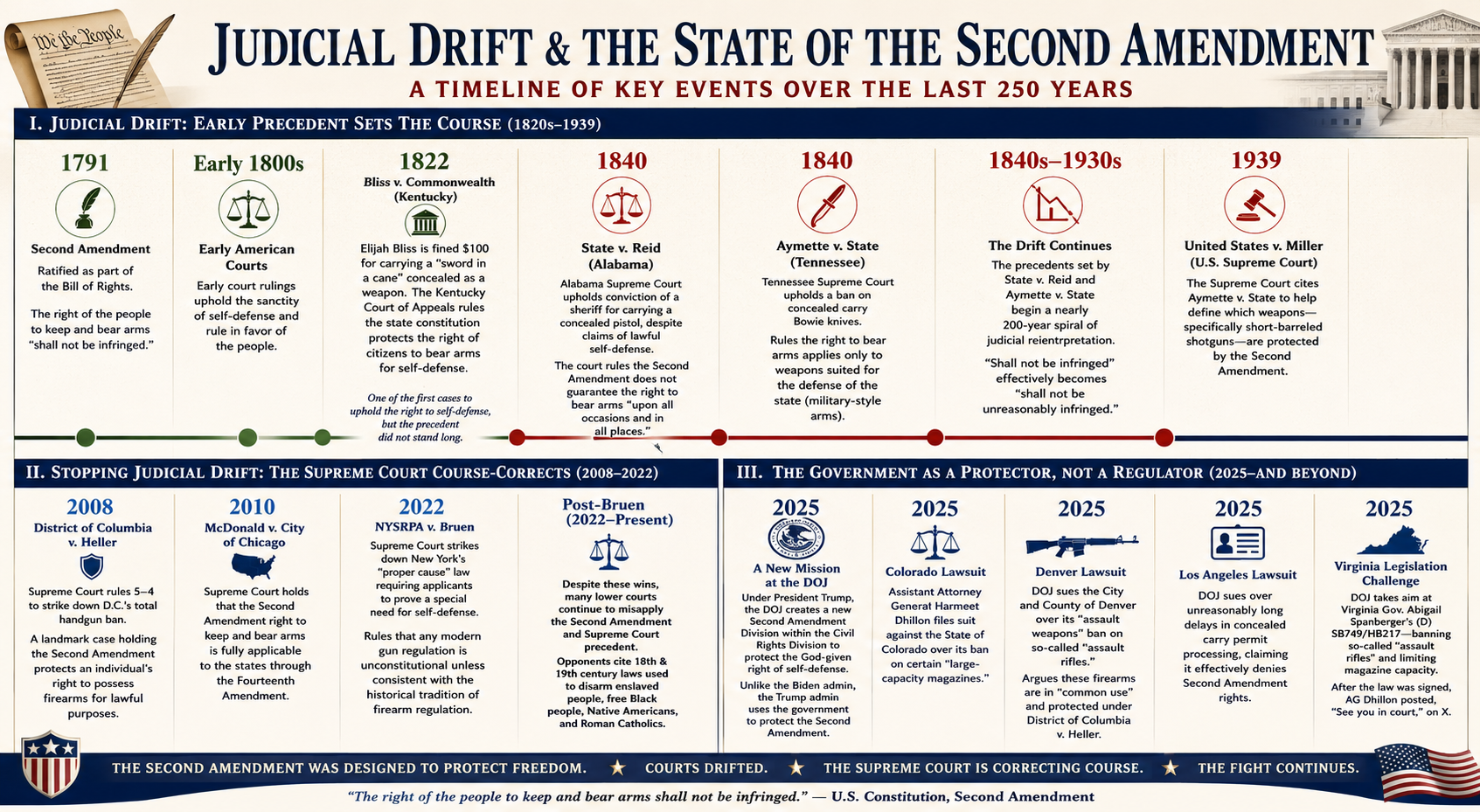
As the years passed, lower courts reinterpreted the Second Amendment, turning “shall not be infringed” into “shall not be unreasonably infringed.”
It didn’t happen overnight.
Early American courts understood the sanctity of self-defense and passed rulings in favor of the people. In 1822, the Kentucky Court of Appeals ruled in favor of Elijah Bliss in Bliss v. Commonwealth. Bliss was fined $100 for carrying a “sword in a cane” concealed as a weapon. Prosecutors argued Bliss violated an 1819 Kentucky statute that banned the carrying of concealed weapons. The court ruled that the state constitution protected the right of citizens to bear arms for self-defense.
Bliss stands as one of the first court cases to uphold the right to self-defense, but the precedent did not stand long. Over the next few years, judicial interpretations would begin to water down the Second Amendment.
In 1840, the Alabama Supreme Court established broad power to regulate the Second Amendment in State v. Reid. The case involved an Alabama sheriff who was prosecuted for carrying a concealed pistol. The court upheld the conviction, despite the sheriff’s documented claims that he was carrying the weapon for lawful self-defense. The court argued that the Second Amendment did not guarantee the right to bear arms “upon all occasions and in all places.”
In the same year, the Tennessee Supreme Court upheld a ban on carrying concealed Bowie knives in Aymette v. State. The court ruled that the constitutional right to bear arms applied to weapons suited for the defense of the state (read: military-style arms). This ruling falsely interpreted the meaning of the militia established by the Founders and created precedent that was later used to restrict firearms. Almost 100 years later, the United States Supreme Court cited Aymette in its 1939 decision United States v. Miller, to define which weapons—specifically short-barreled shotguns—were protected by the Second Amendment.
Both State v. Reid and Aymette v. State are very early examples of judicial drift. The precedent set by these cases continued to spiral for nearly 200 years as courts reinterpreted the language of the Founders to fit their individual cases.
Stopping Judicial Drift
Anyone familiar with firearm policy knows today’s so-called “assault weapon” bans, magazine capacity restrictions, sensitive carry locations, and firearm purchase limits are rampant across the United States. The current state of the Second Amendment couldn’t be further from the intentions we see laid out by the Founding Fathers—but not all hope is lost.
In 2008, the Supreme Court began to course-correct decades of judicial drift in a 5–4 ruling that struck down a complete handgun ban in Washington, D.C. The case, District of Columbia v. Heller, became a landmark Supreme Court case that held the Second Amendment protects an individual’s right to possess firearms for lawful purposes. Two years later, the Supreme Court affirmed this right for all states in McDonald v. City of Chicago.
In 2022, the Supreme Court once again revisited the Second Amendment by redefining the rules legislatures must follow when passing any firearm law. In New York State Rifle & Pistol Association, Inc. v. Bruen, the Court struck down New York’s restrictive “proper cause” law, which required applicants to prove a special need for self-defense. After striking down the law, the Court ruled that any modern gun regulation is unconstitutional unless the government can prove it is consistent with the historical tradition of firearm regulation in the United States.
While these recent cases have worked to correct decades of judicial drift, court systems continue to interpret the Second Amendment and Supreme Court precedent unfairly. In many cases, Democratic attorneys have resorted to referencing laws from the 18th and 19th centuries that were used to restrict slaves, free black people, Native Americans, and Roman Catholics from owning firearms. They hope these laws will satisfy the Bruen requirement, but they represent an unfaithful interpretation of Bruen and highlight the possible need for further Supreme Court clarification.
The Government as Protector, Not Regulator
For decades, courts and lawmakers treated the Second Amendment as a second-class right, allowing wave after wave of restrictions that the Founders never intended. Now, as the Supreme Court begins correcting that judicial drift, the federal government is increasingly being forced to confront a basic constitutional question: Will it defend the right to keep and bear arms—or continue enabling its erosion?
That responsibility falls largely to the Department of Justice (DOJ) Civil Rights Division, which is tasked with protecting the constitutional liberties of every American. Under President Donald Trump, the DOJ created a new Second Amendment Division within the Civil Rights Office specifically for that purpose. Unlike the Biden administration, which harnessed the federal government to regulate the Second Amendment, the Trump administration is aligning with the Founding Fathers’ vision and using the government to protect the God-given right of self-defense.
Under Article II of the Constitution, the attorney general is responsible for handling legal cases involving the interests of the United States. Congress specifically granted the DOJ authority over federal litigation in passing 28 U.S.C. §§ 516–519.
Federal law allows the attorney general to sue state or local governments when there is a “pattern or practice” of violating constitutional rights. We are now seeing this with the Second Amendment across the United States. Since the creation of the Second Amendment Civil Rights Office, Assistant Attorney General Harmeet Dhillon has filed suit against the state of Colorado over its ban on certain “large-capacity magazines.”
The DOJ has also sued the city and county of Denver over its so-called “assault weapons” ban. The agency argues that these firearms are in “common use” and therefore protected under District of Columbia v. Heller.
In Los Angeles, California, the DOJ sued over unreasonably long delays in concealed carry permit processing, claiming they effectively deny Second Amendment rights.
Dhillon has also taken a special focus on Virginia Gov. Abigail Spanberger’s (D) gun control centerpiece, SB749/HB217—which bans “assault rifles” and limits magazine capacity. After Spanberger signed the law, Dhillon responded, “See you in court.”
Why Gen Z Must Carry the Constitutional Torch
The Second Amendment is more than just a historical artifact or a set of guidelines—it is a structural safeguard set in stone by men who had experienced the brutality of tyranny firsthand.
That safeguard can only endure if each generation is prepared to understand it, defend it, and prevent its continued erosion. It is impossible for a populace to defend a right they are not aware they possess.
This reality places a burden on Gen Z. Will we pick up the torch and continue to shine the beacon of freedom, or will we allow our rights to be snuffed out by policymakers and court systems that don’t follow the true meaning of the Second Amendment?
The Founders viewed an armed citizenry as the last safeguard against tyranny. Even after 250 years, that responsibility has not changed. Continued protection of the American way requires engagement with the history, the legal framework, and the civic consequences of letting our rights falter.
The Second Amendment was never intended to be symbolic. It was intended to function. Whether it continues to do so will depend on how the next generation views our last line of defense against tyranny.
MORE RESTORATION NEWS HEADLINES:
2A: Armed and Ready: Hegseth Restores Off-Duty Warfighters’ Right to Carry on Base
BIG ED: Student Governance Activism: The New Front in America’s Education Wars
WATCH: China's Ready for WW3. Are We? with Col. Grant Newsham | Restoration Spotlight
WATCH: The State of the Second Amendment with Bronson Winslow | Restoration Spotlight
We need your help to save America—chip in today.
Restoration News, a project of Restoration of America, is your trusted investigative news source for the America First movement. As a rapidly growing conservative news site, we focus on delivering accurate and insightful exposés on political news, immigration news, leftist lies, and other pressing issues affecting everyday Americans. Our uncompromising commitment to a hard-hitting, fact-based, America First, and faithful perspective ensures that you receive news that aligns with your values.
Every dollar gets us closer to winning the war on woke.