
Stacked Seats—How Immigration Tilts the Scales for Democrats in Congress
Democrats represent far more non-citizens in Congress than do Republicans.
A Restoration News analysis of non-citizens in congressional districts shows Democrats represent far fewer American citizens than Republicans do, since non-citizens contribute to congressional apportionment.
The United States Constitution mandates that seats in the House of Representatives be apportioned among the states based on total population, a count that includes every resident regardless of citizenship status. This longstanding practice ensures all inhabitants—citizens, legal immigrants, and even illegal aliens—factor into the allocation of congressional districts and, by extension, the Electoral College.
However, this system has unintended consequences in a nation with around 25 million non-citizens that the U.S. Census knows about—although this number is likely much higher when factoring in illegal alien estimates. While non-citizens cannot vote in federal elections, their presence inflates the population count that determines political power.
Data compiled by Restoration News from the Census Bureau's American Community Survey reveal stark differences in the citizenship composition of congressional districts held by Democrats and Republicans.
For Democrats, the path to political power isn’t persuading their fellow Americans of their platform but rather opening the floodgates to more immigration.
Why Counting Non-Citizens for Apportionment Favors Democrats
Democrats hold seven of the 10 congressional districts with the highest non-citizen percentages. There’s a huge caveat, however: All three Republican districts rank in the top 10 because they’re in south Florida with a large Republican-leaning Cuban population. One of those district’s representatives was born in Cuba, while the other two were born to Cuban parents—one having previously worked as a Telemundo news anchor.
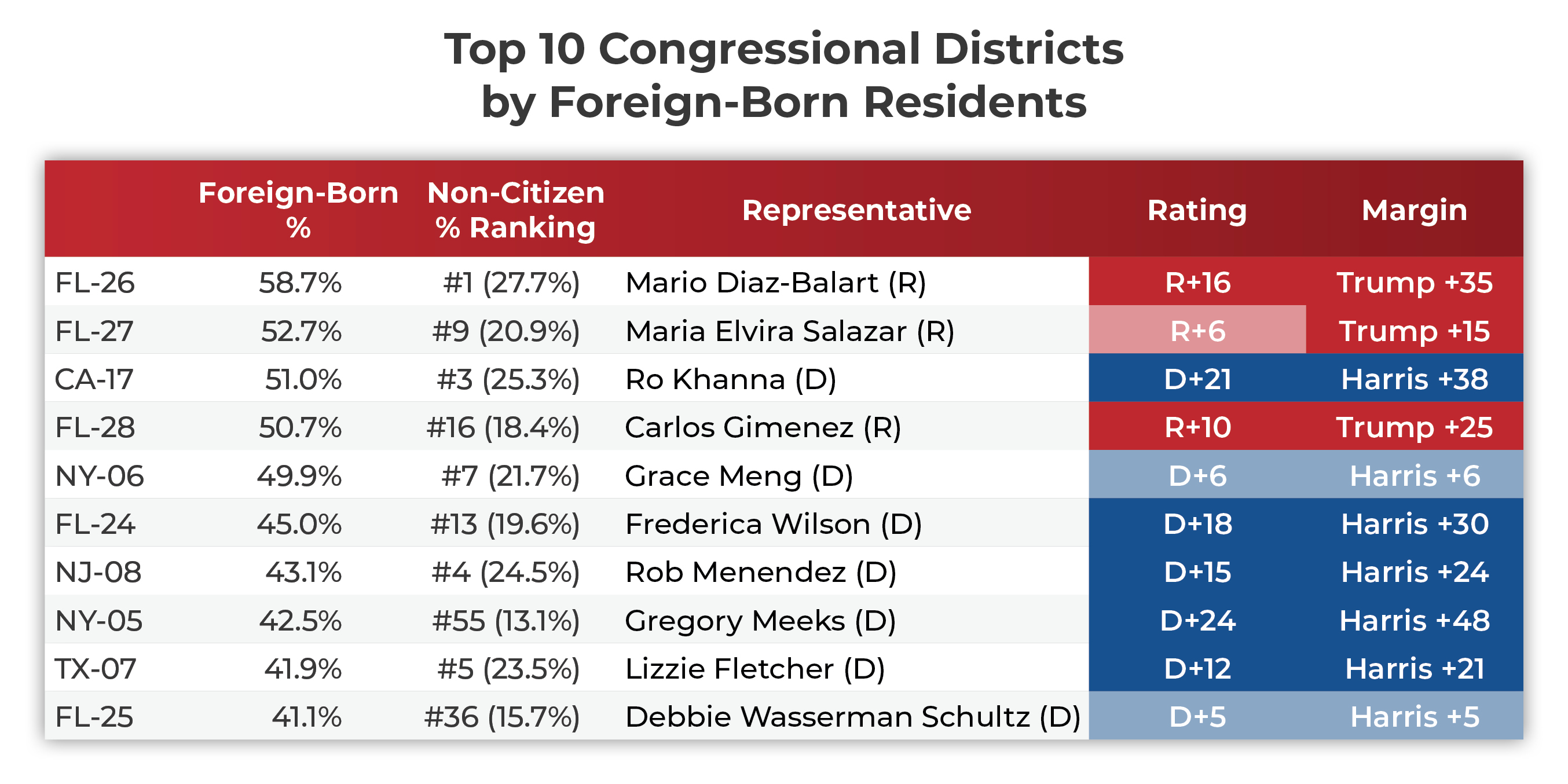
A similar Center for Immigration Studies (CIS) analysis found the same combined voting-eligible population between the 13 districts with the highest non-citizen populations and the nine districts with the lowest non-citizen populations. This shows there are four fewer representatives in the 13 districts with the lowest number of non-citizens than in the 13 districts with the highest number of non-citizens.
There are two ways Democrats use immigration to game the apportionment system. First, by becoming the party of the educated elite and supporting increased immigration, they filter out would-be Republican voters in many of their districts. Secondly, by increasing the foreign share of the population, they can win by relying on ever fewer votes.
(RELATED: 36 Seats Could Be Up for Grabs in New Supreme Court Redistricting Case)
Using Immigration to Mix a Darker Shade of Blue
It is not coincidental that Democrats represent more immigrant-heavy districts than Republicans.
The CIS analysis found that each percentage point increase in the non-citizen share of a congressional district’s adult population matches a 1.8 percent point increase in the Democrat share of the vote.
The Democratic National Committee and its brain trust made the conscious decision after former President George W. Bush’s 2004 reelection to fully abandon the white working class in exchange for socially liberal but fiscally moderate college educated whites—many of whom traditionally voted Republican. The downside, however, is that the latter don’t procreate as quickly as the former, wiring a demographic time bomb into this strategy.
"Districts 'stacked' with non-voting residents enable a smaller electorate to punch above its weight, skewing representation toward one side."
But economic geography mattered more than whether their base raised future Democrats.
Today, the wealthiest zip codes and their environs attract the most immigrants. Democrats wouldn’t get as many votes—but they wouldn’t need as many.
This is in part a consequence of economic opportunity. Immigrants who move to a country for a better life flock to areas where jobs are plentiful. In America’s industrial heyday, immigrants settled more evenly where industrial jobs were available, including places like Youngstown, Ohio and Springfield, Massachusetts. Today, pursuing jobs means moving near the wealthy where there’s likely to be an availability of housecleaning, lawn care, and fast-food employment, or near universities, which all provide maintenance and construction jobs.
Increased immigration siphons off these wealthier congressional districts from the rest of the country by creating a caste system of wealthy, college-educated Americans and immigrants who assimilate into their class and a foreign underclass. Working class Americans largely stay away, as the elitist concentration keeps housing costs too high, and the foreign underclass keeps wages too low to make it worth it.
As the parties diverge more strongly along class lines, many from the immigrant underclass who do assimilate realize the party of their neighbors and employers don’t represent them culturally or economically. Although President Donald Trump did better than most Republicans among this group, for college-educated, white-collar immigrants, voting Democrat forms part of the assimilation process.
Needing Fewer Voters to Win
Congressional districts are drawn to have roughly equal total populations—averaging 760,000 people—but when a significant portion are non-citizens ineligible to vote, the actual number of eligible voters will vary wildly.
For instance, in California's 13th District, 17 percent of adults are non-citizens and 27 percent are foreign-born. Five percent of the people in California’s 1st District are non-citizens, and the foreign-born make up 10 percent.
Yet District 1 had 108,000 more votes cast, despite Rep. Doug LaMalfa (R) winning it by nearly a 2–1 margin, while the District 13 race was decided by less than 200 votes.
As a result, voters in non-citizen-heavy districts wield outsized influence. In the 10 districts with the largest non-citizen shares, total votes cast in the 2022 midterms amounted to just 1.37 million, compared with 2.69 million in the 10 with the highest U.S. citizen shares. This means voters in the 10 lowest-citizenship districts wields about twice the influence as voters in the 10 highest-citizenship districts.
Democrats who run in these districts don’t have to compete for as many votes as Republicans who represent more rural and exurban districts, because non-citizens cannot legally vote. This means the larger the immigrant pool, the easier it is for Democrats to win. This demographic reality distorts the foundational democratic principle of "one person, one vote."
By counting non-voters toward population totals, the system allows fewer actual voters to elect a representative, concentrating power in areas where Democrats’ support is strongest. In essence, districts "stacked" with non-voting residents enable a smaller electorate to punch above its weight, skewing representation toward one side.
The higher concentration of non-citizens in Democratic districts isn't just a statistical factoid; it's a structural feature that advantages one party over another in Congress. By inflating population counts without adding voters, it creates a scenario where political power accrues automatically, challenging the notion of equal representation in a citizen-driven democracy.
(READ MORE: The Emerging Permanent MAGA Majority)