Should a Former Cop from China Who Celebrated Charlie Kirk’s Murder Have U.S. Asylum Status?
Deng Haiyan travels the world on a Chinese passport despite designation as a political “asylee.”
A popular Chinese YouTuber who has claimed political asylum in the United States seems to hit all the right notes. Deng Haiyan, the U.S.-based YouTuber known as “二大爷” (Èrdàye, “Second Uncle”), has gained over a million followers for his Chinese-language channel, in which he offers political commentary and criticism of the Chinese Communist Party (CCP). Wikipedia’s entry for Deng lists some basics, but Grokipedia gives a succinct bio for Deng:
A former police detective in China, he has positioned himself as a dissident voice, self-identifying as a “rebel” against the regime and drawing on his law enforcement background to analyze stability maintenance tactics and government propaganda. His commentary has appeared in international outlets and sparked discussions on platforms like X (formerly Twitter), including comparisons between Chinese state media and Western coverage of political figures.
Moreover, Deng weighs in on American politics, sharply slamming Republicans in general, and President Donald Trump in particular. His criticism is typically a hard-left lean in favor of political figures in the Democratic Party, which draws frequent comparisons between Trump and Xi Jinping, the president of the People’s Republic of China (PRC) and CCP chairman.
And perhaps most disturbing is his poisoned commentary over the assassination of Charlie Kirk, an American champion of truth.
Besides the YouTube channel, Deng has two X accounts—@Alex8282019 and @tankman2002. In various posts at @tankman2020, Deng has said that Elon Musk may face prison time, offered sharp criticism of the defense of the Uyghurs in Xinjiang province, and criticized the very U.S. Constitution that permits his asylum. Meanwhile, his latest posts at @Alex8282019 present a travelogue of sorts, showing posts from trips to various South American countries.
It remains unclear what occupation other than YouTuber affords Deng the financial freedom to travel so extensively—and why he still travels using his Chinese passport.
Questions about Deng’s Passport
What is clear is his influence over Chinese-language populations now living in the United States. As a so-called “exiled dissident” who produces videos critical of the CCP, he has gained a wide following.
His most popular videos include documentaries he's produced from hidden video he claims to have captured from his multiple “invitations to tea”—a euphemism for interrogation—with CCP officials.
Deng obtained a Green Card through political asylum after stating he faced persecution by the Chinese government. He claims in his public social media profiles that CCP officials invited him to tea ten times and searched his home twice for evidence of foreign espionage before he escaped to the United States.
But inconsistencies in his public story have led Chinese anti-communist activists in America to point out the red flags in Deng’s story. Questions have mounted around his true intentions in influencing the Chinese diaspora in America.
After receiving asylum, Deng renewed his Chinese passport at a PRC consulate and has used it to travel internationally, including to Japan, Peru, Mexico, and Europe. A person who can freely renew and rely on a Chinese passport does not appear to be living in fear of the Chinese state.
The in-person interview he gave to Wang Zhi’an (王志安) in Japan contains clear inconsistencies that expose the problems in his story. In a May 2024 conversation recorded while Deng was visiting Tokyo, Wang asked whether Deng still traveled on a Chinese passport. Deng confirmed he did, noting he holds a U.S. Green Card and that he had renewed the passport before leaving the United States.
In the interview, Wang points out that Deng had obtained political asylum and expresses surprise that Chinese authorities would renew the document. Deng adjusted his story. He said the renewal occurred earlier, during a period when he was still keeping a low profile, had not been writing or speaking out online, and was working odd jobs. He first described the renewal as something done before the Japan trip, then moved it backward once the implications for his asylum claim became clear. Even under the revised timeline, Deng applied for asylum shortly after arriving in the United States in late 2019 and has said it was approved relatively quickly, meaning the renewal would have taken place after he had already claimed a well-founded fear of persecution.
Deng’s account of his career inside the system is largely self-reported and only partially corroborated. He has said he graduated from the People’s Public Security University of China, worked seven years as a criminal police officer in Guangzhou’s Huangpu District, and was then transferred into local government offices—including the Party committee office, Organization Department, government office, and emergency management office—because of his writing skills after he failed to win a promotion inside the police. Only two early 2003 bylined reports in Guangzhou Daily and Yangcheng Evening News identify Deng as a Huangpu Public Security Bureau correspondent. After roughly 2008, when Deng says he moved into core government posts, online reporting disappears—no promotion announcements, personnel listings, or ordinary bureaucratic mentions—raising questions about whether records were removed or whether the full career can be verified.
Penalties for Asylum Fraud
Asylum fraud carries substantial consequences under U.S. immigration law. Regulations allow the United States Customs and Immigration Service (USCIS) or an immigration judge to terminate a grant of asylum if there is a showing of fraud in the application such that the person was not eligible for asylum when it was granted. The Immigration and Nationality Act (INA) further permits termination if the person has voluntarily availed themselves of the protection of their country of nationality—for example, by obtaining and relying on its travel documents in a way that demonstrates they no longer fear persecution. Other grounds include a fundamental change in country conditions, certain criminal convictions, terrorism-related bars, or acquisition of a new nationality. If the person has already acquired a Green Card on the basis of the asylum grant, the government can seek rescission of permanent residence under INA’s section (§) 246 and place the individual in removal proceedings.
A finding of fraud or willful misrepresentation of a material fact also triggers permanent inadmissibility under INA § 212(a)(6)(C)(i). In more extreme cases, an immigration judge can find that an applicant knowingly filed a frivolous asylum application, permanently barring the person from any benefits under the INA. Criminal charges for false statements or document fraud are possible but less common than the immigration consequences.
Deng’s inconsistent storytelling opens him up to further scrutiny over the validity of his asylum application.
Along with the main question of whether he truly fears the Chinese government or a return to China, Deng made other weird statements in the 2024 interview. He talks about the five years he spent at university in China—normally a four-year program—and references a 2019 disciplinary document with an “over-quota birth” charge, even though China had already relaxed its one-child policy by that time. Deng has also given differing explanations across interviews as to why the authorities began investigating him in 2018, and the short video clips he has released of the interrogations appear to show local Huangpu officials rather than state-security personnel.
One must wonder how he even managed to record these scenes over multiple interrogations without the authorities getting wise to it. After all, don’t the communist authorities typically confiscate all personal belongings and electronic devices before serving tea?
Combined with the passport-renewal admission and Deng’s post-asylum international travel on a Chinese passport, reconstructed from Deng’s own videos and posts, these gaps indicate the asylum claim contains material inconsistencies.
Deng’s background makes the allegation more pointed. He is a former criminal police officer who served in Guangzhou’s Huangpu District after graduating from the People’s Public Security University of China. He joined the CCP in 2004 and remained a member until October 2019, when local authorities expelled him from the Party and dismissed him from his public post. Deng has said the punishment stemmed from articles he published online criticizing aspects of CCP history and policy. He has described repeated interrogations, home searches, and surveillance in the year before his expulsion. After leaving China in late 2019, he settled in the Los Angeles area and built a large YouTube following with commentary on Chinese politics and history.
An anti-CCP activist who goes by the handle “@helen_maga99” on X, or Helen, examined the video Deng has presented as secret footage of his October 2019 disciplinary hearing, in which Huangpu District officials announce his expulsion from the CCP and dismissal from his post. Helen notes that the formal decision is dated September 25, 2019, yet the recorded announcement occurs on October 9—after the most serious penalties had already been imposed. She questions how Deng could have gotten his exit controls lifted and his passport returned precisely at the moment of the heaviest punishment, allowing him to buy a ticket and leave for the United States. She asks another very important question: why, if authorities suspected him of colluding with foreign forces, did they neither question his wife in detail nor hold his family as leverage after he applied for asylum? The CCP often resorts to these methods to exert leverage over suspected dissidents.
Helen further argues that the footage itself appears staged: the officials show no reaction to a phone held close to their faces, one even encourages the recording, and the overall presentation lacks the security protocols normally applied during formal interrogations. She concludes that the inconsistencies in timing, the lifting of restrictions at the critical moment, and the implausible “secret recording” undermine the persecution narrative Deng has offered in support of his asylum claim.
The international travel videos and posts he released raise even more questions. He’s posted videos from his trips to Japan, Peru, Mexico, and Europe—all on a Chinese passport. That seems impossible for someone who sought asylum from the very same government he feared.
Incitement?
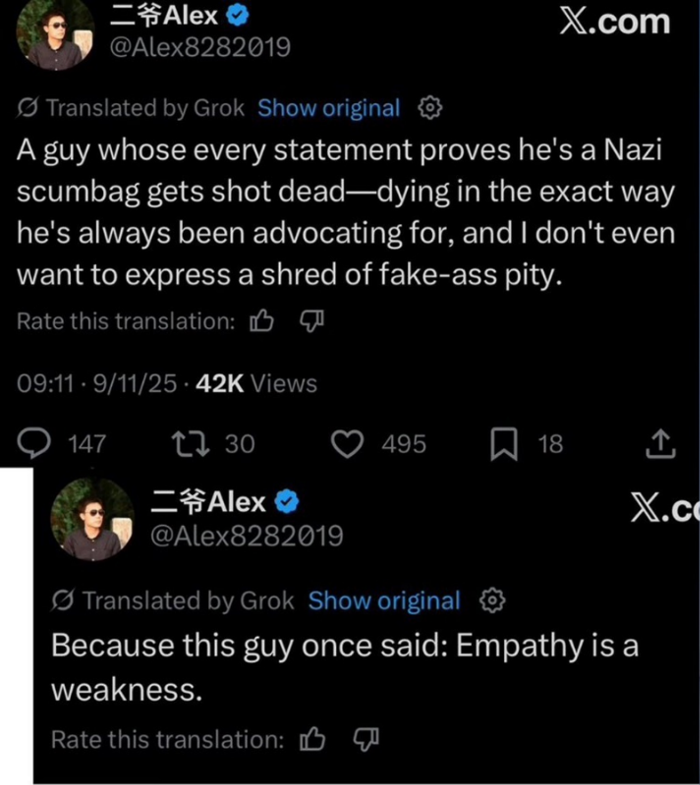
Scrutiny on Chinese language channels intensified after the tragic September 2025 assassination of Charlie Kirk. Deng posted comments that celebrated the killing, refusing to express “fake-ass pity” while calling Kirk a “Nazi.”
Days after Kirk's assassination, Secretary of State Marco Rubio said the United States would revoke visas for foreign nationals who “celebrate the murder, the execution, the assassination of a political figure.”
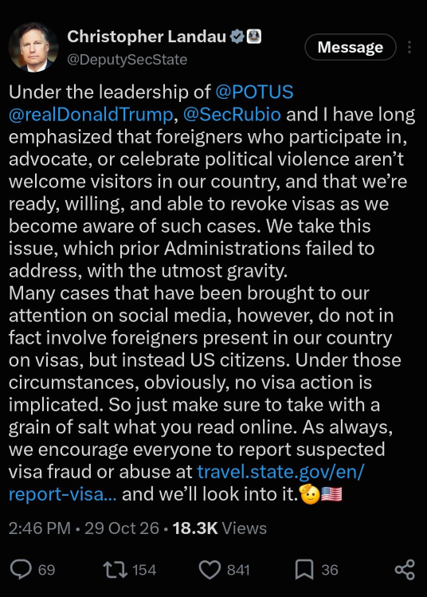
The State Department later confirmed it had revoked at least six visas on those grounds. Green-card holders face a higher bar for removal based on speech alone, though the administration has used foreign-policy and terrorism-related provisions of the Immigration and Nationality Act in other cases involving political expression. Deng’s posts about Kirk brought him additional attention from critics already focused on his asylum file.
What Are Deng's True Motives?
Is Deng truly a dissident seeking asylum from the Chinese government and CCP oppression? If not, what is he, and what is his ultimate goal?
Restoration News has reported multiple times on Chinese influence operations in the United States. China’s United Front Work Department and related influence operations aim to shape political attitudes and behavior among the Chinese diaspora in the United States by exploiting local social divisions, amplifying narratives of racism, discrimination, and political exclusion, and driving wedges between overseas Chinese communities and their host country. These efforts, which include mobilizing diaspora groups around contentious “wedge” issues, co-opting community organizations, and targeting Chinese-language media and social platforms, are tactics designed to increase loyalty to Beijing, mute criticism of the CCP, and complicate their full integration into American civic life.
If Deng wanted to help sow dissension and create more confusion, the path to growing his influence would include presenting himself as a persecuted enemy of the CCP to build trust among Chinese speakers in America.
A frequent theme of his videos and social media posts centers around drawing parallels between Chinese media and Western coverage of politics, and comparing Trump to Xi. His bona fides as a "dissident" give him authority to make such claims. This sows confusion and doubt in the validity of the American government. After all, if it's just like China, why should new immigrants care about protecting our constitutional order?
What is clear, however, is that his stated biography doesn't add up. One must ask why.
As another anti-communist activist noted on X:
1) If he truly faced persecution from his country of origin, it would be irrational to proactively apply for a passport at that country’s embassy or consulate;
2) The Chinese government’s willingness to renew his passport for ten years and allow his family members to exit the country also indicates that, at the time, he was not regarded as an object requiring restriction or suppression;
3) Genuine asylees typically use refugee travel documents issued by the asylum country, rather than continuing to hold and use a passport from their country of origin.
The combination of an alleged fraudulent asylum claim, a long career inside the Chinese security apparatus and the CCP, limited independent corroboration of that career, and public comments on a political assassination has made Deng a target of sustained criticism in Chinese-language online spaces. The State Department should open an investigation.
MORE COVERAGE FROM RESTORATION NEWS
Foreign Meddling: Climate Activist PACs Tied to Communist China Poised to Swing Close Midterm Elections
The War We Can't See: The Soft Occupation of America by the Chinese Communist Party
Exodus: Autobiography Tells the Tale of a Christian Capitalist Who Escaped Mao's China
The United Front: Controversy Widens Over Candidate's Possible CCP Links
Influence Campaign: "Conservative Influencer" Lindy Li’s Ties to the CCP Go Deeper than We Knew
We need your help to save America—chip in today.
Restoration News, a project of Restoration of America, is your trusted investigative news source for the America First movement. As a rapidly growing conservative news site, we focus on delivering accurate and insightful exposés on political news, immigration news, leftist lies, and other pressing issues affecting everyday Americans. Our uncompromising commitment to a hard-hitting, fact-based, America First, and faithful perspective ensures that you receive news that aligns with your values.
Every dollar gets us closer to winning the war on woke.