Pill Pushers: How a Dark Political Agenda Made Abortion More Dangerous Than Ever
Politics, negligence and an insidious ideology continue to cost babies—and unsuspecting women—their lives.
A Restoration News Investigation
Former President Bill Clinton once envisioned "an America where abortion is safe and legal, but rare." At least, that was his claim on Jan. 22, 1993, the 20th anniversary of Roe v. Wade and his third day occupying the Oval Office.
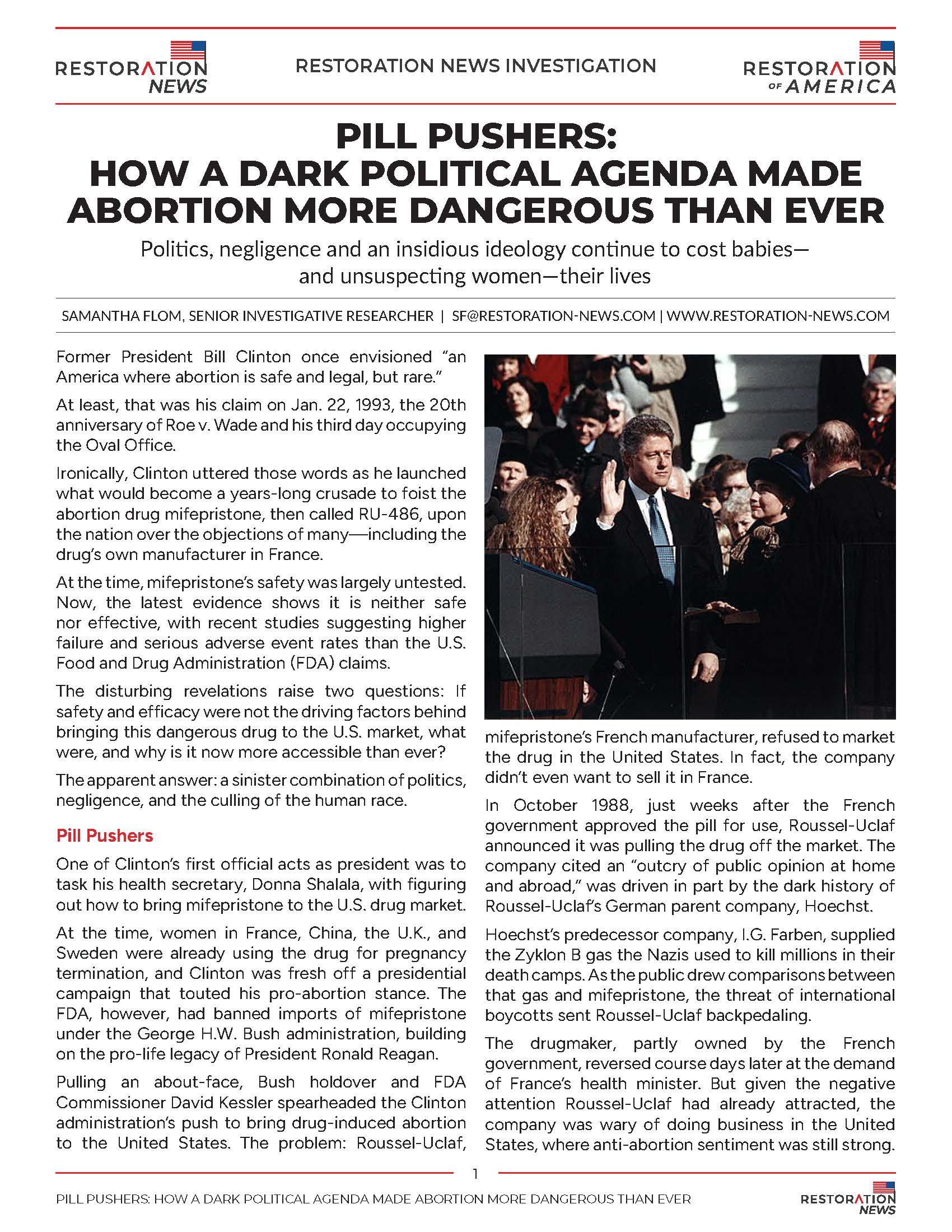
Ironically, Clinton uttered those words as he launched what would become a years-long crusade to foist the abortion drug mifepristone, then called RU-486, upon the nation over the objections of many—including the drug's own manufacturer in France.
At the time, mifepristone's safety was largely untested. Now, the latest evidence shows it is neither safe nor effective, with recent studies suggesting higher failure and serious adverse event rates than the U.S. Food and Drug Administration (FDA) claims.
The disturbing revelations raise two questions: If safety and efficacy were not the driving factors behind bringing this dangerous drug to the U.S. market, what were, and why is it now more accessible than ever?
The apparent answer: a sinister combination of politics, negligence, and the culling of the human race.
Pill Pushers
One of Clinton's first official acts as president was to task his health secretary, Donna Shalala, with figuring out how to bring mifepristone to the U.S. drug market.
At the time, women in France, China, the U.K., and Sweden were already using the drug for pregnancy termination, and Clinton was fresh off a presidential campaign that touted his pro-abortion stance. The FDA, however, had banned imports of mifepristone under the George H.W. Bush administration, building on the pro-life legacy of President Ronald Reagan.
Pulling an about-face, Bush holdover and FDA Commissioner David Kessler spearheaded the Clinton administration's push to bring drug-induced abortion to the United States. The problem: Roussel-Uclaf, mifepristone's French manufacturer, refused to market the drug in the United States. In fact, the company didn't even want to sell it in France.
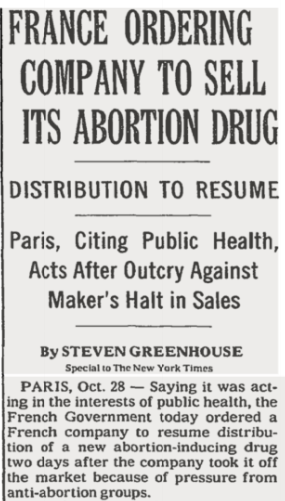
In October 1988, just weeks after the French government approved the pill for use, Roussel-Uclaf announced it was pulling the drug off the market. The company cited an “outcry of public opinion at home and abroad,” was driven in part by the dark history of Roussel-Uclaf's German parent company, Hoechst.
Hoechst's predecessor company, I.G. Farben, supplied the Zyklon B gas the Nazis used to kill millions in their death camps. As the public drew comparisons between that gas and mifepristone, the threat of international boycotts sent Roussel-Uclaf backpedaling.
The drugmaker, partly owned by the French government, reversed course days later at the demand of France's health minister. But given the negative attention Roussel-Uclaf had already attracted, the company was wary of doing business in the United States, where anti-abortion sentiment was still strong.
In a September 1993 memo initially obtained by Judicial Watch, Kessler informed Shalala of Roussel-Uclaf's "liability and boycott concerns" and demands for indemnification from any potential damages arising from protests or mifepristone's side effects.
According to Kessler, the FDA informed the drugmaker "it would go far beyond FDA's appropriate role to seek such protection for a drug company." Agency representatives still offered "to advance the idea within the department" anyway.
Kessler detailed the Clinton administration's efforts to strongarm Roussel-Uclaf and Hoechst into signing over the patent rights for mifepristone to the New York-based Population Council, a nonprofit Roussel-Uclaf had previously contracted with to conduct U.S. clinical trials of the drug.
Noting the "pressure" Clinton, Shalala, and the FDA had already exerted on the two companies to come to the table, Kessler suggested that the administration could leverage its diplomatic ties to turn up the heat.
"It may be that France and Germany would be unhappy to learn that their companies were not accommodating a request made by the United States government," he wrote. "The U.S. ambassadors to France and Germany will need to be consulted on these issues, and your counterparts in France and Germany may also need to be involved."
Dark Motives
The Clinton administration's behind-the-scenes pressure campaign eventually paid off. Roussel-Uclaf struck a deal with the Population Council in May 1994, opening the door for mifepristone's development in the United States.
With that win under his belt, the president was free to loosen it a bit. Within a matter of weeks, he was signaling his true intentions behind promoting the drug: Population control.
"One-third of our children are already hungry, two of every five people on Earth lack basic sanitation, and large parts of the world exist with only one doctor for every 35 or 40,000 people," Clinton said on June 29, 1994, during a State Department speech.
"It is clear that we need a comprehensive approach to the world's future. If you look at the numbers, you must reduce the rate of population growth."
While the president claimed his administration did not support abortion as a method of family planning, he nevertheless went on to advocate for worldwide access to the procedure in a speech endorsing the use of family planning for population control.

Notably, population control was also the original objective of the Population Council. The nonprofit, founded by John D. Rockefeller III, emerged on the scene in 1952 to promote eugenics and the deliberate "reduction of fertility" to effectively wipe out the poor, racial minorities, and other populations leadership deemed unfit for reproduction. Early players included American Eugenics Society founding member Frederick Osborn, who served as the organization's first administrator, and then-Planned Parenthood Federation of America Director William Vogt, who popularized the idea that Earth has a limited "carrying capacity" for humanity.
While Clinton may have sought to downplay his position's ties to that movement, at least one of his supporters was less concerned with the optics.
In a letter initially obtained by Judicial Watch, attorney James "Ron" Weddington urged "President-to-be Clinton" to promote government-funded abortions—both chemical and "conventional"—to eliminate the lower class.
"You can start immediately to eliminate the barely educated, unhealthy and poor segment of our country," wrote Weddington, who, alongside his then-wife, convinced the Supreme Court in Roe to green-light decades of unregulated abortion nationwide.
"We don't need more cannon fodder. We don't need more parishioners. We don't need more cheap labor. We don't need more poor babies." – James "Ron" Weddington
Weddington claimed he was not calling for "some sort of mass extinction" of the poor but went on to suggest that Clinton "use persuasion rather than coercion" to achieve the same end.
He encouraged the president to "enlist the aid of sports and entertainment stars to counteract the propaganda … that, throughout the ages, has convinced the poor that children are necessary to fulfillment as a person."
He went on to argue that humanity's survival "depends on our developing a population where everyone contributes. We don't need more cannon fodder. We don't need more parishioners. We don't need more cheap labor. We don't need more poor babies."
Although the letter is dated Jan. 6, 1992, the cover letter addressed to Clinton's "transition team" suggests it was likely written in 1993. Given what it promotes, however, the message might as well have been written in 1952 by Rockefeller himself.
Feigned Neutrality
The FDA has long held that its process in approving mifepristone was fair and apolitical.
In an April 2023 interview with Time, former FDA Commissioner Jane Henney said the agency "followed to the letter" its normal process for reviewing new drugs.
"We did not let the political climate or political issues around abortion influence what the agency did," Henney said.
Yet the agency issued its first "approvable" letter for mifepristone in September 1996, weeks before voters signed off on a four-year extension of the Clinton administration. Four years later, the FDA issued its final approval of Mifeprex, or brand-name mifepristone, just ahead of another presidential election that could have derailed the drug's approval.
The optics are hard to ignore.
Abortion proponents often point to the lengthy review period as evidence that the FDA did its due diligence. They neglect to mention that the drug sponsor's legal squabbles and struggles to secure a manufacturer extended the timeline, not FDA scrutiny.
After acquiring mifepristone's patent rights in 1994, the Population Council tapped a former business partner, Joseph D. Pike, to lead efforts to bring the drug to market. Pike created a complex network of shell companies and began soliciting investors and a manufacturer.
In May 1996, Hungarian drugmaker Gedeon Richter signed on to make the drug. But months later, Pike pleaded guilty to an unrelated misdemeanor forgery charge in North Carolina, alerting the company, the Population Council and investors to his unsavory past.
By February 1997, the Population Council had filed a lawsuit to oust Pike from the project and Gedeon had terminated its contract.
Lobbyist Kyle Michel lamented the turn of events in a June 1997 memo to Jennifer Klein, First Lady Hillary Clinton's senior domestic policy advisor and a staff member for the president on the Domestic Policy Council.
"The cancellation of the manufacturing contract by Gedeon will cause at least a three to five-year delay in bringing the drug to market, even assuming a new manufacturer is located immediately," Michel wrote, noting that the drugmaker would need FDA approval as well.
He urged Klein to encourage Donald Blinken, then-U.S. ambassador to Hungary (and father to future Secretary of State Antony Blinken) to meet with Gedeon's managing director to convince him to reconsider.
"We need the Ambassador to stress to Mr. Bogsch the importance of this product to the current Administration and encourage Gedeon to work with the investor group to work out an interim arrangement whereby the investor group can bring the drug to market on schedule," Michel wrote.
It remains unclear who Michel was lobbying on behalf of, though in his cover letter, he expresses his hope that Gedeon will reverse course and "manufacture the product for us."
He also notes that his letter was a follow-up to a phone call he received from Klein about "the mifepristone matter currently under consideration in [her] office."
This suggests that, contrary to the FDA's claims, White House officials were actively involved in ensuring mifepristone's approval.
Uninformed Consent
The Population Council eventually secured a Chinese manufacturer, and within months of Mifeprex's approval, ads touting the drug as "another safe abortion choice" began to roll out nationwide.
By early 2003, that message echoed in abortion clinics across the country, including the Planned Parenthood in Bryan, Texas, where Abby Johnson served as a regular volunteer.
Clinic staff had assured Johnson that chemical abortion was nothing to worry about—it was just like a typical menstrual period but with heavier bleeding. When she unexpectedly became pregnant by her soon-to-be ex-husband, she had no reservations about taking the pills.
Johnson took the first pill, Mifeprex, at the clinic and experienced no immediate side effects. The next day, she took the second drug, misoprostol, at home and then lay down in bed to wait.
Within minutes, she was in agony.
"I started feeling the most intense pain I had ever felt in my life," Johnson told Restoration News. "I started bleeding in the bed, and I got up, and as soon as I got up, blood was just gushing out of me."
The complications Johnson experienced that day extended far beyond the standard cramping and nausea to include heavy blood loss and loss of consciousness—side effects Planned Parenthood had failed to mention. When she later called the clinic for an explanation, the nurse seemed annoyed that she would dare to question the process.
"I started feeling the most intense pain I had ever felt in my life." – Abby Johnson, CEO and founder of And Then There Were None and ProLove Ministries
The nurse's suggestion: Down some ibuprofen, apply a heating pad and take a warm bath. In other words, just wait it out.
"I realize now that I probably had retained tissue, that I probably had something still in my uterus. I mean, I could have become septic. I think I was very fortunate not to get very sick after my abortion," said Johnson, who now helps abortion workers exit the industry through her nonprofit And Then There Were None.
Others have been less fortunate. Later that same year, 18-year-old Holly Patterson of Livermore, California, became one of the first American women to die from a septic bacterial infection following a drug-induced abortion.
Her father, Monty Patterson, said he had never seen so much fear in his daughter's blue eyes as he did on the day she died.
"The look to me was like, 'Dad, save me . . . . Get me out of this,'" he told Restoration News, recounting the day that has haunted him for decades.
But it was too late. There was nothing he or the ICU doctors could do.
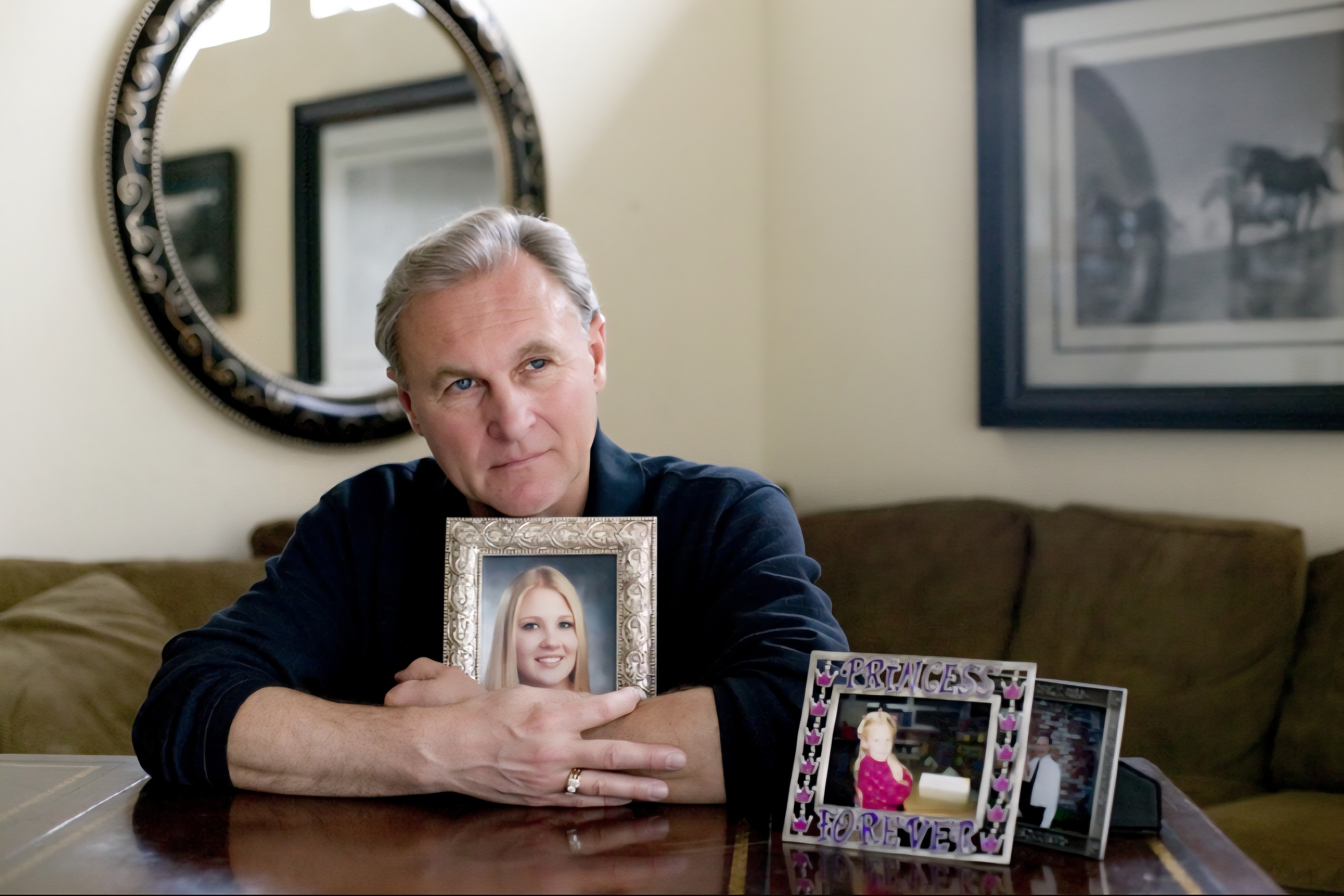 Monty Patterson holding a photograph of his daughter, Holly
Not long after his daughter drew her last breath, he received a call from an executive at Planned Parenthood who expressed her condolences and told him that "these things sometimes happen."
"I said, 'Oh really? Well, they shouldn't happen to anybody—no young woman, no young girl out there—ever. This should never happen, and I’m not accepting that,'" he said.
Determined to find out what happened to his daughter, Monty Patterson threw himself into research. From public records, clinical trial data, and some investigative work, he learned that multiple other women had died of bacterial infections after chemical abortions.
That discovery eventually led to the addition of a warning concerning the risk of serious infections to the Mifeprex label—a small win in his years-long fight to spare others from his daughter's fate.
He also created a website, AbortionPillRisks.org, to notify women of the dangers he wishes his daughter was informed of.
"I'm not really sure if she knew she was taking this big a risk with the abortion pill," he said. "I don't think it really was laid out for her how much of a risk this would be for her life."
Out of Control
By April 2006, Mifeprex had been linked to at least six U.S. deaths, including five from septic infections, and public concern was so high that even abortionists who had previously prescribed the pills were rethinking that decision.
"None of these women should be dying; it's shocking," Dr. Peter Bours, an abortion provider in Portland, Oregon, told the New York Times at the time.
"Mifeprex has more bleeding, more complications, more retained tissue. In every place where you compare Mifeprex to surgery, Mifeprex is always worse."
The mounting evidence, according to Denver-based Dr. Warren Hern, showed that chemical abortion was riskier than its surgical counterpart. Surgery "should be the procedure of choice," Hern told the outlet.
Dr. Damon Stutes of Reno, Nevada, agreed, noting that he refused to offer chemical abortions as the complications "far exceed the complications of surgical abortion."
Seeking answers and accountability, members of the House Government Reform Committee held a hearing that May to examine the FDA's decision-making.
Defending the agency's actions, Janet Woodcock, then-director of the FDA Center for Drug Evaluation and Research, testified that Mifeprex's approval followed a review of "three adequate and well-controlled trials" documenting its safety and efficacy. But Dr. Donna Harrison, director of research for the American Association of Pro-Life OB-GYNs, told Restoration News that those trials did not meet the FDA's typical standards.
"They approved the drug based on a few studies, none of which were blinded, randomized and controlled," said Harrison, who also chairs the Alliance for Hippocratic Medicine.
A randomized, blinded and controlled trial is one in which participants are randomly assigned to treatment groups—including a baseline control group—without knowing which treatment they will receive to eradicate potential biases. Harrison noted that the FDA usually requires the submission of data from two such trials for new drug applications.
When testing a new drug for which there is no comparable medication, the control group would typically receive placebo. But in the case of Mifeprex, Harrison said that even today, no such study exists.
"What they have is what's called dose comparator trials where they look at two different doses or different ways of administration," she said. "But they haven't done a placebo control—not that I can find."
Skirting the Rules
Aside from relying on potentially biased trials, the FDA appears to have eschewed other important standards in approving mifepristone.
For instance, despite having no clinical data on the drug's effect on minors—data the Population Council initially agreed to provide—the agency approved its use on all age groups.
The FDA also greenlit a new use for misoprostol, the second drug in the chemical abortion regimen, over the manufacturer's objections.
Further, the agency approved Mifeprex's use through a regulation known as Subpart H, which exists to expedite the approval of new drugs for "serious or life-threatening illnesses" by allowing their restricted use.
Pregnancy, of course, is not an illness, and an abortion is an elective procedure performed to end a life, not save one.
Subpart H also requires that the proposed drug provide "meaningful therapeutic benefit to patients over existing treatments." Yet Harrison said there is no evidence to suggest chemical abortion provides any meaningful benefit over surgical abortion.
"And [the FDA] actually knew that," she added.
An FDA medical officer's 1999 review of U.S. clinical trial data for Mifeprex acknowledges two comparison studies that found chemical abortion was riskier and less effective than surgical abortion.
Specifically, a U.S. study published in 1999 found that drug-induced abortions had a substantially higher failure rate (18.3 percent compared to 4.7 percent), took nearly 10 days longer for the bleeding to stop, were more likely to require unplanned surgical intervention, and caused participants "significantly greater pain, nausea or vomiting" than suction and curettage abortions.
Another study conducted in China, Cuba, and India and published in 1997 yielded similar results.
"Mifeprex has more bleeding, more complications, more retained tissue," Harrison said. "In every place where you compare Mifeprex to surgery, Mifeprex is always worse."
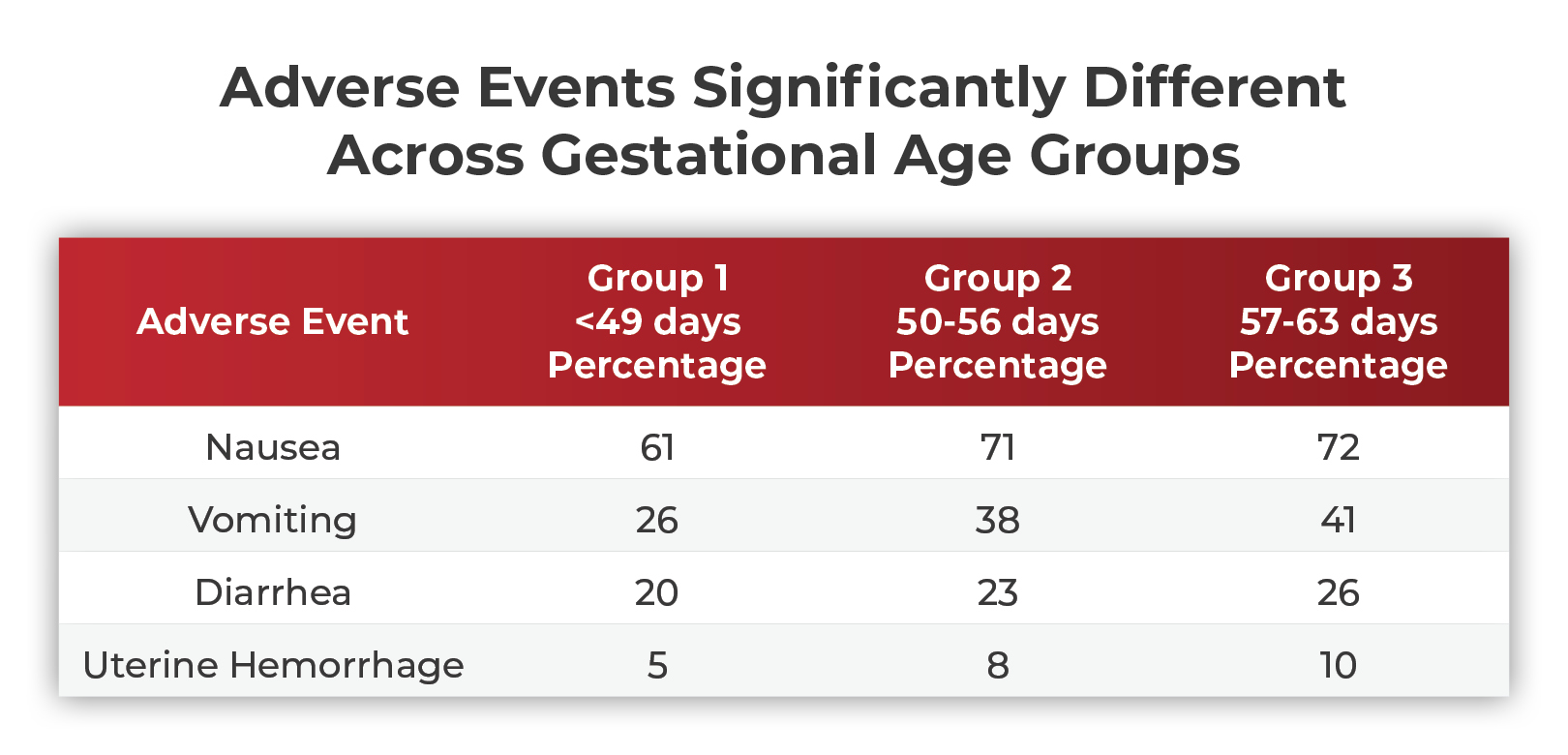
Still, the FDA pushed ahead with the approval, even removing some of its own proposed restrictions at the last minute, including a crucial ultrasound requirement.
An ultrasound, Harrison noted, is needed to accurately date a pregnancy and rule out a potentially fatal ectopic pregnancy.
Conveniently, the two pages of the medical officer's review that might explain the FDA's actions—those concerning the agency's deliberative process—are redacted.
Dangers of Deregulation
Despite the FDA's questionable decision-making, the abortion industry has pointed to the agency's approval of mifepristone as evidence that it is both safe and effective.
Recent studies suggest otherwise.
The Restoration of America Foundation's review of medical insurance claims data from 2017 through 2023 found that 10.93 percent of drug-induced abortions resulted in at least one serious adverse health event—a rate 22 times higher than the FDA claims. In 2023, the rate was even higher at 11.2 percent.
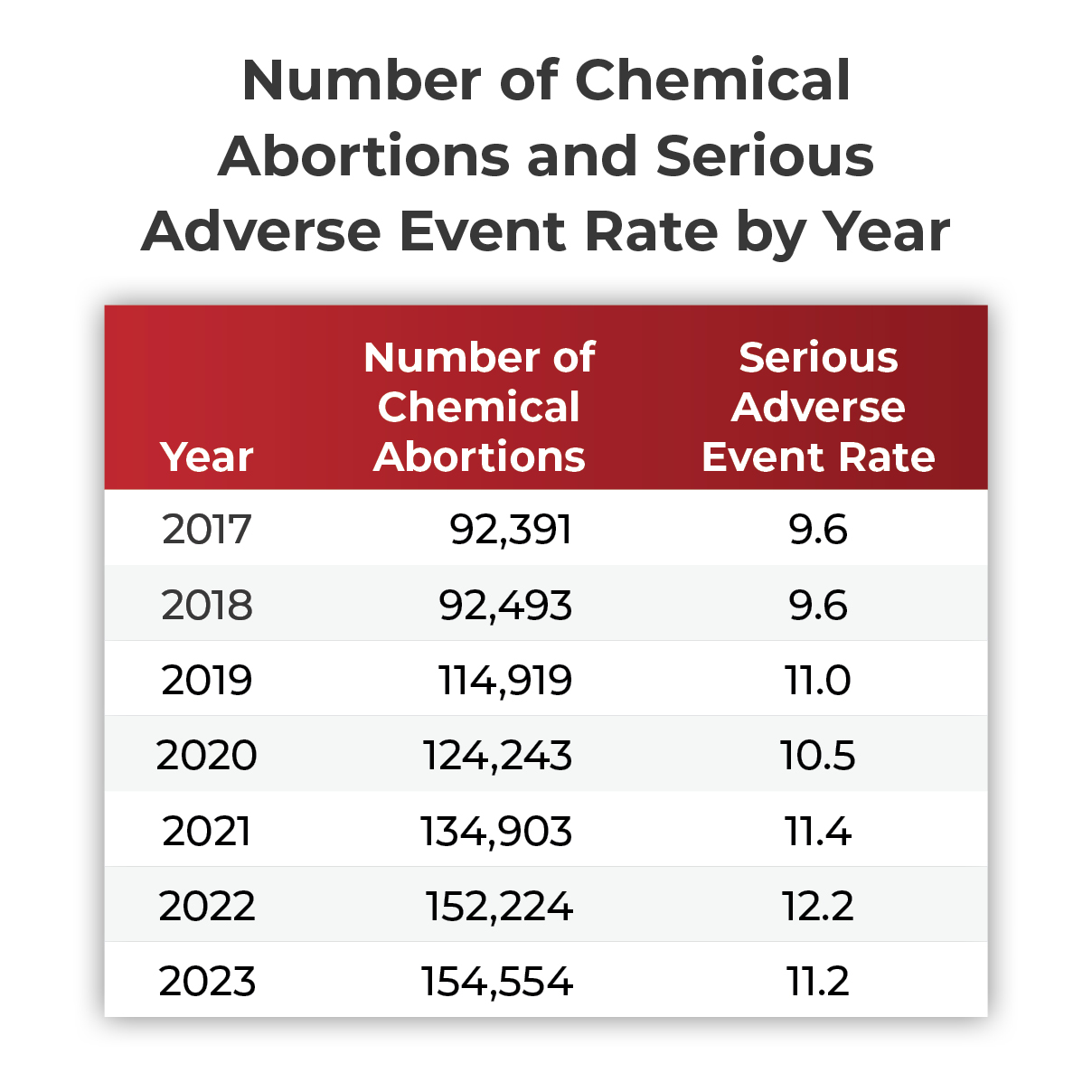
The Ethics and Public Policy Center's study of the same data corroborated those findings. The nonprofit additionally found that chemical abortion has a failure rate of about 5.26 percent, or roughly one in 19 cases. The combined failure rate from all clinical trials listed on mifepristone's FDA label is 3.2 percent.
Those figures make the FDA's rollback of all meaningful restrictions on mifepristone even more alarming.
In 2016, the Obama FDA extended mifepristone's approved use from seven weeks into a pregnancy to up to 10 weeks, greenlit non-physicians prescribing it, and dropped the number of required in-person doctor's visits from three to one. At the same time, the agency stopped requiring prescribers to report nonfatal complications, making it harder to assess the full consequences of those sweeping changes.
By late 2021, mifepristone was more accessible than ever despite the complications of the COVID-19 pandemic. Caving to political pressure, the Biden FDA suspended its in-person dispensation requirement for the drug so that patients could obtain it online without ever consulting a physician.
Less than a year later, at least three women had died from chemical abortion complications: Alyona Dixon of Nevada and Georgia mothers Amber Nicole Thurman and Candi Miller.
Both Dixon and Thurman allegedly obtained their pills from abortion clinics and then finished the process at home. Miller, according to ProPublica, ordered the drugs online.
An autopsy reportedly revealed that Miller not only suffered an incomplete abortion but also had a lethal combination of painkillers—including the dangerous opioid fentanyl—in her system.
Her family did not know how she obtained the fentanyl, and she had no prior history of drug use. As she purchased the abortion drugs illegally, there is a possibility they were laced with fentanyl.
The black market for abortion drugs, bolstered by the FDA's newly relaxed standards, creates a litany of safety concerns for women seeking an easy and affordable escape from motherhood.
Aid Access, for instance, ships abortion pills to anyone in any state upon completion of an online form. Buyers need not even prove they are female, much less pregnant, to obtain these drugs, and many women are now learning this the hard way.
Criminals Take Advantage
In the wake of the FDA's deregulation spree, several lawsuits and criminal cases have sprung up concerning coerced abortions involving drugs purchased online.
Liana Davis of Corpus Christi, Texas, filed a lawsuit on Aug. 11 accusing Marine pilot Christopher Cooprider of spiking her hot chocolate with 10 misoprostol pills, hospitalizing her and killing their unborn baby girl. The complaint alleges he obtained those pills, along with mifepristone, from Aid Access.
Another Texas woman lost her unborn child in October 2024 after her boyfriend, Justin Anthony Banta, allegedly spiked her drink with abortion pills while they were at a coffee shop. Banta faces charges of evidence tampering and capital murder.
 Justin Anthony Banta
A 2023 case in Florida had a happier ending in that the victim discovered the plot to kill her unborn baby before it was too late. According to the Hernando County Sheriff's Office, defendant Haley Ann Raborn confessed to buying an abortion pill online and soliciting her ex-boyfriend to trick the victim, his ex-fiancée, into taking it.
Meanwhile, a Louisiana mother stands accused of ordering abortion pills from a telehealth abortionist in New York earlier this year and illegally coercing her teenage daughter into taking them. The baby died and complications from the abortion landed the teenager in the hospital.
The latter case has raised questions about the constitutionality of shield laws such as New York's, which serve to help telemedicine abortionists who facilitate interstate abortion crimes to evade justice. Between the existence of such laws and the growing black market for abortion drugs, the popular argument that abortion is now a states' rights issue falls flat.
The Right Thing
As the legal and safety concerns surrounding mifepristone continue to mount, so do calls for the FDA to rectify the dangerous situation it created.
"There have been drugs pulled off the market for much fewer side effects than what Mifeprex has," Harrison noted.
She and leaders from five other medical organizations penned a letter to Health and Human Services Secretary Robert F. Kennedy Jr. and FDA Commissioner Marty Makary, urging the immediate reinstatement of the former restrictions on mifepristone.
"We want the FDA to be aware that we are watching, and we want them to do the right thing when it comes to Mifeprex," she said.
The "right thing," according to Harrison and her colleagues, includes requiring chemical abortion patients to get an ultrasound to date their pregnancy and rule out a possible ectopic pregnancy. It would also involve an FDA review of real-world data to assess mifepristone's safety.
At a Senate Finance Committee hearing on Sept. 4, Kennedy confirmed that a safety review is underway but said he did not know the specifics of how that process is being conducted.
While the secretary also revealed that the Biden FDA "twisted the data to bury one of the safety signals" for mifepristone, he could not commit to restoring the restrictions the prior administration stripped.
"I don't know if the White House has yet taken a position on that," Kennedy told Sen. Steve Daines (R-Mont.), promising to find out.
At least 36 American women have already lost their lives in connection with mifepristone abortions and more than 4,000 have experienced serious complications. If the FDA ultimately decides to uphold the status quo, other federal officials should be prepared to step in.
Federal law already prohibits the mailing of abortion drugs and other materials meant for producing an abortion or inciting other "indecent or immoral" acts. The Biden administration chose not to enforce that law, known as the Comstock Act, in cases where the drugs are for legal abortions, though the Trump Justice Department could scrap that rule and invoke the law as written at any time.
Lawmakers could also pass new legislation to restore the FDA's former safeguards for mifepristone. Sen. Josh Hawley (R-Mo.) introduced a bill to that effect in May.
Meanwhile, additional legislation cracking down on shield laws could prevent abusers from wielding abortion drugs as murder weapons. Sixteen state attorneys general have already called upon Congress to consider taking action.
Harrison, however, said she is encouraged by the FDA's commitment to reviewing mifepristone's safety.
"I am hopeful that there will be an objective review. I'm hopeful," she said. "And if there is an objective review, then this drug should not be on the market."
Chip in today and help us expose the woke Left
Restoration News, a project of Restoration of America, is your trusted investigative news source for the America First movement. As a rapidly growing conservative news site, we focus on delivering accurate and insightful exposés on political news, immigration news, leftist lies, and other pressing issues affecting everyday Americans. Our uncompromising commitment to a hard-hitting, fact-based, America First, and faithful perspective ensures that you receive news that aligns with your values.
Every dollar gets us closer to finishing the fight