It's Time for Trump to Move Against Credit Card Sharks
Capping usury would protect American families from the debt trap keeping many in lifelong poverty.
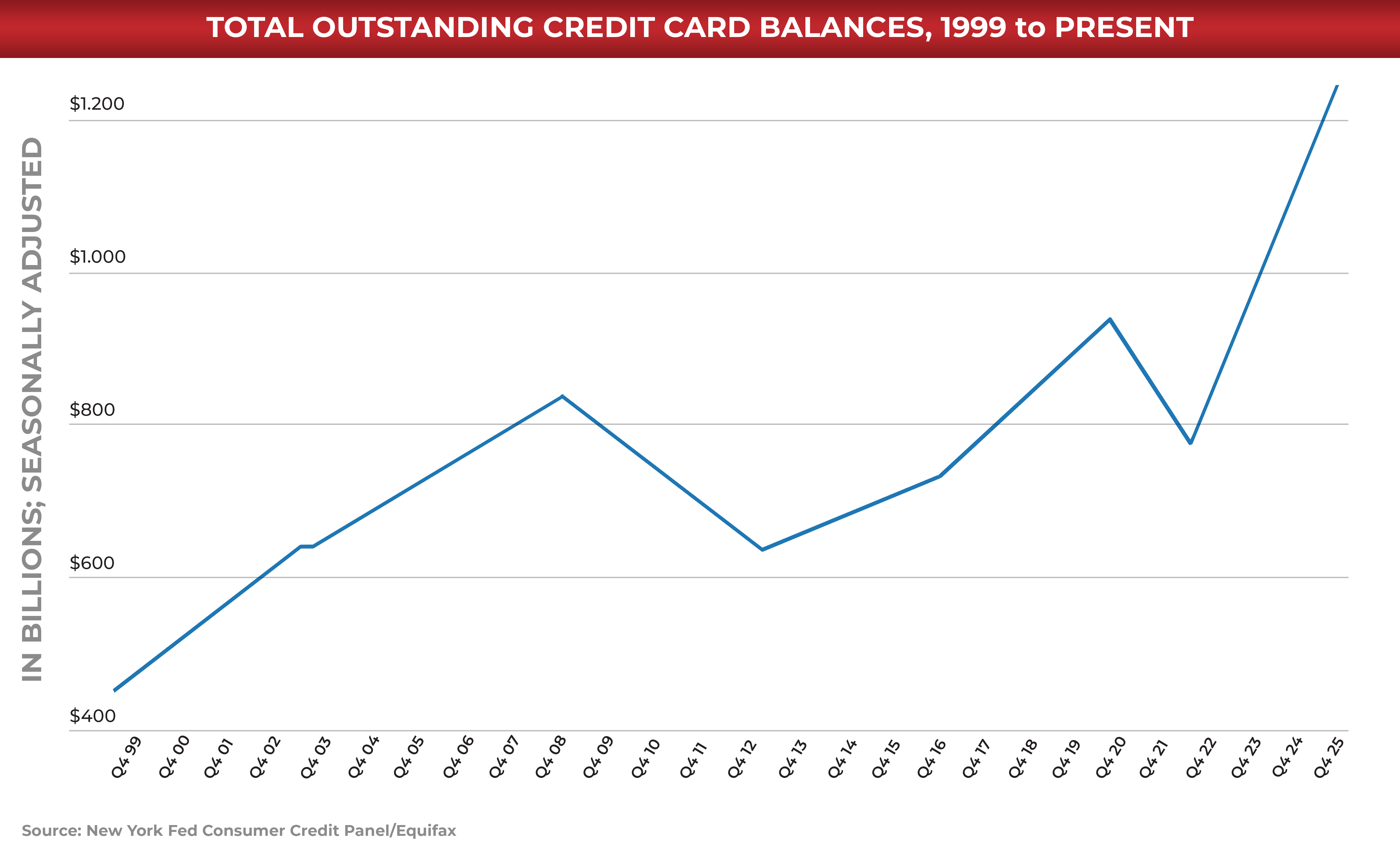
American families are drowning in over $1.277 trillion in credit card debt, up from just $478 billion in 1999. Nearly half of card holders carry a balance from month to month, and over half of those—56 million people—have carried a balance for over a year. As a result, only 44 percent of Americans have more emergency savings than credit card debt.
This especially affects younger Americans. Last year marked the first time Millennials surpassed Baby Boomers in average credit card debt, clocking in at nearly $7,000 per card holder.
This is undoubtedly contributing to the collapsing birthrate, as Americans have not yet learned the art of pair bonding while poor. A survey last month from the online billing site Invoice Home found nearly half of Gen Z and Millennials are going into debt to pay for dates. Among Gen Z, 30 percent said they would break up with anyone who didn't spend enough for them on Valentine's Day, and one in six Millennials spent $1,000 last year on dates gone wrong.
Two massive contributors to the problem: Easy access and an average APR of 23.77 percent for new credit cards. Just as banks flooded the market with easy subprime mortgages in the early 2000s, credit card companies are burying consumers in unpayable debt.
President Donald Trump's call for credit card companies to cap interest rates at 10 percent is not government overreach but fairness rooted in millennia of usury laws, from ancient codes to the English Common Law's interest caps of less than 10 percent under which the American colonists lived.
Although a president cannot unilaterally force companies to cap interest rates, he can use regulatory agencies to make life miserable for companies that refuse to comply. Trump should give credit card issuers a 10 percent cap deadline. Those that fail to comply should face frequent, intrusive audits and intense monopoly scrutiny. Additionally, the Consumer Financial Protection Bureau should harass these companies by eliminating their ability to charge fees, banning their lucrative add-ons like identity theft protection, and making it easier for class-action lawsuits by restricting mandatory arbitration clauses.
But relying on regulatory agencies alone may not be necessary. Capping credit card interest rates enjoys rare bipartisan support. Last February, Sens. Josh Hawley (R-MO) and Bernie Sanders (I-VT) introduced the "10 Percent Credit Card Interest Rate Cap Act" to codify Trump's proposal. Trump should use the bully pulpit to demand Congress pass it.
What About Bankers' Profits?
Assuming Trump could bully credit card issuers into bending the knee or get his plan through Congress, many free market proponents take the banks' side. They argue that charging high interest rates is fair because it allows banks to hedge against risks inherent in extending credit to the poor.
However, a Vanderbilt University study last year concluded, "The profit margins of the credit card market at every FICO tier are thick enough to absorb a very significant reduction in interest caused by a new federal usury rate."
The industry's average return on assets (ROA) stands at a whopping 6.24 percent, five to six times higher than typical bank ROA. For low-credit-score borrowers—with average delinquency rates above 10 percent—it exceeds 10 percent. The Vanderbilt study found even before the Federal Reserve cut the federal funds rate last September, capping credit card interest rates at 15 percent would still allow issuers to enjoy an ROA higher than the Fed's rate at nearly every FICO tier.
Banks could easily offset lost interest collection and fees by trimming excessive advertising budgets. But this ties into another moral hazard baked into the credit card incentive structure. Preying on the poor with interest and fees isn't even the most lucrative aspect of the industry. Although this gives the industry $120 billion per year, swipe fees surpass it at $162 billion—nearly 30 percent of which is pure profit for issuers. For consumers, they pay for this in higher prices at checkout even if they don't own a credit card. This adds to the motivation to spend on advertising, to get as many credit cards activated as possible, and to boost reward programs to incentivize users to swipe them.
Defending credit card usury as "risk pricing" is really just giving banks and credit card companies a license to exploit.
What About Needy Consumers?
When garnering sympathy for fat cat bankers doesn't win the argument, opponents of credit card interest caps employ the plight of the needy consumer. They argue credit card caps would hike fees, slash access, promote riskier alternatives like payday loans, and deny the poor access to rewards programs.
Regarding excessive fees, the Consumer Financial Protection Bureau already capped late fees at $8 in 2024. Prior to that it was typically $32. Although it backed down when trade associations sued, if credit card issuers insisted on being obstinate by refusing to cap interest at 10 percent, the bureau could simply lower allowable fees to $0 for those institutions. The trade associations will sue the bureau regardless for any attempt to fulfill its mandate.
As for access, the Vanderbilt analysis demonstrates that U.S. credit card issuers' bloated profits provide ample cushion to absorb caps without gutting access to those who are realistically qualified.
Credit card companies already charge an interest rate nearly as high as payday loans, and payday lenders' lower reputation would discourage many low-income, would-be credit card holders from resorting to them for discretionary spending. Then, there is the additional cash lower-income people would enjoy because of the enforced responsibility of a credit card interest cap, negating the need to resort to payday lenders for daily necessities.
It's true that capping credit cards at 10 percent would force issuers to cut back on their generous rewards programs. But the Vanderbilt study found the interest savings outweigh rewards by at least three times at every FICO tier. Overall, a 10 percent cap would cost consumers $27 billion annually in lost rewards but save them $100 billion, for cumulative savings of $73 billion.
Besides, these rewards perks are a cash transfer from the poorest in society to the wealthiest. Currently, the interest paid between the low-FICO users and high scorers ranges between 21 and 2.5 percent. The exploitative structure relies largely on the poor racking up massive fees and interest to pay for the rewards of those who can afford to cover their balance.
Capping credit card interest rates is not radical intervention, but a restoration of the common-sense principle that lending should help borrowers—not ruin them.
With nearly $1.3 trillion in credit card debt crushing Americans, a bipartisan consensus is building to rein in the credit card industry, which enjoys profit margins fat enough to absorb a rate cap. Whether through regulatory pressure, legislation, or a combination of both, Trump has a rare opportunity to deliver a meaningful economic win for working Americans. This would help break cycles of generational poverty and dismantle a predatory system. The credit card industry has enjoyed its license to exploit long enough.
It's time for Trump to revoke it.
MORE ECONOMY NEWS:
SAVING FOR THE FUTURE: Want to Save Social Security? Adopt the Australian Retirement Model
VIRGINIA BLUES: Spanberger Lied About Repealing the Car Tax—Instead Democrats Push Progressivism
COMMENTARY: Mamdani’s Rent Control Plans Will Make the Rental Market Worse for Working People
REBUILDING AMERICA: Reindustrializing America Without Retraining Americans is Futile
We're reporting on the frontlines of the culture war—fund the fight today
Restoration News, a project of Restoration of America, is your trusted investigative news source for the America First movement. As a rapidly growing conservative news site, we focus on delivering accurate and insightful exposés on political news, immigration news, leftist lies, and other pressing issues affecting everyday Americans. Our uncompromising commitment to a hard-hitting, fact-based, America First, and faithful perspective ensures that you receive news that aligns with your values.
Every dollar gets us closer to winning the war on woke