INTERVIEW: Oregon’s Failed Wildfire Hazard Map Reveals a Wider Scandal
ProPublica runs interference for state bureaucrats in a heavily slanted "news" article that dismisses important statistical analysis.
It's easy for the rest of the country to ignore what happens in deep blue Oregon. The state that boasts some of the most breathtaking vistas in North America also serves up some pretty crazy political movements. With only eight electoral votes that have safely gone the Democrat's way in presidential elections over the past several decades, the rest of the country has bigger issues that garner more headlines. We generally assume (correctly) that whatever comes out of the state is reliably nutty and leftist, and can be ignored in favor of poring over the news from swing states. A massive bureaucracy, far-left judges, and machine politicians thrive in that lack of scrutiny, creating a dominant power structure that crushes opposition.
That ecosystem has created a lack of transparency and a culture of unresponsiveness. It is in that culture that the Oregon Wildfire Hazard Map was born. The rest of America needs to take a lesson from this sordid affair, because these types of things happen a lot more often than most realize. One data scientist tried to analyze the product commissioned by the state legislature and got completely shut out when he attempted to make inquiries into the process. Along the way, he revealed the state of Oregon as guilty of either deliberate manipulation or gross incompetence. This project threatened the property values, insurability, and habitability of thousands of homes across the state.
In order to reset a narrative that got out of control after public outcry, the phony "independent" reporting site ProPublica dutifully defended Oregon's bureaucrats. The far-left outlet misled the people it interviewed to publish a hit piece on those who objected, calling them conspiracy theorists who succumbed to "misinformation."
This story has a lot of big government elements: A bureaucracy run amok with no oversight, the intrusion of the state into private property rights, a symbiotic relationship with a press outlet that's anything but independent, and a confluence of unintended consequences that proves yet again that just because the government can do something, doesn't mean it should.
(RELATED: Online Realtor's "Climate Risk Assessment" Attracts Suspicion)
The Oregon Legislature Bungles a Project
This whole thing goes back to the 2021 session of the Oregon Legislature. That year, they passed Senate Bill 762, which then-Gov. Kate Brown (D-Portland) signed into law. The Oregon Department of Forestry (ODF) describes it as comprehensive, bipartisan legislation that allocates over $200 million in funding to help Oregon "modernize and improve wildfire preparedness." SB 762 passed a year after the devastating Labor Day wildfires of 2020 that spread quickly due to an anomalous wind event. Eventually more than a million acres burned, destroying thousands of homes and choking the skies with smoke for weeks.
Among the elements included in the sweeping legislation were a 20-year strategy and wildfire risk mapping. To bureaucrats, there's no issue that can't be solved with growing budgets and planning that makes it look like they're doing something. SB 762 gave ODF wide latitude to write their own policies and regulations, and a mandate to map out the areas of the state at high risk of wildfire.
ODF states the purpose of the wildfire hazard map on its website:
The wildfire hazard map's purposes are to:
- Educate Oregon residents and property owners about the level of hazard where they live.
- Assist in prioritizing fire adaptation and mitigation resources for the most vulnerable locations.
- Identify where defensible space standards and home hardening codes will apply.
So ODF, along with Oregon State University, got to work drawing the wildfire risk map for the entire state. When they finished, they unveiled a map that suddenly put 58 percent of the entire state into a "high risk" zone. This project created a new land designation, the Wildland-Urban Interface (WUI). ODF based its risk map on the assumption that the WUI held the highest risk of wildfire.
Put a pin in that assumption—turns out it's pretty important.
Now that ODF and OSU had collaborated to put together supposedly hard data, the rest of the state government could get to work crafting "home hardening codes." That meant that potentially 58 percent of the state could see new regulations on their property, new zoning requirements, and new insurance assessments. Of course, the state claimed the legislation made insurance hikes due to the maps illegal, but that didn't stop insurance companies from taking a long, hard look at the data.
Landowners Fight Back
It seems like a good idea—homeowners at risk should create defensible spaces, clear underbrush, and have an evacuation plan should a wildfire ever come to their doorstep. The state and counties should allocate firefighting resources to vulnerable areas.
But, as C.S. Lewis wrote in The Screwtape Letters, the greatest evil is "conceived and ordered in clean, carpeted, warmed, and well-lighted offices, by quiet men with white collars and cut fingernails and smooth-shaven cheeks who do not need to raise their voice."
The broad strokes of "making Oregon more resilient" soon morphed into onerous and expensive homebuilding regulations and new codes forced on existing homeowners. Were the proof of risk irrefutable, it would have been a bitter pill to swallow for homeowners.
Should that proof turn out to be based on shaky assumptions, well, the state would invite more than a few strongly worded letters.
The Oregon Property Owners Association (OPOA) sounded the alarm in 2021, upon the passage of SB 762. They noted that the new law shifts wildfire regulation authority from the counties closest to the property owners to four existing state agencies, each with their own inputs into the regulations: Oregon Department of Forestry (ODF), Oregon State Fire Marshal (OSFM), the Oregon Department of Land Conservation and Development (DLCD), and the Oregon Department of Consumer and Business Services (DCBS). The alert described the process for making the wildfire map:
This map will serve as the state’s map for all wildfire risk efforts. ODF is directed to map every Oregon parcel and assign a wildfire risk to the property. From a 10,000 acre ranch in Union County to a condo in Lake Oswego, ODF will classify every parcel in one of five wildfire risk classes – extreme, high, moderate, low, and no risk.
Once ODF completes its risk mapping and assigns a risk category to each individual property, they must then define and map the wildland-urban interface (WUI). As it sounds, the WUI is supposed to consist of those areas where a mix of housing and wildland fuels exist. The mixing of both is the interface.
"Unfortunately," the alert continues, "the environmental industry and some ardent supporters of SB 762 are using the most recent wildfire to create policies that have nothing to do with wildfire prevention." This is where corruption got into the process—right at the input stage. An overly broad definition of WUI is "helpful" to state bureaucracies, OPOA dryly pointed out, "as it subjects more property to regulation." More money, more grants, more studies, and more fingers in the pie.
Without even scratching the surface, Oregonians immediately recognized the risk of entrusting unelected state bureaucrats with such a project while replacing local authority over the process. Outrage ensued almost immediately, with homeowners across the state recognizing the risks and mounting protests. Constituents flooded legislative offices with calls and emails. It became the biggest controversy in the state for several years running. The first maps released in 2022 had to be redrawn after intense backlash. It took three more years for the agencies involved to publish new versions.
One of the intervening factors: Due to the backlash, the legislature felt the pressure to pass a law in 2023 to make it illegal for insurance companies to use these maps in their home insurance calculations. Too little, too late, however, as the bad press had understandably swamped the process.
The new maps, finally released in early 2025, placed a whopping 58 percent of the state into high- or extreme-risk zones, based on new algorithms created by ODF and Oregon State.
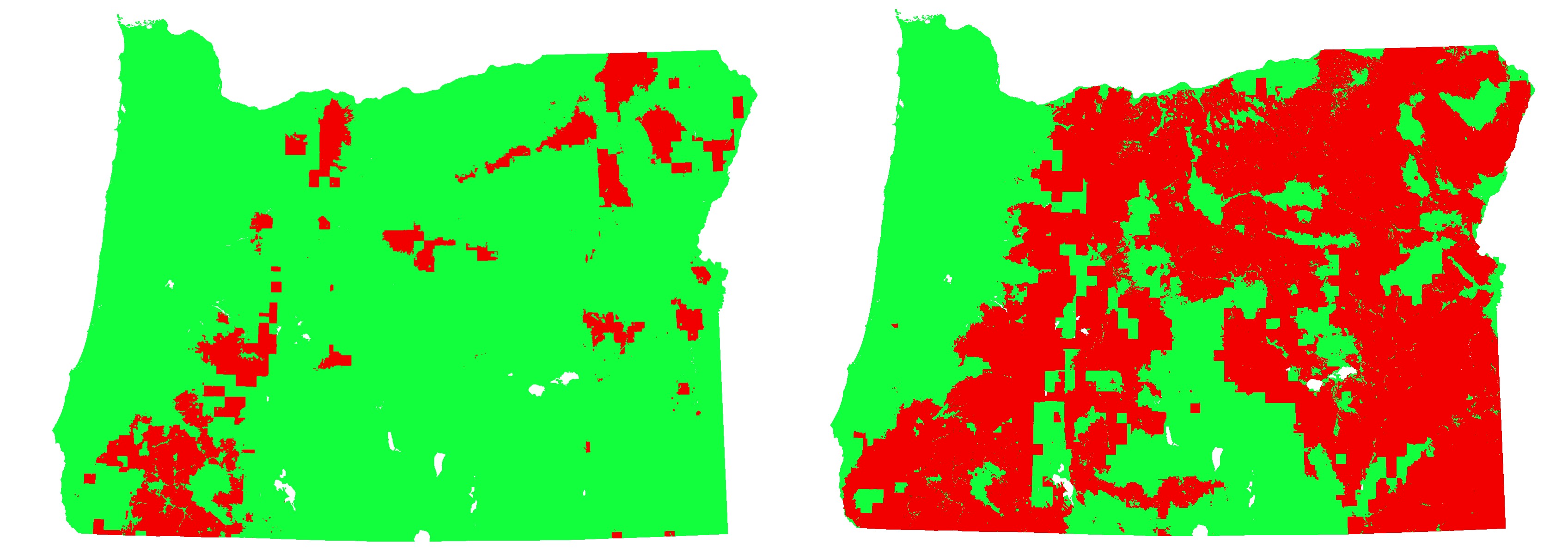 90th percentile of the state at historic risk, vs. the fake 90th percentile at risk that the state published which actually shows the 42nd percentile
Letters to homeowners went out soon after, causing another round of righteous outrage. The letters from the state informed homeowners that in order to be in compliance, they would need to create defensible space around their home, and any new construction—or remodels to existing homes—would need to comply with new "home-hardening" regulations for building materials. An example is shown below, 15 pages in all, replete with legalese, "Findings of Fact," and other jargon justifying the new designation foist upon the homeowner.
Data Scientist Gets Caught in the Crossfire
Computer scientists refer to programming and modeling based on faulty or corrupted assumptions as GIGO: Garbage In, Garbage Out. If your computer model relies on unreliable data, no amount of algorithmic magic will make it spit out realistic results (see, also: Climate Change, and models thereof).
One computer scientist in southern Oregon was personally affected by the fire hazard maps, with his home placed in the high-risk zone. After getting caught up in the dragnet, he put his particular set of skills to work. Jeremy Kauwe works for a medium-sized regional bank as a Senior Data Scientist. His entire job centers around creating and analyzing probability models. So he set about to examine the data used by Oregon to create the fire hazard maps.
When confronted with Kauwe's detailed analysis, the state clammed up. "When I identified this discrepancy between the map’s assumptions and [the state’s] own fire history data, I reached out directly to Chris Dunn, a wildfire risk scientist at Oregon State University, and to Andy, the project’s designated point of contact under him," Kauwe said. "I presented the issue clearly in an email—including the statistics of OSU's chosen threshold and what the actual data showed. Neither Chris nor Andy responded."
What Kauwe discovered left him furious. "What I found is straight up corruption or negligence," he said in an interview with Restoration News. "Either way, not a good look." He was alarmed not only with the errors he found in the state's computer modeling, but also with their response. Kauwe sent an email to the dedicated email address at Oregon State for public inquiries, which gave him access to the data they used to create the models and maps. Over the course of a few weeks, he corresponded with Andy, a point of contact who oversaw the data, and began finding inconsistencies.
The more questions Kauwe asked, the quieter Andy got.
Remember that part about the Wildland-Urban Interface (WUI) discussed earlier? Here's where the house of cards comes apart for the state. Recall that, for the purposes of defining high- and extreme-risk areas, the thresholds adopted by the state agencies assume that the WUI represents the highest risk type of land in the entire state of Oregon.
Kauwe proved that assumption 100% false.
Oregon State University says in every public document and communication that the high-risk designation applied to the 90th percentile of the state, or 10 percent of the land. By analyzing the data and the model, Kauwe discovered that the Oregon State University data put more than half the state—a whopping 58 percent of it—into the high-risk bucket.
And then Oregon State and ODF went into denial mode.
According to Kauwe,
In an email to me, OSU's Andy—the project’s point of contact—explained how hazard classes were defined: "The high hazard class represents approx. the top 10% (90th percentile and above) of tax lots with the greatest average hazard value." This is a direct and unqualified claim. Anyone reading it would assume that only the most extreme 10% of properties in Oregon were supposed to be labeled "high hazard."
Kauwe points out several other public communications in which Oregon State and ODF reassert the claim that only the 90th percentile of land would qualify as high-risk. "When I analyzed the underlying hazard values myself," he said, "the results did not line up with the official claim. The supposed '90th percentile threshold' actually fell at the 42nd percentile of the full dataset. Instead of designating 10% of Oregon as 'high hazard,' the method swept in 58% of the state."
"By adopting this false threshold," Kauwe continued, "the state institutionalized a basic statistical misrepresentation: OSU put it in writing; the Rules Advisory Committee failed to test or challenge it; and the Board of Forestry codified it into Oregon Administrative Rule."
As a result, he concludes, thousands of Oregonians were suddenly and incorrectly classified as living in "high hazard" zones.
Kauwe has assembled all of his information into a professional format, similar to the reports he produces at his day job. He published all of it at a website that any homeowner can use as a reference.
To drive the point home, he went so far as to learn how to use Geographic Information System (GIS) software to produce his own maps, similar to the process used by the state. He summarized his process on his website:
To evaluate the model's performance, I focused exclusively on the burn probability output produced by Oregon State University and compared it to historical wildfire records—the same in-sample data the model was trained on . . . . I created a uniform grid of spatial points to evenly cover the state and then intersected each point with both the model’s burn probabilities and historical fire events . . . . Once aligned, I converted the data into a CSV where each row represented a geographic location with its corresponding burn probability and whether or not a fire had historically occurred . . . . The final analysis showed that the model lacked classification power, and I published the results and methodology in a public-facing website to promote transparency.
That's an important point worth repeating: Kauwe used the state's own burn probability data and cross-referenced it against historical burn records. He used this data to assess the model's validity. Kauwe knows from his day job and education that all models can be tested against the training data—the historical fire data—to determine if the outputs make sense. The outputs should have been identical once the model was trained using what the state said were its parameters. His tests revealed that the model had the same ability as a random number generator in determining where historical fires would burn. That's when he realized the model was flawed.
Kauwe says his analysis came to the opposite conclusion as the state: The WUI was about 20 times less likely to burn according to historical records. "OSU's own data show that fires occur far more frequently outside the WUI than inside it," he told Restoration News. "Only 1.22% of WUI-designated land burned during the period, while 24.61% of non-WUI land burned during the same period. This translates to a relative risk ratio of 20.17—meaning that non-WUI areas were nearly 20 times more likely to experience wildfire than WUI areas."
When confronted with Kauwe's detailed analysis, the state clammed up. "When I identified this discrepancy between the map’s assumptions and OSU’s own fire history data, I reached out directly to Chris Dunn, a wildfire risk scientist at Oregon State University, and to Andy, the project’s designated point of contact under him," Kauwe said. "I presented the issue clearly in an email—including the statistics of OSU's chosen threshold and what the actual data showed. Neither Chris nor Andy responded."
ProPublica Bemoans "Misinformation"
Kauwe sent his analysis to his contacts at Oregon State on March 29, 2025. On June 10, Rob Davis, a reporter for ProPublica, posted in a large Facebook group, Firesafe Rural Alliance—an online forum for Oregonians affected by the wildfire risk maps to virtually gather and exchange information. Davis previously worked for The Oregonian as an investigative reporter on the environmental beat. His largest contribution was a four-part report, "Polluted by Money: How corporate cash corrupted one of the greenest states in America."
One thing became clear from the ProPublica article: Davis clearly came at it with a predetermined agenda in mind, and arguably failed to disclose that agenda in his interactions with residents of rural Oregon feeling the brunt of these heavy-handed policies.
Now the Northwest Reporter for the radically left ProPublica, Davis posted in the Firesafe group that he was interested in hearing about "harms or impacts you may have experienced" with the wildfire hazard maps. In response to this post by Davis, dozens of folks left comments that their home insurance companies had jacked up their rates, dropped their coverage, or both.
A sampling of the comments:
"We live outside of Jacksonville on 22 acres. Our property has 6 fire hydrants! House is surrounded by green grass and a mowed pasture. Cancelled by Farmers using only our zip code."
". . . wildfire map categorized our home as extreme. Following that my insurance increased by approximately 40% last year and was non renewed this year. I recently acquired a different policy and person that inspected our property was shocked at the rating and the fact we were non renewed. He stated we were most likely low risk based on his inspection."
"My insurance only went up $100. But my coverage was cut in half."
"We are disabled seniors. It is hard enough to keep up the defensible space but, we manage to do it each year. With what they are asking us to do . . . . We would have to hire people to make our property and home fire proof, something we can't afford . . . . Our property value has gone down, our insurance and property tax has gone up."
Dozens like that.
So what did Davis report? On August 7, ProPublica ran with this headline:
How the Rapid Spread of Misinformation Pushed Oregon Lawmakers to Kill the State’s Wildfire Risk Map.
"This is how misinformation gets accepted as fact," Davis begins.
This after Kauwe repeatedly reached out to him to discuss his findings. In fact, Davis interviewed Kauwe. "Rob Davis interviewed me, I told him exactly what my research found," Kauwe said. "OSU’s own wildfire risk team stated in an email to me that the fire map classifies Oregon’s top 10% hazard zones. My analysis of their data shows it actually labels 58% of the state—nearly 6 times more than they claim. And it performs no better than random chance at predicting where wildfires have historically burned."
Davis refused to include any of this information in his report. "Rob left all of that out," Kauwe said. "Instead, he framed us as conspiracy theorists spreading misinformation."
"Oregon’s hotter, drier climate isn’t the problem. The map is," Davis wrote. "In the end, what's most remarkable about the campaign against Oregon's wildfire map isn't that misinformation found an audience. It's that it worked." He quoted state bureaucrats who blamed the problems with the maps on "lack of communication."
Davis quoted state Sen. Jeff Golden (D-Ashland), who represents a small college town in an otherwise rural district heavily affected by the maps: "I got tired of trying to convince people that the model was smarter than they were," Golden said.
One thing became clear from the ProPublica article: Davis came at it with a predetermined agenda in mind, and arguably failed to disclose that agenda in his interactions with residents of rural Oregon feeling the brunt of these heavy-handed policies.
Of course, for those who have examined ProPublica's motives in the past, this comes as little surprise. Restoration News exposed them as the "attack arm of the Democratic Party" in 2023.
A Cautionary Tale for the Rest of America
These things don't simply happen in a vacuum, or spring from some hare-brained legislator's fever dreams. Legislation too often originates from special interests or lobby groups, packaged in a sales pitch designed to obfuscate ulterior motives. The green movement has frequently provided cover for all sorts of corrupt public policy, under the guise of stopping climate change or protecting Mother Earth.
So why the mad rush by the state to pass a law shifting fire policy away from the counties to unelected bureaucrats in Salem? Why the insistence on a fire map that denies generations of accumulated knowledge about forest management and sensitive areas? Defenders of the Narrative like Rob Davis and Sen. Golden would have you believe "misinformation" leads to the advancement of "conspiracy theories" that don't rely on experts whose models are smarter than simple rural homeowners.
When we see this pattern repeat itself, however, some uncomfortable questions bubble to the surface. When western states refuse to mitigate fire risk and massive wildfires result, officials blame climate change. When densely populated southern California neighborhoods get wiped out in a weekend by a fast-moving fire, empty reservoirs, dry fire hydrants, and slow response times by fire officials take a back seat to heaping blame on the Trump administration over federal funding. When the federal response to catastrophic flooding in western North Carolina gets held up for months and people have no ability to rebuild, officials block civilians from providing material aid. When devastated SoCal homeowners can't secure building permits to rebuild their homes and neighborhoods, state and city officials deflect and deny.
And when various corporate entities team up with state bureaucrats to invent spurious environmental risk zones in disparate areas of the country, one can't help but wonder at the connection. Call it a conspiracy theory if you like, but dismissing these questions fails to reveal the true motivations behind the public policies that have cost real money, and real lives.
(READ MORE: The End of the Green Panic)
Help us finish the fight—chip in today
Restoration News, a project of Restoration of America, is your trusted investigative news source for the America First movement. As a rapidly growing conservative news site, we focus on delivering accurate and insightful exposés on political news, immigration news, leftist lies, and other pressing issues affecting everyday Americans. Our uncompromising commitment to a hard-hitting, fact-based, America First, and faithful perspective ensures that you receive news that aligns with your values.
Every dollar gets us closer to winning the war on woke.